
ILL you listen to my shayri (poetry)?” asked a little girl, with a smile that exposed the broken tooth behind her lips. I refused with a smile and walked on. Next, a man approached us soon and offered to show us the entire city of Fatehpur Sikri for a hundred rupees, thus saving some money for our entire group. We agreed hesitantly and were led to the Buland Darwaza that flanks the dargah of Salim Chisti, the famous Sufi saint with whose benediction Akbar’s favourite son Salim was born. The mausoleum was the greatest of Mughal emperors’ tribute to the saint.
The guide belted out verse after verse, trying to lead us to the era of yore. “This is the main part of Fatehpur Sikri,” he declared after reaching near the dargah. We were taken aback. So what about the grand palaces we had seen on television? “There are some palaces more, but you can see them yourselves. My job was to show you this.” A hundred rupees for two rotten shayrs and a mile-long dialogue? We soon learnt that the fraud had no access to the main palaces of Fatehpur Sikri. Saving our money, we got a government-appointed guide, who settled for less than that amount.
He took us through the alley of palaces. “Akbar had three wives, a Muslim, a
Hindu and a Christian. The most famous was Jodha Bai, the sister of Man Singh and the mother of Akbar’s successor Salim.” This was quite contrary to the knowledge I had of the five-thousand women in Akbar’s harem (do not expect historical accuracy from any guide here). Palace after palace, he went on explaining the logic behind the intricate carvings and the inherent Catholicism, which have absorbed many traditions into it.
“Do you know why these palaces are all in red sandstone?” he asked us. This was the format of the whole sojourn, making us realise our ignorance before enlightening us with his logic. We nodded, betraying our ignorance. “Lal means ‘red’ and Lal also means ‘son’. The whole city was constructed in the joy of Salim’s birth. Akbar loved Salim a lot. Hence he did the whole set of palaces in Lal Pathar or red sandstone.” I wondered, “How much a
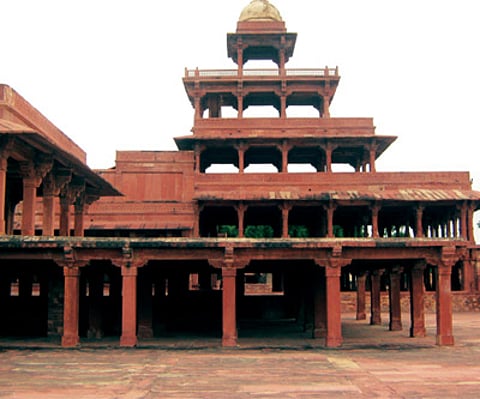
father did for his son!” Yet, Salim remained a rebel throughout his life. Akbar, the emperor who won hearts and kingdoms with equal magnanimity, died without having won over his son. The temple used by Jodha Bai, the Panch Mahal and the palaces of Akbar’s other queens were all grand structures, that used to be guarded by eunuchs, as queens were not guarded by the male guards. The actual history of Jodha Bai and his other wives though is still disputed.
The guide suddenly turned back and said: “Many people will tell you about
Anarkali. But sir, it is all the masala of movies and theatre. There was no
Anarkali.” Who knows if this is a 500-year-old royal conspiracy to hide the darker side of Akbar?
“Here,” he said pointing to the seat in the middle of Anup Talao, “Tansen used to sing for Akbar. We entered an adjoining palace. “There,” he pointed at a raised platform, “Akbar used to sit with one of his queens.” I wondered what the others did when he enjoyed the music with just one. We went on. The astrologers’ seat, the stable, the Diwan-e-aam and Diwan-e-khaas were all treats to the eyes. “When Akbar reigned here, the queens used to shop here, at Meena Bazaar.” I now got the answer to the question that bothered me, regarding the occupation of the other queens when one spent time with Akbar. Shopping money was the easiest way to mollycoddle one’s wife, even then.
In front of the Panch Mahal is the ground of Chausar, where Akbar played the game of dice with slave girls as pawns. Surprisingly, the grandest of all the palaces seemed to be that of Birbal. With his wit, he even managed to get the best part of the cake for himself. The palace, constructed for one of his queens, was gifted later on to Birbal. The guide tried to entertain us with a few Birbal jokes, which we had read to death in our Amar Chitra Katha comics. The way out of the massive stable led us to the exit and we moved on, back to the dargah.
The sun was about to set. It was the month of Ramzan. “Are you not keeping fast?” I asked him. He nodded: “Everyone does not have the capacity dear, to keep a fast. I’m quite old and sick. I roam around these palaces endlessly till I get enough for a day.” I moved on. After covering my head, I entered the dargah. “People pray for themselves, their parents and their friends. This has been built by a father in remembrance of the saint who gave him a son.” I spread a shawl over the tomb and strewed flowers over it. As I moved to the marble screens and tied the thread, my heart choked with a mystifying sense of trance. The singers had begun qawwalis for the evening.
I did not know when I came out of that trance, but by then it was time to leave.
Life seemed anew within minutes. The divinity had cast its spell over us. The little girl was still standing outside. “Will you listen to my shayri?” she asked with the same smile. I smiled back. My friend handed five rupees to the girl and she belted out her lines. I could not make anything out of the half-broken Urdu of the six-year old but I was feeling light from head to toe. As I was about to board the bus, I turned back once again. The dargah and the palaces stood kissing the skies. Every brick of Fatehpur Sikri sings the glory of Akbar and India's inclusive past.
— arju1987@hotmail.com
Factfile
Fatehpur Sikri is an hour’s drive from Agra. It is well connected by road from Delhi and Agra. Accommodation: The best option would be to stay at Agra and travel by road to Fatehpur Sikri. Many star and budget hotels are available in Agra. Where to eat: Fatehpur Sikri is famous for its Mughlai paratha, an eight-layered paratha. A good tourist guide will direct you to the hotels serving the speciality. Many famous eateries are there in Sikandra, on the way to Fatehpur Sikri.