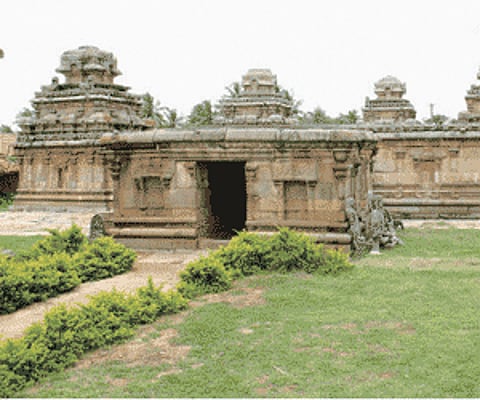

BANGALORE: Strange are the ways by which places obtain their names. If Bangalore got its name due to the boiled beans that the then ruler of the region chanced upon when he was lost in a forest, Kambadahalli, one of the oldest Jain religious centres in Karnataka, has an equally intriguing story to tell.
Kambadahalli, which is earlier known as Kambapuri, is located on the Shravanabelagola-Mandya road and this ninth-century-old architectural marvel is attracting heritage lovers from across the world.
The bell tale
Folklore has it that the bells tied to the top of the Manasthambha at the Panchakuta Basadi located here do not ring by themselves, and when they do; they portend the death of a person in the village. What’s more, elders of the village attest to the fact that the bells do not ring even during storms and, at times, ring without even the slightest hint of a breeze!
Around 10th century, this place had as many as 72 Jain temples in its vicinity and however, with the passage of time, it started losing its Jain heritage. The bund of a water body to the north-west of this village, which was its primary source for irrigation, was damaged during heavy rains and used to flood surrounding areas even after frequent repairs. This went on for years until one day the village head proclaimed that God had appeared in his dream and had asked him to demolish all Jain temples, but one, and use the resulting pillars and stones to repair the tank-bund, which was dutifully followed. With the region now left with just a single temple, the pillar (kambha) that flanks the temple at its entrance lent its name to the village.
According to the seer of Jain Mutt, Kambadahalli Bhanukeerthi Bhattaraka Swamiji, stone inscriptions dated back to 9th to 12th centuries have been found from here. The basadis are built in Dravidian architectural style and everyday poojas are organised. Two years ago, during an excavation two statues of Lord Bahubali have also been found on the premises.
What to look out for
Panchakuta Basadi
One of the most beautiful Dravidian structures built in the Ganga style in the state. Archaeological records date the temple to A.D. 900. As the name indicates this temple is a complex of Panchakutas.
The temple is made of a trikuta that share a common navaranga (a pillared hypostyle hall), and a dwikuta. Attractive carvings divided into nine cells are found on the ceiling of this navaranga. The central and main garba griha of this temple complex has a four-foot high black coloured stone idol of Lord Adinatha in padmasana as its main deity. An attractive feature of this temple is that all the three garba grihas have unique pinnacles with their domes resembling the ones at the Taj Mahal at Agra.
Shantinath Basadi
Located at the right of the Panchakuta Basadi, the Shantinatha Basadi houses a 12-foot high black coloured stone idol of Lord Shantinath in Kayotsarga (a yogic meditative posture that signifies renunciation) as its main deity. The garba griha is preceded by a wide navaranga flanked by tirthankara idols on either side. The temple inscriptions give wide details about the history of the region.
Bahubali statue
In 2007, the ASI stumbled upon a life-size statue of Lord Bahubali dating back to the ninth century was found here when Jain temples at Kambadahalli were being renovated. The idol has long flowing hair and bears resemblance to the Bahubali metal statue being preserved in the Metropolitan museum, New York. Another distinct feature of the image is the creepers entwining the legs.
bngexpresso@expressbuzz.com