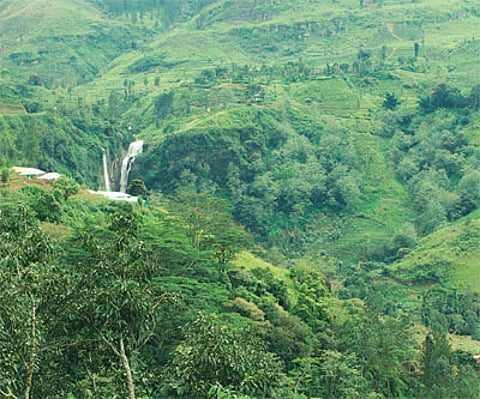

A group of us planned a recent holiday in Sri Lanka even though for a long time my north Indian mind could not but associate the emerald isle with King Ravanan, the villain of the Ramayana. Of course, all that changed after we splashed around the pristine beaches of Lanka’s southern coast and were awed by the Buddhist temples in Kandy and Colombo. But we did manage to touch upon the mythological-on-my-mind: up in the tea-cultivating hills of Nuwara Eliya, near the highest point in Sri Lanka, where we visited a temple that marked the spot where Hanuman found Sita, while she was held captive by Ravanan. (Coincidentally, our visit occurred on the day the Allahabad High Court decided that the Ayodhya plot was the Ram Janmabhoomi.)
A modern Sita temple has been built in a village known as Seetha Eliya, five kilometres away from Nuwara Eliya, a town that is 1,868 metres above sea level and nestled under the Pidurutalagala peak, and which still carries many remnants of the Raj. Indeed, Nuwara Eliya’s entire landscape of pine trees and terraced hills, in the centre of an island that is otherwise filled with swaying palm trees, reminds us of hill stations like Shillong or Shimla. So in its own right Nuwara Eliya is a worthwhile tourist attraction despite the back-breaking drives from one point to another (even within provinces and even though the entire island itself is just 432 kms long and 224 kms wide). Fortunately, after the end of the “war” against Tamil nationalists the government decided to widen many major roads, and one such is the road that goes from Nuwara Eliya to Seetha Eliya, which previously took a nail-biting 45 minutes (this, admittedly, was according to our taciturn guide who was most reluctant to visit a Hindu monument), but now is a brisk 20-minute drive.
Once you reach the Seetha Eliya hills covered with the Ashoka forests, it is a breathtaking sight. Hill-tops in the clouds, even on a sunny day. Legend has it that Sita was kept in the hills and that she came down to the stream where the present temple is constructed for her bath. The temple stands on the slope from the road to the stream below, so that you have to climb down a few steps to get to it. It is constructed in the style of south India, with a terraced-pyramidal roof that has several cherubic deities on various steps. In the three-and-a-half years that we have lived in the South, I have come to prefer such temples as refuges of serenity and meditation. (My favourite temple in Chennai is the Hanuman temple in Mylapore, which is quite a contrast to the Hanuman temple in Connaught Place, New Delhi, which seems kitschy and Ramanand Sagar).
Behind the Sita temple complex are hills with black earth visible between the grass and trees, and that blackness is quite the contrast from the red earth we had been seeing over which many Tamil tea plantation labourers were hunched. The temple priest, happy to see us (the temple is deserted of devotees, maybe
because the locals are working the tea-gardens, and not enough religious-tourism from India is happening yet; though a western couple come in for a glance as we depart later), says that the earth is black from having been scorched by Hanuman as he darted flaming arrows and left Ravanan’s captivity. It wouldn’t have been uncanny had it not been for the miles of red earth that had abruptly ended before the temple.
But the really amazing part of this site is a large rock along the stream between the temple and the hill of black earth. On the large rock are four deep
depressions, each a half metre wide, each smoothly formed, all arranged in a pattern. The priest tells you this is a footprint of Hanuman and from that it would appear that the selfless-if-brawny deity (I worship him because of his heart of gold) was perhaps 25 feet tall to cause a print that big. Of course, my son Barun points out that Hanuman was first hidden in the trees in miniature form before he revealed himself so how did he morph from Tom Thumb into a giant? His cousin Divija says that the footprint could also be the result of natural erosion of the rock by the stream over thousands of years. These anomalies, however, are not enough to shake my faith.
Inside the temple is one sanctorum dedicated to Sita (though Ram-Lakshman are there to give her company, as is the praying Hanuman), and one chamber is dedicated to Hanuman himself. On the upper walls are murals from the epic. It is utterly peaceful here. We offer our prayers and feel spiritually refreshed on this brilliant morning.
The guides have a minor quibble about Ravanan’s actual city. One of them shows us a map and further south from Nuwara Eliya are the Ravanan Ella falls, behind which is a cave where Ravanan is supposed to have kept Sita. Ravanan’s royal palace, he argues, is actually there. Who knows? My own fascination with the epic has grown ever since I visited Ayutthaya, for centuries the capital of Siam, some years back. Now that peace has returned to Lanka, special Ramayana holiday packages could hold the key to more Indian tourists to the paradise that is Lanka.
— editorchief@expressbuzz.com