
There is something about visiting a place for the second time. You unconsciously look for those sights that held your eye during your last visit. And that’s exactly what happened when Sikkim beckoned a second time. Back on my first trip in 2005, I was single, almost penniless and dependant on my folks to find the money for my travel needs. The second time around I was a little more mature, perhaps a little more prejudiced and self-financed, albeit with a little help from my ‘better half’. The five-hour cab ride from Bagdogra airport to Gangtok was dusty but gave us a fantastic view of the Teesta River. Compared to the grimy and humid Bagdogra, Gangtok was cold, but in a nice delicious ‘need some ginger-cardamom spiced tea’ kind of way. Because the dark sets in early in the east, 5.30 pm seemed like 7.30-8 pm. As we trudged along MG Road I stopped in to take in the sights. It resembled a Yash Raj movie set, complete with fake flowers lining the median of the cobbled street, with street lamps and park benches and a Bollywood number blaring away on the speakers. Evening meant a walk around M G Road and trying out the local food and drinks. And if you are a beer-drinker, a must-try in Sikkim is their Dansberg beer (sold only in Sikkim and Bhutan), the lightest possible beer available in India (that’s the opinion of my better half, who is quite a beer aficionado.) Our stop the next morning was Nathula, to get a glimpse of the age-old silk route between India and China. (In Tibetan, Nathu means listen while La means pass). Located at a height of 14,140 ft, it’s not easy to get there. You also need to get permits (which means filling up a form and providing proof of identity along with recent photographs).
In Sikkim you need a good driver at your disposal since the roads are just about manageable. But kudos to the Border Roads Organisation (BRO); it’s never easy mending and re-mending roads that are constantly exposed to the vagaries of nature. As we crossed the beautiful Tsomgo Lake (known as Changu Lake) and the vehicle trudged its way to Nathula, our driver very sagely advised us, “aap jab upar jayenge toh dheere chaliye, nahi toh sarr chakrajayega.” (Walk slowly else you will end up feeling woozy.) And as we walked along slowly, it was a huge effort to avoid getting lightheaded owing to the altitude. So there we were, at one of the borders of India. Perhaps that’s one of the few places where you do get a tad patriotic when you see the tricolour flying high. Of course except for a few people, who perhaps were waiting to see the Great Wall, because we found them asking “China kahaan hai?” (Where is China?) A bemused Indian soldier pointed towards the barbed wired fence and said “uss taraf”? A few kilometres away, a must-stop for all the armed forces and now even tourists is the Baba ka Mandir, a revered shrine of Major Harbhajan Singh who drowned in a glacier during the Indo-Chinese war in 1962. Legend has it that Major Singh (also known as Baba to the armed forces) appeared in one of his friends’ dream after his death and asked him to build a Samadhi in his name. Till this day the army continues to send his personal belongings home every year where a special reservation is done to drop Baba home. (Actually a soldier from the army carries a picture of Major Singh and travels to his native village in Kapurthala).
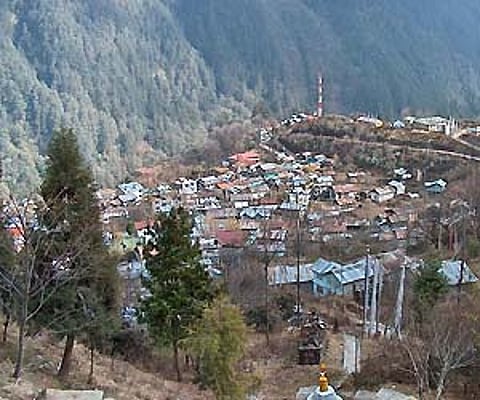
From the dizzying heights of Nathula, we ventured towards the Rumtek Monastery. Built on the insistence of the 16th Karmapa in exile, it’s a photographer’s delight with its Buddhist monks feeding pigeons, oblivious to the stares of the teeming tourists, and a quaint café/canteen that proudly asks you to join the Free Tibet movement. Lachung was our next stop. The temperatures dip and it is generally advised that if you have driven up from Gangtok you must stay the night to acclimatise to the altitude. With great accommodation available with amazing food, we also decided to stay the night and enjoy the delights of being disconnected from the world, because very few mobiles can actually find range here. A traditional trading post between Sikkim and Tibet, (shut down later after the annexation of Tibet) Lachung is a stopover for all tourists making their way to the Yumthang valley, which is famous for the Rhododendron Sanctuary. Sadly for us, these beauties flower only during the spring. So all we were in for was some really cold weather and fantastic sights of the mountains. Right from the start of our Sikkim adventure, from Bagdogra, we had heard a lot about the Kanchenjunga (the Guardian Deity of Sikkim). We really wanted to see it up-close and the best view of the majestic mountain was at Rinchengpong. A small tourist delight to the west of Sikkim, Rinchengpong, offered us great cottage accommodation and a promise of the Kanchenjunga right outside our window. A promise that was well kept, so we woke up with our coffees to a view that showcased the snow-capped Himalayan peaks of Kanchenjunga, Rathong, Kabru, and Koktang. Local sight-seeing at Rinchenpong took us to the quaint but absolutely beautiful Rinchengpong monastery, the Poison Lake (yes that’s the lake’s name) and the Heritage House. West Sikkim also boasts of Pelling, a small town hamlet that also offers magnificent views of the Kanchenjunga peak. Local sightseeing includes a visit to the Khecheopalri Lake (sacred to the Tibetans and Buddhists) and the Singshore Bridge (the second largest hanging bridge in Asia). So after a great 10 days it was time to say au revoir to Sikkim… Au revoir because I want to come back, the next time in March-April, to see the Rhododendrons in bloom in Yumthang valley, and then to the Gurudongmar Lake (a lake we couldn’t see because our vehicle broke down), or perhaps even a visit to Yuksom, the beer capital of Sikkim (I reckon that’s good bait to get my husband back there). Suffice it to say that Sikkim definitely beckons us for a third visit.
varshuu@gmail.com
