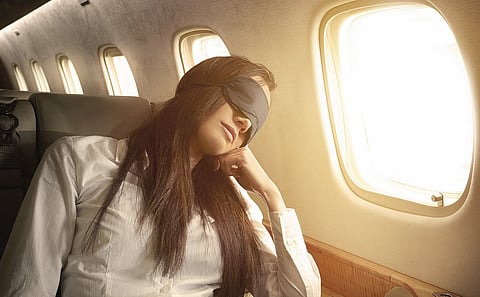

Sleep as we all know is one of the most rejuvenating functions. While getting a good night’s sleep is becoming a luxury these days with long and erratic working hours, and 24x7 of everything, travel too disrupts sleep routines temporarily, leaving people to be crabby and tired as a result.
Travelling across time zones, a new hotel room or place of stay, a new mattress, harder-than-usual pillows and the ambience—all play havoc with sleep during travel. Dr Preeti Devnani, clinical director at Sleep Disorders Clinic, Mumbai, says, “In the human body, sleep is regulated internally when we remain awake for an extended period of time, thanks to the homeostatic drive. Subsequently, the neurotransmitters in the brain help to promote the next sleep period. On the other hand, the circadian rhythm recurs naturally over a 24-hour period and proves that our body shows a preferred time for sleep and activity, guided by the suprachiasmatic nucleus present in our hypothalamus.” She further explains that “as we follow the day and night cycle, we use light as a strong cue to regulate our sleep pattern. Travel introduces an imbalance between the body’s demands and its routine sleep-wake cycle, which becomes irregular and delayed, resulting in the desynchronisation of the body rhythm.”
Dr N Ramakrishnan, senior consultant in sleep medicine at Apollo Hospitals and director at Nithra Institute of Sleep Sciences, Chennai, adds: “Sleep problems are primarily affected during international travel across time zones (although ship lag and post cruise lag are also not uncommon). It is because our internal biological rhythm goes out of sync, more commonly when travelling from the west to the east as our body finds it difficult to advance sleep rather than delay it.” Apart from the direction, the speed at which one travels across various time zones also affects synchronisation of one’s internal time clock. “Travelling to the west prolongs the body clock’s experience of its normal day-night cycle and travelling east runs in direct opposition to the body clock,” says Devnani.
Which categories are more likely to be affected? Babies, young children, men and women, given that some people can cope better than others under similar circumstances? “Jet lag can affect people of all age groups and both the sexes. Older adults recover more slowly. Pre-existing sleep deprivation, stress and poor sleep habits prior to travel, which are prevalent in younger folks, can exacerbate jet lag symptoms. Women are at a higher risk as estrogen is subject to jet lag like conditions,” says Devnani.
But with each one of us being so different, according to Ramakrishnan, the intensity and form vary from person to person. Needless to add, those with underlying sleep issues are more likely to be bothered.
So what can be done to minimise disruption in sleep while travelling, besides managing food, mattresses, pillows, new environment and the weather?
Devnani offers some tips. “Anticipate and plan for time changes ahead of the trip by going to bed and waking up earlier for an eastward trip and later for a westward trip. Avoid alcohol and caffeinated drinks like coffee, tea, cola and chocolates during the journey. Try to get outside in the sunlight whenever possible. Daylight is a powerful stimulant for regulating the biological clock and staying indoors worsens jet lag. On arrival, stay awake until an early, local bedtime.”
In Ramakrishnan’s view, it is a question of mind over matter, which is why he suggests making a conscious effort to adapt. “Drink plenty of fluids. Dehydration makes it difficult for the body to acclimatise to the new rhythm. Unless you have an appointment immediately upon arrival, avoid long naps during the journey.”