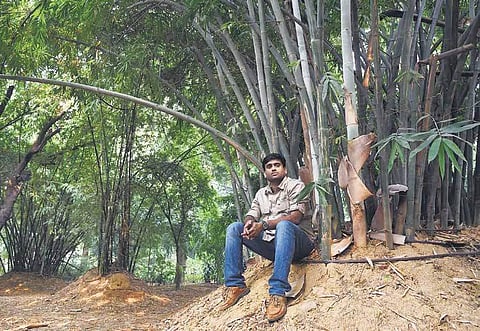

Man-eating tigers might grab newspaper headlines, but deaths due to snakebite go unnoticed, when the reptile takes the lead in man-animal conflict. Snakes kill 50,000 people every year that amounts to five or six deaths every hour. For 41-year-old Jose Louies, science and conservation are two sides of the same coin. And saving these reptiles is the mission of his life.
Growing up in a small town of Kerala, Jose appreciated nature and wildlife from up-close, and the knowledge did not glean from TV channels. “My grandfather was my first teacher. I picked up the basics of conservation from him. My first pet was a snake, a fascination my parents dubbed murky,” says Jose, who joined the IT industry, bowing to societal dictates, though his heart always wanted to do something for the wildlife.

And it was a snake rescue incident in Vadodara that began his journey towards being a wildlifer. “People think it is fashionable to be a wildlifer, but the job demands total commitment,” he adds.
Jose’s interest in snakes led him to India’s renowned wildlife conservationist Romulus Whitaker. “I wanted to be as good as Rom who brings tremendous energy and enthusiasm to the job. He was the one who encouraged me to start a website on snakes in India and today it is the leading website on Indian snakes and a platform to discuss snakes and snakebites,” says Jose, who tapped into the wildlife trade while rescuing snakes, and is in his 12th year of heading the wildlife crime division at Wildlife Trust of India in Noida.
From saving snakes to starting the snakebite initiative, he adopted a pragmatic approach to conservation. The death of a three-year-old girl due to snakebite was what prompted him to start the initiative. He says, “If I have to save snakes, I have to make sure that people don’t get killed by them regularly.”
The initiative has 2,500 volunteers, who impart information about snakes and snakebites to people, across the country. “We tell our volunteers to follow the protocol—use a bag and a hook and don’t try it barehanded—always. Also, when you add faith healers to the mix, the problem only gets compounded with people preferring to go to them instead of going to the hospital,” says Jose, who has been propagating the three As of snakebite management—awareness, ambulance and anti-venom.
“I was sure I wanted to be in conservation, and not study the molecular biology of snakes,” says Jose.
A casual conversation during a train journey resulted in increasing Jose’s work, whose team also distributes vials of anti-venom to hospitals across the country. “It’s all mismanaged. Some hospitals don’t have anti-venom, while others have only 2-3 vials and that too are of no use. Thanks to Dr Khadilkar from Pune, we provided 100 vials of anti-venom to a hospital in Chhattisgarh and in the last three years, the hospital has saved 180 people. It is popular as a snakebite treatment hospital now,” says Jose.
His team is also a part of the ‘Big Four (the four venomous snakes—Indian cobra, Russel’s viper, Common Krait and Saw-scaled viper) Mapping Project’, in which they are applying mobile technology to map snakes. “Anybody who sees a member of the big four will take a photo on their mobile, which will upload its location, date and time, and other pertinent details.
From the phone, they will update it on the map after verification. In the last 1.5 years, we have managed records of 5,000 venomous snakes across the country, helping us understand the distribution and density of the big four,” says Jose.
Despite too much going on in his area of expertise, he doesn’t want to stop. Next on the cards is the 2019 upgrade—the snakebite alert that will map all the hospitals (they’ve mapped 500-600 so far) ensuring greater outcomes of timely reach and successful treatment.
Snakes kill 50,000 people every year
They need just 10 square metre for shelter
They are protected under Schedule II of the Wildlife Protection Act, 1972. Killing a snake can land one in jail.
There is no cost for anti-venom, it is free.