
Untamed landscapes, spectacular waterfalls, winding mountain roads and centuries-old tribal art make Bastar one of India’s most intriguing offbeat travel discoveries. There are destinations that make it to every traveller’s bucket list and then there are those that remain deliciously under the radar, waiting to be discovered. Bastar, tucked away in the southern reaches of Chhattisgarh, belongs firmly to the latter. A land of dense forests, dramatic waterfalls, ancient craft traditions and fascinating tribal cultures — this is India at its most unspoilt and unexpected. Long shrouded in mystery and relatively inaccessible to visitors owing to years of Naxal activity, the region is now opening its doors to tourism, offering curious travellers an opportunity to discover a side of the country that has remained largely unexplored.
Intrigued by the promise of this little-known destination, we set off to experience Bastar, where nature and culture come together in spectacular fashion. While Jagdalpur, the region’s principal town, would be the more convenient gateway, limited commercial flight connectivity meant flying into Raipur, Chhattisgarh’s capital, followed by a scenic road journey. We were fortunate to arrive during peak monsoon, when the countryside was dressed in every conceivable shade of green. Streams spilled across the highways, rain-fed pools appeared along the way and the landscape seemed to have received a particularly generous makeover.
The dramatic introduction to Bastar came courtesy of the Keshkal Hills, which rise unexpectedly along the route, announcing the arrival into a region blessed with extraordinary natural and cultural wealth. Beyond the hills lies a fascinating world of indigenous communities, whose artistic traditions and craftsmanship are as distinctive as the landscape itself.
Our first stop was Kondagaon, a charming town that has earned the title of Shilpnagari or city of artisans. It is particularly celebrated for its dhokra art, the traditional bell-metal craft created using the ancient lost-wax technique. With roots stretching back over 4,600 years to the Indus Valley Civilisation, this art form has found a remarkable home in Bastar, where generations of artisans have kept the tradition alive. Today, more than 150 craftspeople continue to practise and innovate in this distinctive medium. The creative repertoire here extends well beyond metalwork, encompassing iron craft, terracotta, bamboo, woodwork, kaudi art and handloom textiles. Walking through this world of handmade treasures offers a fascinating glimpse into the region’s cultural identity, where artistry is not merely an occupation but a way of life.
But Bastar’s charms are not confined to its craft traditions. Nature has been equally generous, as we discovered on our next outing to Tatamari, a picturesque hill destination that is fast emerging as an attraction for nature and adventure enthusiasts. The journey itself is an experience, particularly the winding stretch through Barah Bhanwar, literally translating to 12 turns. As the road snakes through the hills, dense forests and sweeping valley views make for a rather spectacular drive. Spread across nearly 150 acres, the Tatamari plateau offers breathtaking panoramas of the surrounding mountains and an abundance of fresh mountain air. An unexpected highlight was the local Bastariya cuisine, prepared by women from self-help groups. Hearty, flavourful and rooted in regional traditions, our meal here was easily one of the most memorable experiences of the trip.
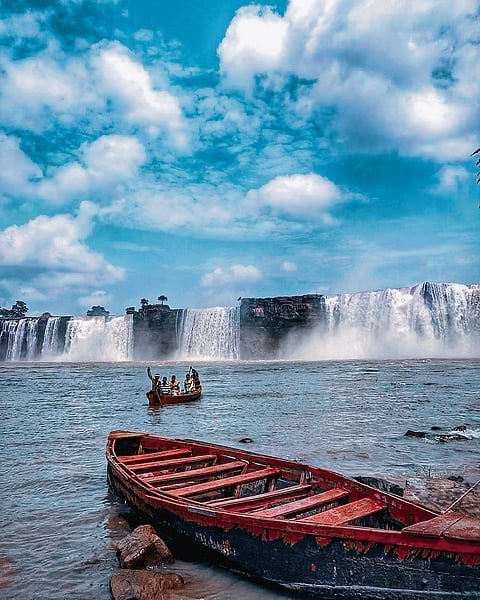
The grand finalé, however, was Chitrakoot/Chitrakote Falls, arguably Bastar’s most spectacular natural wonder. Located on the Indravati River, around 40 kilometres from Jagdalpur, this magnificent waterfall is often called the Niagara of India, thanks to its distinctive horseshoe-shaped formation. At approximately 90 feet high, its real drama lies in its extraordinary width, which can stretch up to 150 metres during the monsoon. And what a sight it is! As the river gathers momentum during the rains, multiple streams plunge over the rocky edge, creating a thunderous spectacle against the backdrop of lush forests. The water can take on a deep reddish hue during the monsoon, while in summer, particularly under moonlight, it appears almost luminous white. Depending on the season, between three and seven streams cascade down the precipice, transforming the landscape into a constantly changing natural masterpiece.
