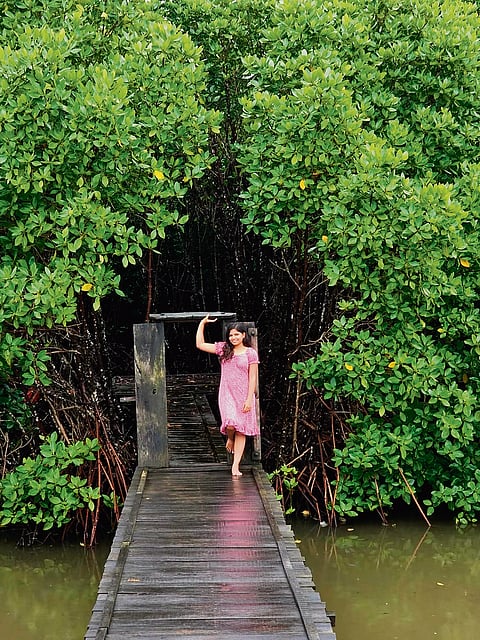

About 25 km north of Udupi, Saligrama Backwater Mangrove Forest offers a quieter way to experience Karnataka’s coast. The backwaters form a tidal estuarine landscape where mangroves line narrow waterways and provide shelter for aquatic life and birds.
The best way to explore it is by kayak. Local operators offer single and double kayaks with life jackets and guided sessions, making the route accessible even to beginners. Paddling beneath the mangrove canopy, we moved through narrow channels where the water was calm enough to reflect the tangled roots and foliage around us.
The ecosystem is also worth observing closely. Kingfishers, egrets and herons can be spotted around the waterways while colourful kites and white-bellied sea eagles can appear overhead. Along the muddy edges, fiddler crabs, mudskippers and other small estuarine creatures add movement to an otherwise quiet landscape. The backwaters also support fish and shellfish that form part of the wider coastal ecosystem.
An early morning or late afternoon outing works particularly well. The cooler temperatures make paddling easier and the softer light brings out the reflections along the water channels. At sunrise, the mangroves are often still and the waterways provide a good setting for birdwatching. Towards sunset, the changing light turns the same route into a photography-friendly stretch of backwater.
Rather than treating Saligrama as a conventional water-sports stop, allow time to explore the mangrove channels at an unhurried pace. The experience is less about covering distance and more about watching the ecosystem around the kayak — a kingfisher skimming across the water, crabs disappearing into the mud or the occasional movement along the banks.
