
The sight is straight out of a fairy tale — a magical pond created by giants, with white and pink water lilies blooming amidst massive boulders atop a mountain. Except that, according to local folklore, the people who once occupied the place were not giants but dwarfs!
About 40 kilometres from the UNESCO World Heritage Site of Hampi, part of the Vijayanagara Empire’s historic legacy, lies Hirebenakal, also known as Moryar Gudda or the ‘hill of the dwarfs.’ Spanning about 20 hectares, it is one of the largest prehistoric megalithic burial sites in South Asia, dating back approximately 2,500 years to the period between the Neolithic and Iron Ages. According to Kannada folklore, the site was built by the ‘Moriyars’ or dwarf-like people believed to possess supernatural powers.
At first glance, the village of Hirebenakal looks like any other, with ploughed fields, mango trees and a cluster of small houses. However, beyond the farmlands, crude yellow-painted arrows guide intrepid travellers through the boulders to the top of the mountain. An hour-and-a-half-long climb over the treacherous boulders leads to a large, flat summit, where the lily-filled pond sits surrounded by thousands of monolithic granite structures — both large and small — as far as the eye can see. Known as dolmens, these structures consist of three vertical stone slabs supporting an oval stone slab as a roof, resembling stone shelters. The larger ones are big enough for two people to stand in, while the smaller ones resemble covers over underground pits.
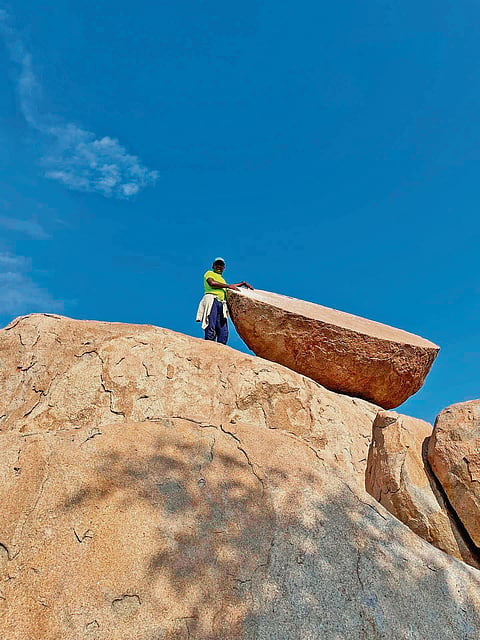
Chandra Naik, a guide from Hampi who also leads treks to the megalithic site protected by the Archaeological Survey of India (ASI), points out the larger dolmens, some of which feature circular, porthole-like openings. “These dolmens look like a house with a window,” he says. Pointing towards another neatly hewn rock resembling a kettledrum, precariously balanced on a boulder, he adds, “This could have been a drum used for signalling.” Although researchers have yet to establish the site’s precise purpose, the discovery of charred bones and pottery fragments suggests that it may have served as a burial ground or memorial site. Some of the structures and surrounding boulders also feature cave paintings in red ochre, depicting human figures carrying spears, riding horses and hunting deer and other animals.

Although the paintings have not been carbon-dated, they bear similarities to documented paintings at other prehistoric sites across India. Karnataka has around 700 documented megalithic sites, including those near Aihole, Pattadakal and Chitradurga. These feature dolmens, menhirs (upright standing stones), rock-cut caves and cists (stone-lined burial chambers). Moryar Gudda, however, is among the largest. The site was first documented in 1835 by Philip Meadows Taylor, a British officer at the court of the Nizam of Hyderabad, who recorded the necropolis in the Journal of the Royal Asiatic Society. Nearly a century later, in 1934, another British researcher documented the cave paintings. It was only in the 1960s that a systematic post-Independence excavation was conducted by Dr A Sundara to establish the chronology of the stone structures.
Today, this open-air repository of prehistoric heritage remains hidden in plain sight, visited mostly by archaeologists, villagers and rarely, by tourists. “It is still intact probably because not many people know about it,” says Naik. Overshadowed by the more popular Hampi, this remarkable heritage site has received little attention from the ASI and Karnataka Tourism. Yet, Moryar Gudda needs greater protection to prevent curious travellers and villagers, who frequently cross the boulders while herding their goats, from inadvertently damaging its fragile remains through a lack of awareness of their historical significance.