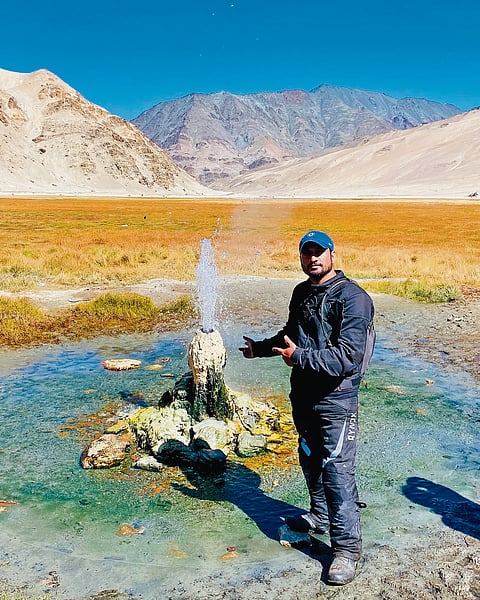

Located in the southeastern Changthang region of Ladakh, Puga Valley offers a rare glimpse of the Himalayas’ geothermal activity, with steaming vents, bubbling mud pools and mineral deposits shaping its stark, high-altitude landscape. Situated at approximately 4,300 metres above sea level, this remote valley is known for its geothermal potential and is an intriguing detour for travellers exploring the Changthang circuit between Hanle and Tso Moriri. Its extreme terrain, wildlife-rich wetlands and pastoral communities make the journey as much about understanding the region as experiencing its unusual geological features.
The valley’s most distinctive sights are its natural hot springs, fumaroles and mud pools, where geothermal activity releases steam through the ground. White and yellow mineral deposits, including sulphur, lend parts of the landscape contrasting colours against the surrounding mountains. Puga is also the site of a pioneering geothermal energy initiative in India, reflecting the potential of the region’s underground heat as a renewable energy source. Visitors should observe these features from a safe distance, as the ground around geothermal vents can be unstable and dangerously hot.
Beyond its geological significance, Puga lies within the wider Changthang plateau, where wetlands and sparse grasslands support wildlife adapted to the cold, arid environment. Travellers may spot migratory birds and waterfowl around suitable wetland habitats, while kiangs or Tibetan wild asses and Himalayan marmots inhabit the broader region. Black-necked cranes are associated with high-altitude wetlands elsewhere in Changthang, although sightings at Puga itself are not guaranteed. Snow leopards and Tibetan wolves also inhabit the wider landscape but are rarely seen. These fragile ecosystems support the traditional pastoral livelihoods of the Changpa nomads, whose herds include yaks, sheep and pashmina goats.
Puga is best experienced as part of a longer road journey rather than a standalone destination. Depending on the route and road conditions, the drive from Leh can take several hours, with travellers commonly incorporating the valley into an itinerary connecting Hanle, Tso Moriri and Tso Kar. The surrounding terrain is exposed and sparsely populated, so visitors should carry sufficient water, food and warm clothing and allow time for acclimatisation to the altitude.
