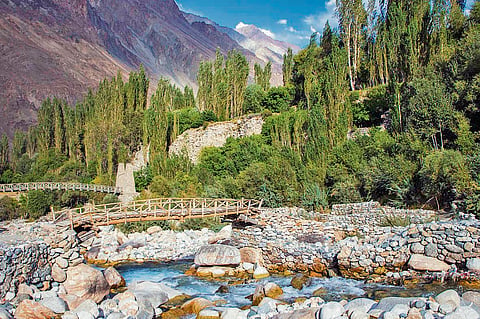

At the northern edge of Ladakh, close to the Line of Control (LoC), Turtuk offers a markedly different cultural experience from the Buddhist-majority communities elsewhere in the region. Although the village is now part of India’s Ladakh Union Territory, it historically belonged to Baltistan and is predominantly home to Balti Muslims.
At around 3,000 metres above sea level, Turtuk sits considerably lower than Leh and many parts of the Nubra Valley. Its relatively warmer climate supports terraced agriculture and orchards, with apricots, walnuts and other fruit crops adding greenery to the otherwise arid Himalayan landscape. The village’s traditional stone and mud houses, narrow lanes and irrigation channels offer an insight into a way of life shaped by the geography of the former Baltistan region. The Balti cultural influence is particularly visible in the local language, architecture and food. Balti is a Tibetan language that has absorbed influences from Persian and Urdu, reflecting centuries of cultural exchange across the region.
A visit to Turtuk is therefore less about conventional Ladakh sightseeing and more about understanding a distinct Himalayan community whose history is connected to the wider cultural landscape of Baltistan. Set aside time to explore the village on foot and visit the small museum housed in the ancestral residence of the Yabgo dynasty. The Yabgo rulers governed parts of Baltistan for centuries and their descendants continue to live in the region. The museum provides context on the area’s royal history and its links with the old trade routes connecting the Himalayas with Central Asia.
Food is another way to experience Turtuk’s Balti heritage. Try traditional dishes such as kisir and paba, a preparation made from roasted barley flour. For a deeper understanding of village life, look for traditional storage spaces known locally as nangro. These stone-lined underground spaces use naturally cool conditions to help preserve food during summer. Turtuk is best approached as a cultural stop rather than a quick sightseeing detour, with a walking tour and time spent speaking to residents offering a better sense of its history and contemporary life.
