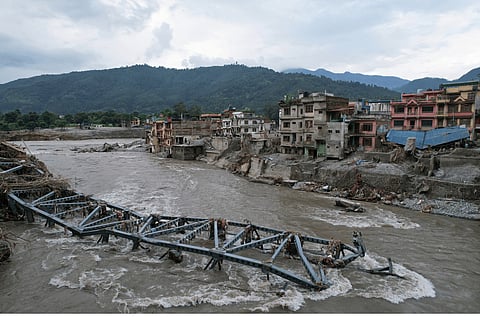
Top Developments
Death toll rises: At least 797 people have died and 3,048 remain missing in Nepal and Tibet.
Nepal toll: Nepal reports 781 deaths and 2,502 people missing, including 592 foreigners.
Tibet toll: China reports 16 deaths and 546 people missing in Tibet, including 261 foreign nationals.
Indians missing: India says 275 citizens and 128 persons of Indian origin remain missing in Nepal, while Chinese state media reports.
Hydropower rescue: More than 100 workers are feared trapped in multiple hydropower tunnels in Nepal. In the Trishuli 3A tunnel, Rescuers drilled and blasted four openings into the tunnel and are assessing the trapped workers’ condition.
New lake: A fresh barrier lake has formed near the Tibet border, complicating rescue efforts.
India joins rescue: Specialised teams from India, China and South Korea are assisting search operations.
Reconstruction costs: Nepal's foreign minister warned the recovery bill could run into “billions of dollars”.
Dead being identified: Nepal has begun burying unidentified victims after collecting DNA samples.
Climate threat: Experts have linked the disaster to a glacial collapse amid growing concerns over Himalayan climate risks.
International aid: The US, Canada, UK, EU, UN and other organisations have pledged millions of dollars in relief.
The United States has announced more than $3.6 million in life-saving humanitarian assistance for Nepal as the country reels from devastating flash floods.
In a statement posted on X, the US State Department said, “There is no higher priority for us than the safety of American citizens. Our embassies in Nepal and China are working closely to assist Americans and support disaster relief efforts.”
“The United States is standing with the people of Nepal by providing more than $3.6 million worth of life-saving humanitarian assistance, including up to three months of emergency food assistance to up to 10,000 flood-affected households,” the statement added.
There is no higher priority for us than the safety of American citizens. Our embassies in Nepal and China are working closely to assist Americans and support disaster relief efforts.
— U.S. Embassy Nepal (@USEmbassyNepal) August 30, 2026
The United States is standing with the people of Nepal by providing more than $3.6 million… pic.twitter.com/ECwYbSW0KG
New exclusive footage obtained and verified by The New York Times gives the clearest view yet of the Aug. 26 Langtang Lirung collapse that triggered the catastrophic Nepal–Tibet floods. Hikers heard a huge crack before ice, rock and debris plunged into the valley, throwing up an enormous dust cloud.
New exclusive footage obtained and verified by The New York Times gives the clearest view yet of the Aug. 26 Langtang Lirung collapse that triggered the catastrophic Nepal–Tibet floods.
— Clash Report (@clashreport) August 29, 2026
Hikers heard a huge crack before ice, rock and debris plunged into the valley, throwing up an… pic.twitter.com/2X8pkSwUOI
Nepal warned Sunday of rising flood waters and urged rescue teams to exercise caution, as efforts to retrieve victims from areas devastated by a deadly torrent of icy debris and water entered a fifth day.
"We have received information that the flood flow in the Bhotekoshi River in Rasuwa has increased further," the National Disaster Risk Reduction and Management Authority (NDRRMA)said in a warning issued at 7:20 am (0135 GMT).
"Therefore, all personnel engaged in search, rescue, and relief operations, those in riverside areas, and everyone else in affected areas including Rasuwa, Nuwakot, Dhading, and Chitwan are requested to exercise caution."
Nepali rescuers seeking to reach hydropower workers believed trapped in tunnels swamped by flood debris were hampered Sunday by heavy overnight rain and rising river waters.
Nepal's government says more than 100 workers may still be alive and trapped inside multiple tunnels at hydropower projects, with key rescue efforts focused on the Trishuli 3A and 3B sites.
Devastating floods near the border with China killed at least 734 people in Nepal and 2,498 remain missing, its disaster authority said Sunday, as rescue efforts entered a fifth day.
Chinese state media earlier confirmed 16 dead in Tibet and 546 people missing following Wednesday's disaster. That takes the overall toll to 750 dead and 3,044 missing.
Nepal Home Minister Sudan Gurung on Sunday visited the flood-affected area in Nuwakot and gave instructions to rescue teams as rescue and relief operations continue in the flood-hit region.
Chinese rescuers near the Tibet border port that was hit by a deadly mudslide were "moved to a safe location" Sunday, after a new lake was formed by a landslide, state media reported.
"On the evening of Aug 29, monitoring drones deployed in the area detected a landslide on a mountainside 2.8 kilometers downstream from the Purepuqiang Tsangpo barrier lake," the state broadcaster said, referring to a drained lake that had in previous days threatened rescue operations.
"The landslide formed a new barrier and a new barrier lake is now forming," CCTV said, adding that rescue personnel near the Gyirong border port had been moved to safer areas.
Authorities in Nepal are warning of possible fresh flooding on Sunday and urged residents in flood-affected districts to remain on high alert after water levels rose in the Bhotekoshi River.
Flood warning notices were sent to people's phones throughout Sunday morning, as rescue crews worked to clear a major highway connecting Kathmandu to one of the areas worst-hit by Wednesday's catasrophic floods.
India has provided 68.5 tonnes of relief material to flood-hit Nepal and deployed technical teams, forensic experts and specialised equipment to support search and rescue operations.
New Delhi has sent specialised tunnel experts and specialised equipment to support search and rescue operations in hydropower tunnels following the devastating flash floods, the Indian Embassy in Kathmandu said in a statement on Saturday.
The Ministry of External Affairs (MEA), in a post on X, said that a fourth flight carrying 11 tonnes of relief assistance landed in Nepal on Sunday.
“It consists of a tunnel technical contingent along with equipment for search & rescue operations; a team of forensics experts for DNA analysis and relief supplies, including blankets, sleeping bags, tarpaulin, plastic sheets & hygiene kits,” the MEA said.
The Indian Embassy in China issued an advisory providing contact numbers for Indian nationals stranded in flash floods.
The post said, “Following the recent flash floods and mudslides in the Tibet Autonomous Region (TAR), People’s Republic of China, TAR authorities have established two dedicated 24-hour English-language hotlines to assist families seeking information about missing foreign nationals. The hotlines can be reached at:
1) 0086-891-6817165
2) 0086-183-0802-6705″
Following the recent flash floods and mudslides in the Tibet Autonomous Region (TAR), People’s Republic of China, TAR authorities have established two dedicated 24-hour English-language hotlines to assist families seeking information about missing foreign nationals.
— India in China (@EOIBeijing) August 30, 2026
The hotlines…
Union Minister Sanjay Seth on Sunday said that there was still no information about Ram Prasad Ghosh, a Ranchi resident who went missing in Nepal following catastrophic flash floods that struck on August 26.
Speaking to ANI, Seth said Ghosh worked for an Australian Hydro project for Andritz in Trisuli and had been missing since the tragedy. He said Ghosh's brother travelled to Kathmandu to search for him, but no information about his whereabouts has been received so far.
Key updates
Death toll in Nepal and China rises to 750, with nearly 3,000 people still unaccounted for as rescue teams continue searching debris-hit areas.
4,451 people rescued so far, according to Nepal Prime Minister, as rescue and relief operations continue.
17,000 children urgently need humanitarian aid, UNICEF warns, amid the widespread devastation.
18 schools destroyed and 20 damaged, disrupting education for thousands of children in flood-hit regions.
At least 93,000 people affected, according to estimates by the International Committee of the Red Cross.
Humanitarian aid reaches temporary camps, but relief needs remain widespread across affected communities.
Nepal seeks international financial and specialised rescue support, including heavy-lift drones, DNA testing kits and body-freezer storage units.
Reconstruction costs could run into billions of dollars, Foreign Minister Shisir Khanal says.
India steps up glacier monitoring following the disaster to track potential risks linked to flooding.
Nepali rescuers seeking to reach hydropower workers believed trapped in tunnels swamped by flood debris resumed work Sunday after rain and rising river waters hampered efforts.
Rescue operations entered their fifth day since the floods, as teams battled difficult conditions at the disaster sites.
About 100 of the nearly 319 individuals who travelled from Tamil Nadu through to Nepal were still untraceable and missing following the flash floods there, state minister A Rajmohan has said.
As many as 219 persons are safe and secure, the Minister said.
Nepal has said it will start burying unidentified and unclaimed bodies recovered after the devastating flash floods tore through the country this week, citing the risk of infection and the deteriorating condition of the remains.
The officials have been collecting DNA samples from the bodies before burying them.They are also maintaining records using identification or reference numbers to facilitate possible identification in the future.
A 20-minute delay at a Buddha temple saved their lives, a realisation that brought tears and a sense of disbelief to a 31-member group of Keralites who returned safely to the state on Sunday after being stranded in flash flood-hit Nepal.
The group, which included women, infants and elderly persons, arrived at the international airport here, where emotional scenes unfolded as the travellers were reunited with their anxious family members.
Eight people from Assam have been safely rescued from flood-hit Nepal and will return home on Sunday, Chief Minister Himanta Biswa Sarma said, adding that efforts were on to trace others reported missing.
The Assam State Disaster Management Authority had earlier said 10 people from the state were missing in Nepal, though several names of those rescued did not feature on its list.
More Keralites stranded in Nepal following the devastating floods have started returning to India, NORKA Roots said on Sunday.
Of the 52 people who contacted the agency's helpline, 45 have been confirmed safe, while seven remain untraced. Sixteen of those confirmed safe returned to Kerala on Saturday.
A 23-member Kailash Mansarovar pilgrimage group, including 19 Keralites, reached Kathmandu early Sunday and is preparing to return home. Another 31-member group from Kerala has reached the state, while a 44-member tour group has returned to India and is travelling from Gorakhpur to Bengaluru.
The death toll from Nepal’s devastating flash floods rose to 768 on Sunday, while more than 2,500 people remained missing as rescue operations entered their fifth day.
The floods, triggered by an ice-rock avalanche following a glacial collapse near the Nepal-Tibet border on August 26, caused widespread destruction across northern and central Nepal. The National Disaster Risk Reduction and Management Authority said 8,730 people have been rescued so far.
Preliminary data from the education ministry showed that 238 students and 18 teachers were among those missing in three flood-hit districts.
As many as 537 workers and employees remained unaccounted for at nine hydropower projects in Nepal’s flood-hit Rasuwa and Nuwakot districts, as rescue teams intensified efforts to reach people believed trapped inside tunnels blocked by mud and debris.
According to the Independent Power Producers’ Association in Nepal, 898 workers were initially reported out of contact after the August 26 floods, of whom 361 have been rescued.
The most serious situation is at the 216 MW Upper Trishuli-1 project in Rasuwa, where around 300 people are believed to be trapped inside a tunnel. At other projects, including Upper Trishuli-3A and Chilime, rescuers have struggled to clear tunnel entrances buried under mud and debris.
Four men from Uttar Pradesh’s Kushinagar district working at hydropower projects in Nepal’s flood-hit Rasuwa district remain untraceable since the August 26 flash floods, their families said.
Meanwhile, an 11-year-old boy from Bihar’s Motihari is searching along the Gandak river in Kushinagar for his father, who went missing in the floods. The boy and his three brothers escaped Nepal with official assistance.
According to Nepal’s Independent Power Producers’ Association, 76 employees associated with Andritz Hydro at the Upper Trishuli-1 project were reported missing after the disaster.
Nepali rescuers drilled, dug and used explosives on Sunday to reach hydropower workers believed trapped inside tunnels filled with flood debris, as operations entered their fifth day.
More than 100 workers are feared trapped at several hydropower projects, with rescue efforts focused on the Upper Trishuli 3A and 3B sites. At the 3A project in Nuwakot, rescuers drilled openings into a mud-filled tunnel, pumped in air and sent cameras inside, but received no response after personnel descended through one opening.
Teams are now widening the access point and preparing to send rescuers equipped with oxygen into the tunnel to assess conditions and search for survivors.
For thousands of people displaced by Nepal’s devastating August 26 floods, the crisis is far from over. Around 3,500 people are living in temporary shelters in Rasuwa and Nuwakot, facing shortages of food, clean drinking water, medicines and sanitation.
The floods, which swept through the Bhotekoshi and Trishuli river systems, have killed more than 750 people and left over 2,500 missing. Crowded shelters are housing pregnant women, new mothers and people requiring medical care, raising concerns about disease outbreaks.
Damaged roads, water pipelines and other infrastructure have also hampered relief efforts. Meanwhile, a monastery near Kathmandu is sheltering around 500 displaced people, many of whom have lost their homes and remain uncertain about where they will go next.
As floodwaters receded in Nepal, survivors returned to devastated homes and markets, searching through mud and debris for belongings while families continued to look for missing relatives.
In Galchhi, Dhading district, Class 11 student Nayan Tiwari and his cousin Nivi began clearing their flood-damaged home. More than 15 houses in their neighbourhood were washed away. “Everything was here before, but now there is nothing left,” Nayan said, adding that the family was determined to rebuild.
The August 26 flash floods, triggered near the Nepal-Tibet border, have killed more than 750 people and left over 2,500 missing.
In Nuwakot, local residents said hundreds of houses, shops, vehicles and school buildings were swept away as the Trishuli river surged. Displaced families are now relying on relief camps for food and shelter, while relatives gather at hospitals and search downstream for missing loved ones.
The death toll from Nepal’s devastating flash floods rose to 781 on Sunday, while 2,502 people remained missing as rescue operations entered their fifth day.
The National Disaster Risk Reduction and Management Authority said 9,435 people have been rescued so far, with bodies recovered from eight affected districts.
The August 26 floods, triggered by an ice-rock avalanche following a glacial collapse near the Nepal-Tibet border, caused widespread destruction across northern and central Nepal, washing away homes, infrastructure and hydropower projects.
Key updates
Death toll in Nepal and China nears 800, with nearly 3,000 people still unaccounted for as rescue teams continue searching debris-hit areas.
4,451 people rescued so far, according to Nepal Prime Minister, as rescue and relief operations continue.
17,000 children urgently need humanitarian aid, UNICEF warns, amid the widespread devastation.
18 schools destroyed and 20 damaged, disrupting education for thousands of children in flood-hit regions.
At least 93,000 people affected, according to estimates by the International Committee of the Red Cross.
Humanitarian aid reaches temporary camps, but relief needs remain widespread across affected communities.
Nepal seeks international financial and specialised rescue support, including heavy-lift drones, DNA testing kits and body-freezer storage units.
Reconstruction costs could run into billions of dollars, Foreign Minister Shisir Khanal says.
India steps up glacier monitoring following the disaster to track potential risks linked to flooding.
Nepali Army engineers have intensified efforts to reach people believed trapped inside the Upper Trishuli-3A hydropower project tunnel in flood-hit Nuwakot, using heavy equipment and blasting to widen an opening into the buried structure.
As many as 537 workers and employees remained unaccounted for at nine hydropower projects in Nepal’s flood-hit Rasuwa and Nuwakot districts, including the Trishuli-3A project.
The operation at the site is focused on reaching 42 people reported out of contact at the 60 MW project, according to the Independent Power Producers’ Association, Nepal (IPPAN).
The Nepal Electricity Authority has separately estimated that around 42 technical personnel were working on an overhaul of the underground powerhouse when they became trapped inside the tunnel, the OnlineKhabar news portal reported.
According to an update from the Nepal Prime Minister's Office, a joint 90-member rescue team has been deployed at the site, comprising 66 Nepali Army personnel, including a special search and rescue team with trained dogs, 18 Armed Police Force personnel and six Nepal Police personnel.
The team reached the main section of the tunnel, known as the “crown head”, around 2 pm and created a 2-by-3-foot opening, the PMO said. Rescuers descended through it using ropes and called out to those inside but received no response.
Rescue efforts continued simultaneously with heavy equipment and blasting as the opening was widened to facilitate a faster and more effective operation, the PMO said.
“Despite the difficult and risky conditions, the rescue team is working tirelessly around the clock,” it said.
The Nepali Army also airlifted excavators and bulldozers to Battar in Nuwakot after dismantling the machinery into sections for helicopter transport, the Nepal News web portal reported.
The tunnel mouth was subsequently located about 40 metres upstream from the vertical hole and about eight metres below it, according to the Ratopati news portal. However, rescuers have yet to reach the workers believed to be trapped inside.
At least 12 people, including five members of a family, from Bihar's East Champaran district remain missing following devastating flash floods in Nepal, officials said on Sunday.
Eight people from Adapur block have been missing since the floods struck the Himalayan country four days ago, Adapur Circle Officer Pragya Nayanam said.
Three of them were identified as Sanjog Mahto of Barwa village, and Umesh Prasad and Brij Kishore Paswan of Uchi Dih village.
Five members of a family from Lala Chhapra village also went missing after the disaster. They were living in Bhimphedi, Nepal, where family head Budhan Sah ran a scrap shop. He had gone uphill to procure materials when the floods struck, another official said.
"Sah's wife Manvi Devi, daughters Asha Kumari, Roopa Kumari and Sandhya Kumari, and granddaughter Ayushi Kumari are missing," he said.
Three people from Jagiraha village in the Kesaria-Chakia area have also been missing, officials said. They were identified as Rambabu Prasad Sah, Pramod Kumar Sah and Muneel Kumar Sah.
A resident of Hardiya village, Arman Miya, who worked as a tailor in Trishuli Bazaar in Nepal's Nuwakot district, has also been missing since Wednesday, Chauradano Circle Officer Ranjan Kumar Baitha said.
Meanwhile, a labourer from Samastipur said eight friends from Bihar went missing after the floods.
Ajay Poddar, the labourer from Samastipur, told PTI Videos, "We, around 12 friends, used to work here as labourers. Four of us had gone to Kathmandu to buy some hardware items. When we returned, the area was swept away by floods, and we were stopped by security personnel from going closer to the site where we worked."
About 85 Americans remain missing after a devastating flood swept through a remote region of the Himalayas, the State Department said on Sunday. The US figure is just a small fraction of the more than 3,000 people that remain missing after the disaster.
At least 797 people have been confirmed dead by authorities in Nepal and China after the wall of water, mud and debris tore through the region and overwhelmed entire villages early Wednesday.
State Department spokesman Tommy Pigott told ABC talk show "This Week" that nine Americans have been evacuated and that he was unaware of any US nationals dying in the disaster. "The remoteness of this location makes getting reliable information difficult. But our dedication remains, our commitment remains," Pigott said.
The US and Canada said they would each provide $3.6 million in aide, while the UK has offered $6.8 million. The UN released $2.5 million in emergency funding. Part of the US funding will go towards road repairs and "mobilizing specialized transport options" to reach remote areas with food and other aid, Pigott said.
India has stepped up its rescue and relief operations in flood-hit Nepal, deploying tunnel engineers, doctors, paramedics and forensic experts as rescuers race against time to reach people feared trapped in hydropower tunnels on the fifth day of the disaster.
India has so far provided 68.5 tonnes of relief material and deployed specialised technical and forensic teams. A fourth Indian flight carrying 11 tonnes of assistance reached Nepal on Sunday.
The latest consignment included a tunnel technical team and equipment for search-and-rescue operations, forensic equipment for DNA analysis and essential relief supplies.
The Ministry of External Affairs said the assistance included “blankets, sleeping bags, tarpaulin, plastic sheets and hygiene kits”.
An 11-member Indian technical team, comprising doctors, paramedics and tunnel engineers, in Kathmandu conducted reconnaissance of hydropower tunnels in the flood-hit Trishuli area of Nuwakot district.
The team also carried out an aerial survey of the Chilime and Langtang areas before beginning work around the tunnel sites.
In total: 3,048 missing
Nepal's disaster agency increased the total number of people missing on its side of the border to 2,502 on Sunday, saying there were also 781 confirmed deaths. The number of missing in Tibet is now at 546, with 16 others dead, China's state broadcaster CCTV reported on Sunday. Together, the total missing stands at least 3,048 and the total dead at 797.
Nepal's disaster agency said Sunday that 592 foreigners were unaccounted for -- an increase on Friday's figure of 517. It did not update the list by nationality. Chinese officials said Sunday at least 261 foreign nationals were among those unaccounted for there.
Nepal: Nepal's disaster agency lists 1,910 missing citizens, in a update on Sunday. That includes 562 unaccounted for in the hardest-hit district of Rasuwa.
Among the missing are 933 people working on hydropower projects, 45 Nepali Army soldiers, 38 police and armed police officers and 19 customs and immigration officers.
China's CCTV said Sunday that 104 Nepali nationals were missing in Tibet.
China: China's foreign ministry said on Thursday that nearly 100 Chinese nationals were among the missing in Nepal. The Nepal Tourism Board said eight Chinese were unaccounted for but that 16 had been rescued.
India: The Ministry of External Affairs said on Saturday that 275 citizens were missing, and an additional 128 persons of Indian origin.
Around 900 Indian nationals are still on the Chinese side but are safe and contactable. Chinese state media said Sunday that 49 Indian nationals were missing in Tibet.
A 19-member specialised forensics team from India began functioning in Kathmandu on Sunday to help augment the analysis of DNA samples for the identification of victims' mortal remains, in the wake of the devastating flash floods in Nepal, officials said.
The spokesperson of the Ministry of External Affairs (MEA), Randhir Jaiswal, shared the update in a post on X.
"Indian nationals who have safely crossed into Nepal from China today: 403 (as per local government sources on China side)," he said in a statement attached with the post.
In the statement, he further said that 500 Indian nationals remain on the Chinese side and "they are safe".
Update on Indian nationals & India’s rescue and relief efforts in Nepal ⬇️
— Randhir Jaiswal (@MEAIndia) August 30, 2026
🕘 As of 2130 hrs, 30 August 2026 pic.twitter.com/jPB1HgP8xS
As many as 49 yatris from Tamil Nadu, after completing the Kailash pilgrimage, were on the China side when the flash floods struck and they are among the missing, the owner of a travel firm who organised the yatra said here on Sunday.
Expressing deep concern about the missing pilgrims, Maravel Nagappan, the firm owner, said that over 40 yatris from Tamil Nadu had completed the Kailash yatra and were waiting to enter Nepal from the China side when the disaster struck on August 26, 2026.
The travel firm owner requested the Central government to get information about the untraceable yatris from the Chinese authorities.
The Kailash yatra, he organised commenced on August 14, he said.
Nagappan said his son Sathyanarayana led the team of yatris and he had spoken just before the disaster struck to Neapalese associates to keep vehicles ready at their end for them.
Nagappan told reporters that his son had conveyed to the Nepalese travel associates that they may clear the immigration formalaities after two hours and accordingly, vehicles should be made available at the Nepal side.
The firm owner said: "So, our group of 49 people were 100 per cent on the China side at that time. So, we request our government, Indian government to take action quickly and get information from China."
At the time of the disaster, about 11 teams of Indian yatris, including those from Tamil Nadu, were waiting to enter China from the Nepal side. "You would have seen video clips of two out of three buses getting swept away in the floods and they were among those waiting to enter China," he said.
At the same time, three teams were waiting to exit China and enter Nepal.
He claimed: "Pilgrims who ran away from the immigration building were from our team. We identified them (by scrutinising the video clips) by our signature jerkin with dark blue--grey shades."
He said that there are also possibilities for yatris to have survived.
All the information related to yatris has already been provided to state government officials, he added.
Four more bodies were recovered from the Gandak river in Uttar Pradesh's Kushinagar district after they apparently drifted into Indian territory from Nepal amid the devastating floods in the neighbouring country, officials said on Sunday.
A total of 13 bodies have been recovered in the district over the past four days, with four recovered on Sunday alone, they said.
On Sunday, an SDRF team recovered the bodies of two women and two men near Bhediyari Thokar No. 3 of the Chhitauni embankment.
The SDRF team was conducting surveillance on the river near Bhediyari Thokar No. 3 when they spotted four bodies in the water. The team entered the river and retrieved the bodies.
On Saturday, SDRF surveillance teams had spotted and recovered three bodies floating in the river. Officials in the neighbouring district of Nepal have been informed about the recovered bodies.
A group of 43 pilgrims from Maharashtra, including residents of Thane, returned on Sunday after being stranded amidst flash floods and landslides along the Nepal-China border during their Kailash Mansarovar Yatra.
The pilgrims, who had traveled through Rudra Tour and Travels, were stuck in the Timure border area shortly after crossing into China.
The floods washed away the hotel where they had stayed and some of its staff members lost their lives, one of the pilgrims said.
Prakash Shantaram Mane, a Kalyan resident who had traveled with his wife Pratibha, expressed profound relief upon landing in Mumbai.
"When we learned that the hotel, where we had eaten our breakfast a little while earlier, had been swept away along with its staff members, we were left completely numb," he said.
Following instructions from Chinese authorities, restrictions were placed on movement, leaving pilgrims from around the world stranded in Saga, he said.
The pilgrims, accompanied by nine Nepali tour staff, eventually returned to Kathmandu on August 29 before boarding a Nepal Airlines flight to Mumbai on Sunday afternoon.

