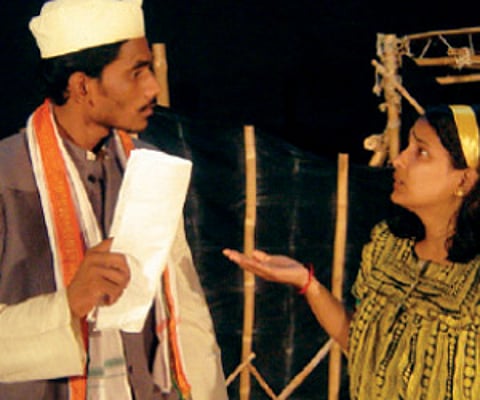

It was World Theatre Day, but this time there was more to rejoice than its auspiciousness. As soon as the curtains went down on Mrigatrushna, an uproar in the auditorium took Samita Mohanty by surprise. It took a while before the director of the two-hour epic play realised that the commotion on that wintry March evening meant only loud appreciation. Some in the audience even climbed on to the stage to compliment her. Samita found her defining moment as a theatre person.
Samita belongs to a new crop of women directors that includes Sujata Priyamvada and Bhaswati Basu, who now share equal responsibility with their male counterparts to revive theatre in present-day Orissa. For long, it has been considered more an educational medium than entertainment — even productions that aren’t ticketed run hardly for two consecutive evenings.
But that didn’t deter these women — in their 30s — to take the plunge into their passion. “I rebelled and left home long ago to satiate my hunger for acting,” says Sujata. “After acting in many productions, I did short courses at the National School of Drama before joining Natya Chetana as a full-timer.”
In 1994, she got an opportunity to
direct schoolchildren for various plays. “I knew I had the calling.” She showed her mettle in plays like Ganga, Dhala Suna, Bana and Rebati. The last one helped her to be taken notice of “as a woman who tried something innovative,” adds Sujata who has been a
resource person at various national and international workshops.
Unlike Sujata, Bhaswati hails from
a theatre family — her father being
the renowned Asim Basu. Also, she
was lucky to get a supportive husband
despite “you mostly spending money from your own pocket to make presentable, entertaining fare,” notes Bhaswati, a guest faculty at the drama department of Utkal Sangeet Mahavidyala, whose Aparna, Dine Ratire, Yada Yada Hi Dharmasya and Tyaga have received encouragingly good response.
The perception of theatre as a glamour-less world prompts many girls to choose films, television or even albums as a career. “Two out of 10 students in the drama department pursue the career with seriousness. I often feel I should have a house with a huge rehearsal room from where I can look after both my
responsibilities — my home and my production,” shrugs Samita, a guest faculty at Utkal Sangeet Mahavidyalaya who is pursuing a PhD in drama. She is married to theatre director Gouranga Rout, who feels theatre in Orissa today has brightened compared to a time when men performed the roles of women. Like many critics, he is all praise for Samita’s Mrugatrushna, Muktabihangi, Yugantika, Bhaimananka Katha and Ameta Bhagyaban Pilare.
There are a few commonalities that bind the trio. One, their taking off as actors before switching over to direction; second, their affiliation to eminent theatre groups. While Sujata is attached to Natya Chetana, Bhaswati and Samita began their career with Satabdira Kalakar. Notes Subodh Patnaik, the brain behind Natya Chetana: “These women have changed the way we looked at actresses. All of them have taken up challenges in their distinct way to establish themselves as women directors of substance. History can’t ignore them.”
Do actors take women directors seriously? “Absolutely,” avers Sujata. “Drama is a disciplined medium. The director is only the backbone; the rest of the body is dependent on the other members. So there is no question of either dictatorship from my side or defiance from the members.”
Samita feels the environment in which troupes function doesn’t allow disregard for anyone. “Fortunately,” she notes, “artistes dwell in a different world of theirs. There is no concept of a boss.” Adds Bhaswati: “It’s a give-and-take process; all are free to improvise suitably.”
Notwithstanding the relatively small number of productions by women, the state is encouraging their participation at the directorial level. Natya Chetana recently organised two workshops for women directors, and had received close to 30 applications for each of them. In fact, Sujata herself is one of the brightest finds of such a workshop. There are many others who are vibrant at the
regional level too.
In 2006, Utkal Rangamancha Trust, another theatre outfit, had hosted a SAARC countries drama festival for women. “That provided an impetus to the aspiring local theatre artistes,”
observes theatre exponent Ananta
Mohapatra, who heads the Trust.
Dhirendra Nath Mallick of Satabdira Kalakar, the organisation which has also been conducting workshops and producing plays, terms the achievements of women as “remarkable”. Be it stage craft, compositional ability, set or light design, the women directors are creating a different identity, he adds. “They should be given better chances to direct as well as present their productions at festivals within and outside the state.”
Mohapatra maintains that smaller
remuneration for direction is what
is prompting the women in the state’s theatre circuit to take up acting. “This, when a director has to study a lot,
pursue research and travel extensively.” Also, directors are less exposed to the audiences; and neither do they get
scientific training.
Despite these, some have proved themselves. And that’s what makes the slot for a woman in theatre as a director all the more admirable.
— kasturi@epmltd.com
Bhaswati is a guest
faculty at the drama department of Utkal Sangeet Mahavidyala, whose Aparna, Dine Ratire, Yada Yada Hi Dharmasya and Tyaga have received good response
Samita is married to theatre director Gouranga Rout. She has recieved praise for her Mrugatrushna, Muktabihangi, Yugantika, Bhaimananka Katha and Ameta Bhagyaban Pilare
In 1994, Sujata got an opportunity to direct schoolchildren for various plays. She showed her
mettle in plays like
Ganga, Dhala Suna, Bana
and Rebati
