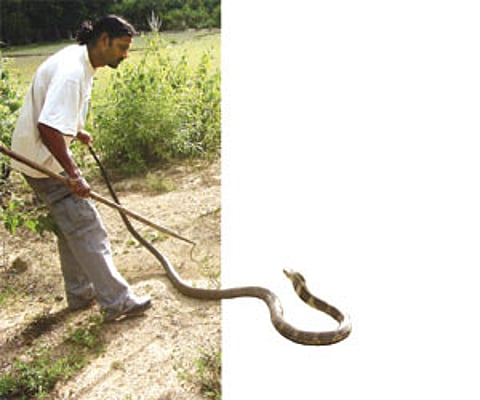

At 7.30 am, it is still dark outside, and the swirling mists ensure that you can’t see much ahead. But the birds around trill and chatter. It is also time for researchers at the Agumbe Rainforest Research Station (ARRS) to set out on their day-long tracking of a king cobra across the rainforest terrain, 560m above sea level in the Sahyadri Range of the Western Ghats. And this is the first time that a scientific study of the movements of the longest venomous snake in the world has been attempted in the wild!
Agumbe, with an average annual rainfall of 7,000-8,000 mm, is known as the Cherrapunji of south India and is adjacent to one of the last surviving lowland rainforest tracts in the Someshwara Wildlife Sanctuary and Kudremukh National Park. Set up in 2005 by well-known herpetologist Rom Whitaker, its main objective is to study and conserve the rainforest of south India, using the king
cobra as a flagship species.
Conservation Officer, P Gowri Shankar’s easy confidence with king cobras during rescue and relocation operations has to be seen to be believed! He has rescued and relocated 86 king cobras in the last three years.
The people in Agumbe — who depend on areca plantations and forest produce for their living — worship snakes, and often ask for help to relocate them away from human habitation. The pioneering Radio Telemetry Project started in March last year, of a male and female cobra, is a collaborative effort with the Karnataka forest department and the University of Arizona. “So far 15 research
volunteers from universities across Mumbai, Bangalore, Mysore and Ahmedabad have undergone training and contributed to this project,” says Gowri. “It has been amazing to observe aspects like nesting, male combat, courtship, mating and cannibalism in king cobras, and to document them scientifically for the first time in the world.”
Over 152 king cobra nesting sites in the wild have been studied since 2005. Since its inception, ARRS has
observed, monitored and studied six nests, in collaboration with the forest department. All the nests were monitored till the hatchlings emerged, and then released in the wild.
The king cobra is considered a barometer of environmental and biodiversity degradation, and is the only snake that builds a nest (about 2 ft high and 6 ft dia) to lay eggs that hatch after around 110 days.
The large number of trees, shrubs, lianas, herbs, climbers and epiphytes with unique ecological and economic value make this
region highly sensitive and vulnerable in terms of conserving flora and fauna.
Young research associate Srinidhi Kashyap, currently at Agumbe to pursue his interest in Malabar pit vipers, gives this writer a comprehensive overview of the work that goes on at ARRS — to study various aspects of ecology, biology and natural history of the king cobra in the wild; nature camps and educational programmes on conservation for young minds and facilities for researchers.
“This is an amazing place to study the ecology of rainforest species endemic to this region and the climate and sparse human settlements ensure that conditions can be just right!” he says.
Wend through the dense undergrowth, giant lianas and towering trees, amid suddenly light and dark days, and it can be so silent, you can almost hear the mists that come on you. On the challenges of the radio telemetry project, A S Pradeep, education officer, ARRS, confirms, “Definitely the terrain, working in the dense rainforest undergrowth and the monsoon that lasts for more than five months! Also finding local trackers who are willing to spare time to guide us within the forests.”
Gowri remembers too the time they “lost the ‘King’ for five whole days, in May, at a time when he was travelling the most during the breeding season!”
ARRS, by connecting researchers, the forest department and the community through its various programmes is playing a crucial role in this biodiversity hot spot. Its future plans include “tracking more king
cobras to record scientifically their territorial behaviour patterns, breeding and nesting habits”.
People with an interest in conservation, education and those who appreciate the biodiversity and natural history of the rainforest can pursue research at ARRS. A self-sufficient, solar-powered, micro hydel power system, which serves as a model for alternative energies at Agumbe, and functional lodging and food facilities ensure basic logistics for interested researchers.
— shobhamenon@airtelmail.in
(The writer is the founder-trustee of Nizhal,an NGO that promotes tree culture and sensitive greening in urban areas)
