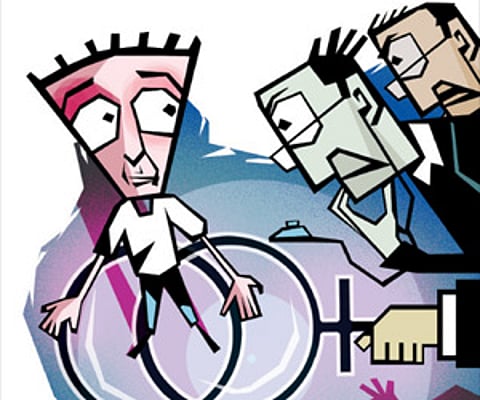

"Nothing much changes simply because the law changes,’’ a cynical friend remarked a few days after the Delhi High Court’s verdict on homosexuality. While his flippant remark annoyed me, it was in line with my own perception on the relationship between legal change and social change. However, the truth is that a lot can be brought to public discussion and even policy change once the law stops criminalizing us. It is shame enough already that we could not address the issue of homophobia in a focussed, sustained and fearless manner for all these years. Crisis intervention seemed to be the only option — to run to help someone after an instance of violence and discrimination has already taken place.
Not any more. We do not have to wait. We should start talking about homophobia in this country. People may ask what the term means, but that does not mean they are not familiar with the emotion. They might have experienced it personally, or dealt it to someone. Homophobia — the irrational fear and hatred of homosexuality and homosexuals. Parents, friends, bosses, colleagues, subordinates, doctors, nurses, teachers, even random people can be, and often are, homophobic. Parents try to pass it on as love and concern. The rest smugly justify it with excuses like, ‘‘Oh, it is unnatural,’’ ‘‘It is morally wrong,’’ ‘‘It is disgusting.’’ As anyone who has tried to live as an "out" queer person can tell you, strongly held, unexamined sentiments like these hurt you more than (seemingly) well-reasoned arguments.
The Campaign for Open Minds, launched by a group of LGBT and human rights activists, public health specialists and support group members, seeks to generate public discussion and debate on the very harsh reality of homophobia. It has taken its first step as an open letter campaign. Three open letters — from health care professionals, from families and friends of LGBT people, and the third one from LGBT people themselves — have been hosted at www.orinam.net, and have already been signed by several people. The Campaign was launched on 11 October 2009, the world Coming Out day.
One primary impetus for starting this campaign has been the flood of negative reactions following the Pride Marches in June, and the Delhi High Court's verdict decriminalizing consensual, adult, same-sex acts. Scarier than any religious leader's loveless virulence on TV have been the several talk shows featuring doctors who claimed they had a ‘‘cure’’ for homosexuality. L Ramakrishnan, Country Director, Solidarity and Action Against the HIV Infection in India (SAATHII), and one of the people behind this campaign observes, ‘‘Parents of LGBT youth are anxious to explore these options in order to ‘reform’ their children and bring them into the hold of gender normative heterosexuality.’’
Adding to that, Sunil Menon of Sahodaran, a male sexual health project in the city, remarks, ‘‘many parents have paid a lot of money to doctors and led their children into situations of trauma and misery.’’
These reversal and aversion therapies subject LGBT people to untold trauma and distress, often seriously damaging their emotional health. Parents must seriously find a better way to express their love for their children than forcing them to change such a vital part of their personal lives just so the families can escape societal criticism. A very supportive and understanding mother of an openly out gay man in the city had this to say: ‘‘I refuse to give much importance to opinions of people. I have had enough of those. I am paring down the things I can worry about to just a few. My children’s happiness comes foremost among them.’’
Magdalene Jeyartnam, Director, The Center for Counselling, says that let alone therapy, even the counselling needs of LGBT people have to be seen in the right context: ‘‘I do not think that anyone from the LGBT community itself need counselling. If at all they do it is like a victim of trauma undergoing counselling/therapy. People who seem to have straight jacketed views on sex and sexual desires are the ones who need help. I think, in many ways, we have forced our views and limited understanding of sexuality on others. Sending them for treatments to change their sexual orientation is like blaming a victim and letting the perpetrators go free.’’
Sridhar Sadasivan, one of the people behind the campaign, emphasises the importance of self-acceptance for one's mental health. After struggling alone with himself for several years in the face of prevalent social perception of homosexuality, Sridhar found relief in self-acceptance. Connecting with other LGBT people in the city and other places, hearing their stories, made him see the horrors that people go through. ‘‘It is horrifying to see how some in the Indian medical community claim that homosexuality is a disease and that they can cure it with conversion therapy, shock therapy etc. These treatments are unscientific and harmful. This brutality against the LGBT community should stop,’’ says Sridhar. Well-known psychiatrist Vijay Nagaswami agrees with this: “Absolutely. I believe that Indian psychiatrists should refer to the directive from the American Psychiatric Association, which removed homosexuality from the list of diseases in 1973, and endorse it.”
The campaign, which is set to go nation-wide soon, is made available in several languages, and also appeals to the media, film industry, educational institutions, work places and business enterprises to be sensitive to diversity. If we have laughed at or made fun of a gay or gay-looking (whatever that means!) person in our classrooms or offices, and have gotten away with it, it is time to realise we are homophobes, that we are discriminatory. If we have altered our relationship to a loved one for the worse, simply because he or she is gay, lesbian or bisexual, it is time to realise we are bigots. If we have passed lewd remarks at Aravanis on the road or in the train, it is time to realize that there is very little difference between us and racists.
More importantly, fighting homophobia cannot just be at an inter-personal level. If a school or a college does not protect LGBT students from discrimination, ragging and violence premised on their sexuality or gender expression, it simply means homophobia is institutionalized. If work places do not include discussions on sexuality in their programs on diversity and ensure non-discrimination, it is nothing but homophobia. For silence amounts to complicity.
— aniruddh.vasudevan@gmail.com
