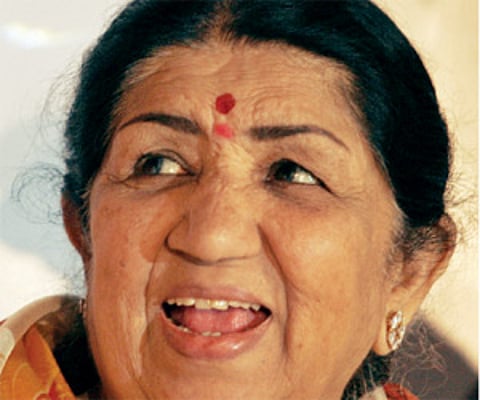

Even in the evening of her life, Lata Mangeshkar’s voice is as fresh as the morning sun. One that could both enliven and soothe the listener’s mind. Eighty years of music and 63 years as a leading playback singer in a huge film industry are no easy feat. It has no parallels — not just in Bollywood, but anywhere in the world. Very few people know Lata’s real name is Hema. She chose her name from her father’s play in which she played a character called Latika.
Pushed unwillingly into a film career, Lata rose to prominence dramatically in the post-Independence film industry — after a lot of personal struggle. When she got her first earnings, she bought a radio to listen to her idol K L Saigal. Unfortunately, the first thing she heard as she switched on the radio was the news of his death. Saddened, she sold the radio at a loss.
The year 1947 saw the exit of Mallika-e-tarannum Noorjehan, who left for Pakistan after Partition. The days of singing stars like Uma Devi, Surendra and Suraiyya were numbered, as the playback system sabotaged their forte, which was the clever conflation of voice and looks. The following year saw the breaking of convention by not just Lata, but also
Mohammad Rafi, whose songs in Dulari turned out to be chartbusters. Two years of back-to-back successes in the form of Andaz, Dulari, Barsaat and Mahal ensured the arrival of Lata Mangeshkar on the Hindi music scene.
The ’50s saw her competing with the likes of Shamshad Begum, Geeta Dutt and later, her own sister Asha Bhonsle. But Geeta was her only true competitor, whose sultry voice gave her a run for her money. No doubt Lata had ‘big’ names in her kitty, with loyalists such as Naushad, Shankar Jaikishan, Roshan, Madan Mohan and Salil Choudhary, under whom she recorded hit after hit. But Geeta had support from S D Burman and O P Nayyar, with the latter never having recorded a single song with Lata, for reasons known only to them. In the ’60s, however, the tide turned in Lata’s favour. Geeta and Shamshad fell silent and their popularity waned. So Lata, along with her sister Asha
began dominating the film music scenario for the next three decades.
This era also saw controversies that engulfed Lata. She never recorded a song with Nayyar. She fell out with C Ramachandra, returning only to record the unforgettable Ae Mere Watan Ke Logon. She stopped recording songs with Rafi — it was over a dispute about royalty with HMV.
This cold war went on for three years. During this time, Rafi loyalists such as Naushad used Asha instead of Lata for duets and on the other hand, Lata loyalists such as Burman used Kishore Kumar to sing duets with her. This gave Kishore a big break with songs like Gaata Rahe Mera Dil, while Rafi sang all the other songs of Dev Anand in Guide. Finally, when they did come together, the first song they sang was Dil Pukare from Jewel Thief.
Meanwhile, she even had a misunderstanding with S D Burman and did not record any songs with him for many years. It was RD who brokered peace between them and got her to sing Mora Gora Ang Lele for Bandini under SD. When Suman Kalyanpur and Vani Jairam broke into the music scenario as overnight stars and slipped away without a trace, Lata was accused of using her clout to get rid of unwanted competition.
She fought with Raj Kapoor and refused to sing for his films. Since he considered Lata his lucky mascot, he made peace with her and never let her go thereafter. From Barsaat to Ram Teri Ganga Maili, she sang for most of his films, and also for all his heroines from Nargis, Nimmi, Padmini and Vyjayantimala to Dimple Kapadia, Zeenat Aman, Padmini Kolhapuri and Mandakini.
There was something unusual and magical about Lata. Probably the reason all her opponents return to her fold, seeking the comfort of her voice, for reasons of money, success and superstition. She has seldom been candid about such controversies in her interviews, save with a few like Ameen Sayani or Nasreen Munni Kabir, for the younger lot have not been able to cast aside the feelings of awe while approaching her.
But Lata has never had it easy. In an industry where superstars gets goose pimples every Friday, with every new release, Lata too must have been hassled with
a flurry of competitors. Responding to the accusation of her throttling competitors, she once said in an interview with Sayani: “Once a person came with his daughter to S D Burman and said that she sings like Lata, to which dada replied saying why he should take someone who sang ‘like’ Lata, when Lata herself sang for him. Therein lay the problem. The new singers never tried to be different. They tried to be like me rather than cultivating something different from me.” Well said, for even today, every big and small singer aspires to sing ‘like’ Lata.
Every musician worth his notes has his favourite ‘Lata song’. There is a ‘Lata song’ for every emotion and every occasion. If you are happy, you sing Panchi Bano Udti Phiroon. If you are sad but love struck, you play Rulake Gaya Sapna Mera. If you are out there to challenge the world, you go Pyar Kiya To Darna Kya. If you want to sing a lullaby, there is Chanda Hai Tu Mera Suraj Hai Tu.
Every girl newly introduced to love would find her emotions resonate in Chalte Chalte from the all-time classic, Pakeezah. Every dark and horrifying place reminds you of Gumnaam Hai Koi. Every bhajan party loves Allah Tero Naam and every marriage party loves Raja Ki Aayegi baraat.
In her illustrious career, she has been showered with many awards; so much that she stopped
accepting Filmfare awards after 1969. Tomorrow, as she turns 80, everyone would agree that her voice still carries the spiritedness of a girl of 18. Age has taken its toll, but then there is still some air of classicism, mysticism and lyricism about her. Perhaps, she has maintained this with a purpose, which has in turn lent her the incomparable aura we see around her today.
— The writer is a management student based in Delhi.
He blogs at www.visionsofcinema.blogspot.com