
Its very location has an air of self-effacement. You cut loose from the arterial roads of Chennai, get on to some obscure by-lanes of Chinmaya Nagar. Finally, at a dead-end, you see streams of yellow light seeping through the blue curtains of a half-finished building. No signboard welcomes — or aids — the newcomer; you have to follow the distant voice that sound like wonderfully worded dialogues enriched by Tamil Nadu’s folk art and theatre culture.
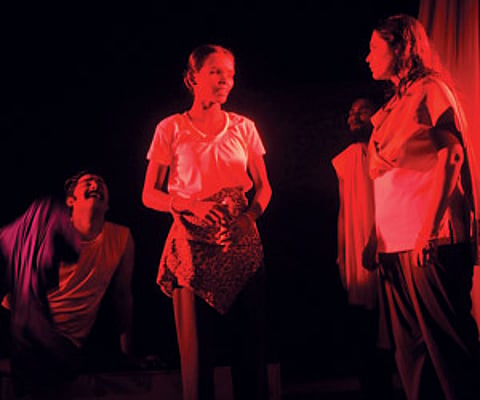
Enter the building that doubles as an office-cum-auditorium, you are greeted to some outlandish performances by actors of Koothu-p-pattarai. The Tamil theatre group is staging its latest production Arjunan Thabasu.
Initially teased and mocked for promoting “a feudal art form”, Koothu-p-pattarai in 30 years has proved its critics wrong by giving a global platform to therukoothu, Tamil Nadu’s street theatre. The difference is that traditional folk techniques get a contemporary twist in its plays. Arjunan Thabasu, for instance, is about the penance of the third Pandava prince to get the potent Paasupatha arrow from Lord Shiva. It essays the challenges Arjuna encounters on his way to the Himalayas in its pursuit.
All the same, the play brings in characters like Ekalavya’s disciples, who try to dissuade Shiva from giving Arjuna the weapon. Here, it’s an uncanny cut to the 21st century as they also speak of the mad arms race among countries of the earth. Without being didactic, the play is rich in satire and provides much food for thought to audience with contemporary interests.
The actors cleverly inter-change characters, thus reinforcing the koothu strain of thought that it’s the characters that matter — not the actors. “Koothu ejects out the actor’s individual identity. Only creativity comes through in their performances,” explains Koothu-p-pattarai’s founder Na Muthuswamy.
The Sangeet Natak Akademi award winner, who is a product of the Little Magazine Movement that changed the future of Tamil literature, got hooked to therukoothu when he watched a Natesa Thambiran play in Purisai (off Kanchipuram in north Tamil Nadu) in the 1960s. “I realised that this must be Tamil land’s prototype theatre. I fell in love with it,” says Muthuswamy, now 73.
“People used to look at Koothu as a vulgar and degenerate art. They made fun of it. Now after we started promoting therukoothu as part of the Indian folk tradition, it has found a lot of audiences in a lot of places,” he says.
Muthuswamy’s first play was Kaalam Kaalamaaga in 1969. It became an instant success and Muthuswamy knew that his mission in life would be to promote therukoothu.
Having come from Punjai, a village near Thanjavur, Muthuswamy expresses angst at city life, the choices modern India makes and the colonial hangover of his compatriots.
These, he believes, have led to the decline of many folk forms. “Take for instance, food. In the villages it’s a very simple, non-fattening meal. Dal and rasam aren’t served daily. But in the cities, we’re used to eating a rich spread that would normally be served in the villages during festivals,” says Muthuswamy.
It is with single-minded passion that Muthuswamy has been pursuing his artistic path since 1977 to recreate a space for street theatre — a space that has been taken over by cinema, TV and radio. The way forward, he’s sure, is give a contemporary look to certain rustic rituals. So, while in the villages the actors would climb a tree to depict a Mahabarata scene, in Arjunan Thabasu they emulate it by doing rope climbing using a satin cloth. Similarly, to denote the power of a woman’s scent, what is sprayed is a deodorant.
Koothu-p-pattarai has also helped to popularise the thudumbu, a percussion instrument used by the tribals in the Nilgiris, peenachi, the pipe music of the Irula tribe, parai, a folk percussion instrument and devarattam, a folk dance.
Another interesting facet of the group is the freedom given to actors to develop themselves and also the play. Initially Arjunan Thabasu was straight and had a totally linear narrative, but the debates at the rehearsals led director Muthuswamy to rewrite the last scene and give the play a more vertical dimension.
Koothu-p-pattarai has 11 full-time actors. New plays apart, the stress is on training and learning new skills. Says Vinodini Vaidyanathan, who left a plush HR job in an IT firm to pursue theatre: “Other groups focus on the final product. But in Koothu-p-pattarai, one constantly improvises, learns what theatre is all about. It teaches you new skills, changes your thought process.”
Many foreign theatre artistes come to Koothu-p-pattari to learn folk theatre under the UNESCO-ASCHBERG programme. The exchange of ideas benefits the Koothu-p-pattari artistes. For
instance, a Costa Rican artiste taught them the rope climbing technique.
The group has produced over 60 plays. Apart from mythological plays like Prahalada Charithram (2003), Koothu-p-pattarai has also given a folksy twist to many foreign productions such as Macbeth (1996).
Financial crunch has forced the group to compromise on grand costumes and elaborate lighting, unlike the therukoothu that one sees in villages. But this is a small compromise to make when one has a bigger goal of bringing audiences to this folk form.
nithya@epmltd.com