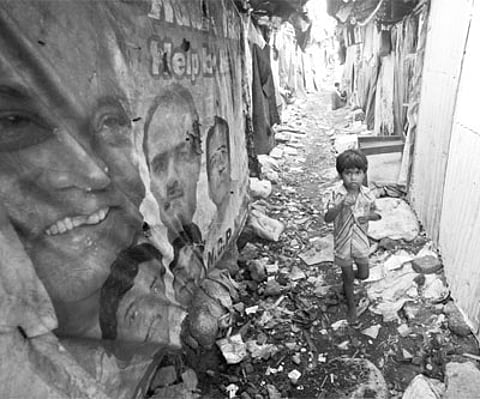

Malnutrition is not confined to the villages alone, but thrives very well in the poorest sections of the urban population. While access to development is prescribed as a cure to the ills of hunger, there are many in the city of Mumbai who are denied this privilege.
Rafiq Nagar 2 is just one of the slums built on the Deonar dumping grounds of Mumbai. Around 6000 metric tonnes of garbage arrives here daily. The scavengers of nearby areas sift through the hills of trash to earn a living.
Layers of plastic make the foundations of homes; old political posters, tin sheets, canvas and cloth make the walls. Discarded condoms litter the pathways.
At one corner, young children sell expired chips covered in swarms of flies for Rs 1 a packet. Most of these packets would have come from the dumping grounds.
Over the last two years, 23 children of Rafiq Nagar 2 have died of malnutrition-related causes or at childbirth.
On September 9, 2009, Munni Hasan Sheikh was refused admission at Sion Hospital for want of space. She went into labour at its gateways. The child died within a few hours of being born. Shamshad Begum lost both her twins, weighing a kilogram each — one dying at childbirth at home, the other only two months later at the city’s KEM Hospital.
Yet, most of the women refuse to go to the hospital. They’re afraid of leaving their doorless homes for fear of being robbed of their measly possessions by drug addicts and delinquents.
Fourteen children died of pneumonia, dysentery and malaria — all were underweight.
The breadwinners work as unskilled labour or as ragpickers and are themselves at the risk of tuberculosis infection due to the high levels of toxicity emanating from the dumping grounds.
Mohammed Mubeen earns Rs 200-250 a day and there are seven members in his family.
Saira Ansari’s two children suffered from malnutrition and her tiny 4’9” frame is symptomatic of one the major problems of malnutrition — that the mothers once were previously malnourished children themselves.
Her eldest daughter, Saina, has now recovered from Grade 3 malnutrition. She was treated by an NGO Apnalaya, that provides nutrition to some 394 other children of Rafiq Nagar 2. There is no ICDS (Integrated Child Development Scheme) here yet.
“I have been working in the slums for 30 years now,” says Leena Joshi, Director of Apnalaya. “Earlier the government was sympathetic to the needs of the poor, and now they ask me why I am helping them.”
“I was asked to stay at home today because we heard the BMC is coming to demolish our homes,” said Mohammed Younis Khan, an auto-rickshaw driver.
The slum is illegal and the constitutional right to a livelihood and to a home belongs to the trash of Mumbai at the Deonar dumping grounds. Most of the tenants of Rafiq Nagar 2 are the landless from Uttar Pradesh and Bihar — the MNS’s Most Unwanted lot.
At the same time, people do not have access to clean drinking water. They have to buy it for Rs 20 a can from the ‘water mafia’, and usage depends on affordability. One woman claims her house has to do with just three cans a day.
Mohammed Alam Hashmi is a landless labourer from Pratapgarh, Uttar Pradesh with habitual complaints against the Thakur landowners who renege on their payments. He has three children, including eight-year-old Zahid Hashmi who lost his eyesight a year ago. He is the only earning member of his family and works as a labourer. His wife now stays at home to look after their disabled son.
Hashmi has to buy him medicines — Ethionamide, Ofloxacine, Kanamycin and Quinoline. The son is also being treated for tuberculosis, another problem endemic in Rafiq Nagar 2. His sister Soni gets nutrition from Apnalaya.
There are only few ration cards in Rafiq Nagar, with a majority of households having applied for a card but have not received anything yet.
Recently, the National Advisory Council, proposed the Food Security Bill, which considers subsidy grains for 75 per cent of the population — categorised under ‘priority’ households and ‘general’ households.
This time, the following entitlements were dropped or diluted from the proposed Act: creche facilities for working women, social security pensions, nutrition supplements for adolescent girls, and ICDS entitlements not already included in the Supreme Court orders.
There are voices of dissent against the act.
“The government always says that it wants to strengthen the PDS, but its actions just weaken it,” says Leena Joshi, who is also involved with the Right To Food campaign.
The campaign has called for universal PDS, the logic being that the rich don’t use the PDS system. The poor do.
Targetted PDS has repeatedly proven counter-productive, as in the case of the people of Rafiq Nagar 2 who don’t have an ICDS or ration cards. They are poor enough to starve, but they are not poor enough to get the government to recognise their poverty.
“Something has to be done,” she says.
Twenty-six-year-old Rafique (name changed) started taking charas when he was eight-years-old. He claims to have been arrested repeatedly for various offenses, from pickpocketing to rape. His father died young and his uncle threw his mother and him out of their Dharavi home.
“I don’t want to scare you,” he says, “but a photographer had come here a while ago. A ‘gora’ (foreigner) whose wallet was full-packed. There was this Bihari boy with me. He decided that we’d take the wallet. We thought it would be full of dollars.
“We picked his pocket, took the wallet and ran. But, there were only tickets in the damn wallet. So we just threw it away.”
Both his arms, from the elbow to the wrists, have numerous scars from a blade or a razor.
Sitting next to him is S, a female alcoholic. Her arms have similar scars. Rafique hints that S sells drugs and alcohol to the slum-dwellers.
“A lot of murders happen here,” he continues. “Someone got murdered even yesterday.”
“Why?”
“Family dispute,” he reveals.
In another part of the slum, a 12-year-old boy cries constantly, while his mother furiously shouts. Soon a crowd gathers.
Apparently a few older boys had beaten up the young boy at the dumping grounds. Reasons will never be known.
The alleged culprits sit at the edge of the dumping ground — six young boys sit under a tarpaulin makeshift shelter, smoking charas
allegedly smuggled in from Rae Bareli, while their neighbour complains discreetly, admittedly afraid, “They harass everyone in the slum.”
“Someone has to talk to them.”
Pushpa, a social worker with Apnalaya tells him that they will send someone who knows how to deal with the boys.
“They’ll give me hell for talking to you,” he confesses nervously.
“Tell them that you were just complaining about the BMC,” I reply. He looks relieved and laughs. He says he likes the idea.
Rafique, meanwhile, has ‘cleaned’ up. He got married a year ago and has a steady job now. He manages to make ends meet, working in a shop, to support his wife and his mother. But then there is the police.
“They still harass me. If anything happens, they show up at my house,” he says. “Even in the middle of the night.”
At the other end of the spectrum is Hamida, a social worker with Apnalaya and a tenant at Rafiq Nagar 2. Her husband is a labourer, while she taught herself to read as a child.
“I used to go to the teachers and force them to teach me,” she says.
She spends her day at the Apnalaya centre, weighing the children, marking their progress, from Grade 3 malnutrition to Grade 2 and then to Grade 1, writing report after report.
She accompanies me to meet the mothers and children of Rafiq Nagar 2 .
We set out specifically to meet people who don’t have ration cards, who worked as informal labourers and whose children were underweight. They are extremely easy to find. They are in the majority here.
“How old is your daughter?” I ask Saira Ansari. “Five,” her mother replies. Hamida instantly corrects her. “No, she’s only four-and-a-half,” she says. The mother laughs. So does Sania, her daughter, who entangles herself in her mother’s dress, giggling. She’s three times her previous bodyweight now, thanks to the NGO’s nutritious food.
Healthy.
— javed@expressbuzz.com