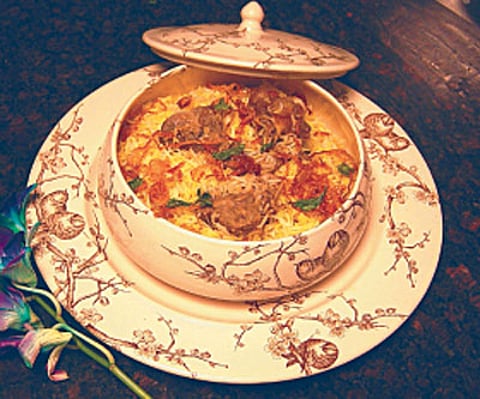

It is almost universally accepted that biryani came to India with the coming of the Mughals but Chef Jacob Sahayam has a different view. Biryani, he says, is basically gravy or curry cooked with rice, and the concept actually originated in Tamil Nadu and especially in the Pandya Kingdom. From there it went to Persia and Southeast Asia where its saw the addition of other fragrant spices like cloves and saffron. This is the version that came back to India through the Mughals.
The traditional Muslim biryani is still cooked in this way, with the rice being allowed to soak in a gravy with the spices and meat, but there are several variations to doing this, most notably the Hyderabadi Dum Biryani where the rice is cooked separately and then layered along with the spices.
According to Praveen Anand, executive Chef of the Sheraton Hotels, there are variations even amongst this categorisation of south Indian style and north Indian style biryani, though usually these are only prepared on request. In the Park Sheraton’s Dakshin only an Andhra style biryani, full of green chilli, is listed but he also makes a Kerala style biryani which is served with a date and lime pickle and a coconut preparation called chamandi.
Some of the more interesting styles that he has attempted, usually for banquets, are the idiyappam biryani or the phikkadi which is rice dumplings with meat and even on occasion, a Hyderbadi style biryani can be prepared with macaroni. Such preparations are usually requested for banquets thrown by Marwaris since most others just prefer the taste of a traditional biryani.
According to Chef Jacob, there are now more convenient ways to make biryani, which allows for some experimentation. There is the pilaf, where the spices are not ground but added as a whole and there is the kadai biryani where the rice and spices are prepared separately and then cooked on a tawa for just a minute. It’s the way in which a housewife might prepare something like a tomato rice but you can also make a mutton rice in this way. Unless it is a speciality restaurant that serves only a particular type of biryani, this is usually the most convenient way and several new ingredients, like mushrooms, for instance, can be combined with rice this way.
The art behind Dum biryani
Did you know that the preparation of the covering of the Dum, is an art in itself. Sous Chef at Chennai’s Courtyard by Marriott, Amit Dash knows it best as the dough used for making puff pastry. The dough is also coated with egg before the biryani is cooked. This helps lock in the flavour of the biryani.
jayantsriram@expressbuzz.com