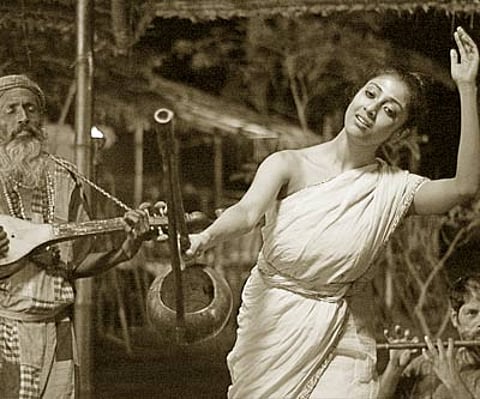

Veteran Bengali film maker Gautam Ghose’s latest effort, Moner Manush, is based on the eponymous novel by Sunil Gangopadhyay. The film won the Golden Peacock award at the
recently concluded International Film Festival of India in Goa. It is a sprawling film, made from a novel that places a unique individual, who came to be known as Lalan Faqir in the second half of the 19th century in undivided Bengal, even then riven by caste, class and religious differences in a unique religio-cultural position in the region. He was then discovered by the enlightened
zamindar and artiste, Jyotirindranath Tagore, elder brother of the celebrated poet and writer, Rabindranath Tagore.
Lalanchandra Kar, a Bengali Hindu peasant with a propensity for composing songs with a mystical import, finds himself in a literally life- changing situation, when he is found almost dead, floating in the river on a bamboo stretcher by Muslim peasants, abandoned by his patron after having contracted smallpox, then a killer disease. The humanity of his rescuers brings him back to life, both literally and metaphorically. He has lost his memory of the past and is eager to embrace the present. At that point, Shiraj Sai, a wandering mendicant becomes his mentor and opens up new pathways to experience the mysteries of human existence. Gautam Ghose’s film grapples with all the pain and dilemmas that dogged Lalan’s footsteps as he sought answers to the meaning of life. It is a gallant though somewhat turgid exercise.
The film is replete with music — there are 23 songs — but the quality of the singing is good without being inspired. That seems to be, at least to this viewer, a problem because a folk song has to sound inspired in its rendering in order to strike a chord in heart of the listener, and viewer. One can say in Ghose’s defence that these days there aren’t too many singers who can render a Baul or a Bhatiali or a Bhawaiyya song with feeling and conviction. This deficiency hardly seems to matter in the film because most of the listeners today have not heard the real music anyway. What is served up in Moner Manush is a passable version of Lalan’s poetry set to old East Bengali melodic folk forms.
Ghose’s film is set outdoors, except for a few night scenes, including a couple on Jyotirindranath Tagore’s houseboat on the river Padma. The songs are performed energetically amidst nature in its changing moods. The result is very pretty, very pictorial. Ghose photographs natural vistas with great enthusiasm and his close-ups call for attention. It is a visual language that will impress contemporary audiences greatly; that he loves to tilt the line of the horizon and photograph great spans of water, much to the chagrin of the purists, hardly seems to matter.
His work seems one-paced. The film is just over two-and-a-half hours long and accommodates a whole lot of information on the man and his life. It is, however short on psychological insights. Why Lalan’s mind opened up the way it did to the contradictions in human behaviour is hardly ever suggested, let alone enunciated. It needs a Goya to suggest a variety of tones within a single colour by varying the pressure on the brush while painting, or a John Ford in cinema to
articulate an inner life while using truly subtle means in depicting the contradictions in its
externals. It would be unfair to expect of Ghose such leaps of the imagination.
Moner Manush is all about the external life of Lalan Faqir, the eternal outsider and his band of followers who wish to build for themselves a just, humane community within the forest where they live. The woods luckily belong to the Tagores, whose scion Jyotirindranath, is seen quite often on his boat doing the octogenarian Lalan’s portrayal. This scene is used to hold the narrative together and also to express all of Lalan’s most critical thoughts.
Lalan and his intrepid followers are shown saving a Brahmin woman from being burnt alive on the pyre of her husband to fulfill the ‘obligations’ of sati. The Brahmins and Maulvis come together in a normally divided religious society, in
order to teach Lalan and his band a lesson. It is lucky that the enlightened Tagores have sat down to hear the case and Lalan and his followers are able to stave off the bigots thanks to the support of these liberal zamindars, aware of Hindu, Muslim, Buddhist and Sikh thought, and thanks to the inroads made by the East India Company, of Jewish and Christian thought too. In addition, they are well acquainted with liberal Western political and social ideas. In a way, it was fortuitous that Lalan found in Jyotirindranath Tagore, a friend and a staunch defender of his conception of liberty and of his reverence for life.
Gautam Ghose does touch upon some aspects of this relationship.
parthafm@gmail.com