
The ornate architecture of a barren expanse of northwest India has graced one of lush-green Kerala’s oldest cities on the shores of the Arabian Sea. With enough drama, a couple of months ago. On May 8, at 11.43 a.m., during the auspicious prana pratishtha puja, members of the Jain community in Kochi got a jolt of surprise. Just 15 ft above the dome of the temple, a helicopter suddenly appeared, its rotor blades making a staccato sound, and at a particular point, it dipped, and rained a shower of petals—rose, marigold, lotus, and jasmine. “The timing was perfect,” says C P Jain, one of Kochi’s leading businessmen. “It was an auspicious moment for us.”
All this happened during the inauguration of the first Jain temple in Kochi, where the Jains have been living for 150 years.
The 2000-sq ft shrine took four years to build—at a cost of Rs 1.5 crore that came from the donations of the community over 21 years. It is made of spotless white marble brought especially from the desert state. “If there was a slab with a single black spot, we would return it,” says Jain, a trustee of the Sree Swetambar Murtipujak Jain Sangh, which built the structure. “More than 40 truck loads were used.” Skilled artisans from Rajasthan were hired to do the designs on the pillars and the walls. “Ours is a close replica of the Dilwara Jain temple on Mount Abu in Rajasthan,” says Mohanlal Jain, one of the seniors in the community.
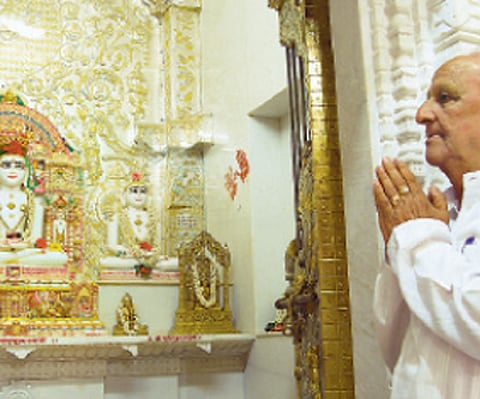
Indeed, there are sharp carvings of a wealthy lady sitting on a chair placed on the back of a caparisoned elephant, as well as three Mangal Murtis, or statues of the gods placed in alcoves in the outer walls of the temple. Inside the sanctorum are three Tirthankaras placed side by side. The main God is Shri Vasupujya Swami, who is the 12th Tirthankara. The statue is made of milky white marble. The god is sitting cross-legged, with a gold necklace and garlands around his neck and red roses on his feet.
Sitting on either side of Shri Vasupujya Swami is the 7th Tirthankara, Shri Parshvanath, and the 20th, Shri Munisuvrat Swami. Behind them, on the wall, are etchings of creepers and of devotees, done in a mix of gold and silver. At one side, on the wall, there are numerous palm prints in red. During the inauguration, people placed their palms in wet kumkum powder and pressed it on the wall.
The doors have silver etchings. On one, there are illustrations of the 14 dreams that Queen Trishala saw, before giving birth to Lord Mahavira, the 24th Tirthankara.