
At 7 am on a summer day, Dutch cultural anthropologist Dr Bauke Van Der Pol steps out of Fort Kochi’s Brunton Boatyard hotel, armed with a 17th century map, and accompanied by a group of visitors. After a few minutes, he says, “According to the map, this is where the entrance to the fort was.” Of course, today, there is nothing to distinguish it. There is an auto-rickshaw stand at one side, a bus stop on the other, and wayside shops selling cold drinks and trinkets. After walking for a while, he points at an elevated section of the ground, and says, “This was where a bastion was located.” A bastion is a fortification projecting out from a fort. There were seven of them at Fort Kochi, connected by a rampart. “Ramparts were 15 feet high and wide,” says Bauke. “So the soldiers, in their blue tunics, could walk on it and observe the people, both inside and outside the fort.”
The Dutch defeated the Portuguese in 1663 and took over the fort. More than 300 years later, many buildings remain the same, including the house of Ivan D’Costa, a former assistant collector in the excise department.
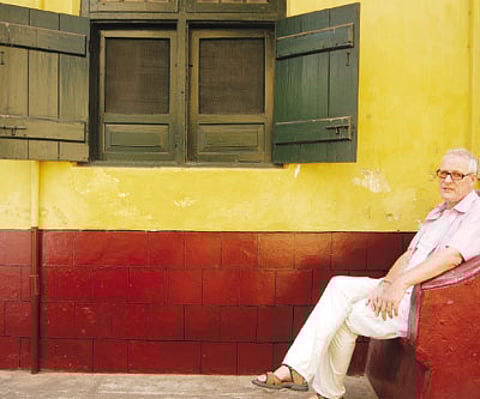
At the outer verandah of his home, there is a cement seat. “It was here that the people would sit in the evenings and gossip,” says Bauke. Inside, rooms have red stone floors, high ceilings, wooden beams and thick walls. D’Costa had another seven-room house nearby. Bauke has a Dutch sale deed of 1760 for it.
David Hall, which was recently restored by the CGH Earth Group as an art centre, was also Dutch-owned. It was in this house that governor Hendrik Van Rheede researched on medicinal properties of local flora and fauna, and wrote a 12-volume book, Hortus Malabaricus (Garden of Malabar) in 1678, identifying more than 700 plants.
Outside, Bauke points at a street sign: Burgher Street. “A burgher is somebody who has been set free from his landlord, and has voting rights,” he says. “The people who lived on this street did not work for the Vereenigde Oost-Indische Compagnie [or VOC, also known as the Dutch East India Company]. They were free men. They made a living on their own and got married to women with Portuguese blood.”
Another road sign evokes mirth. “Princess Street had been initially called Prince Street in honour of Dutch Princes Maurits and Wilhelm,” says Bauke. “But when the British took over, in 1795, they would pronounce Prince Street quickly, so over a period of time, it became Princess Street.”
Bauke halts at another sign: Petercelli Street. “Many people in Fort Kochi ask me who Petercelli was,” says Bauke, with a smile. “I have to tell them Petercelli is not the name of a person, but the Dutch word for parsley. So, this might have once been a vegetable market.”
Suddenly Bauke stops in front of a bakery, which sells bruder, a Dutch bread. It’s chocolate brown and has a sprinkling of raisins. “This is the only shop that makes it,” says Bauke. “And it tastes exactly like the bread in Holland.” But the price is steep, at `100 a loaf.
Bauke came to Kerala in the 1970s and fell in love with the people, culture, and history. Thereafter, he has made more than 50 visits. To study the Dutch impact on India, Bauke did a three-year research at the National Archives in The Hague, Rijksmuseum in Amsterdam, Cambridge University, British Library in London, and Bibliotheque Nationale in Paris, as well as the Asiatic Society in Kolkata. He also visited many places in India where the Dutch had a presence, including Tuticorin, Masulipatnam, Patna, and Surat. The research and travels were made possible by a grant from the Dutch Ministry of Education, Culture, and Science.
The result — a book that Bauke authored on the Dutch East India Company, called The VOC in India. “The book has sold well in Holland, because the history of the Dutch in India is fascinating,” he says.