
A growing tribe of technophiles, artists and small businesses is investing in futuristic printers to explore the soul and potential of 3D, but clearly, the journey has only begun. You hear of people printing ceramic pots, a pizza or even replica body parts directly from computer code. A few days ago, a story about German company Biozoon’s 3D printed food for the elderly made news, proving all it takes is the right kind of ink–ceramic, glass, metal or powder. In India, the prohibitive cost of both the printer and materials like resin (which go from `50,000 to a few crore of rupees), means the ‘makers’ aren’t many. Auroville-based product designer Samvit Blass, who makes 3D lamps, is one of the exceptions.
Blass’ studio in a township near Pondicherry has lighting options made from ABS, a thermoplastic that melts easily. He imports the material from the US. The 34-year-old product designer, who enjoys stretching the limits of his Makerbot 2X 3D printer, started his company LiGHT-FiSH (L-F) in 2009 in Mumbai (where he taught design and animation at Raffles Design International), before moving back to his hometown. “For me, coming back to Auroville and to L-F, which is more than a design company, is to be a facilitator for change. I want to educate students about the process, and about how a small start-up can create quality products,” Blass says.
In the last few years, he has fashioned laser-cut stainless steel and acrylic lamps that have been displayed on alternative platforms like music festivals and developed quite a following among architects. In a few months from now, his Acacia series will be retailed at the craft-based chain, Fabindia, while some other new pieces can be seen at The Road, an upcoming biker bar in Pondicherry. Besides creating emotion-driven products like Eiffel, a laser-cut lamp “inspired by a woman’s form”, Blass is also involved in street light and pool projects. The latter, featuring stainless steel and aluminium underwater lights for pools and ponds, are waterproof up to 50 metres.
Some three months ago, Blass extended his 3D printer experiments to his mainstream work. The additive method of manufacturing (as opposed to the traditional subtractive method) is used here, and Blass knew he could do much with the intuitive and analytical design process. “There is no wastage; we use the least to make the most. I have been passionate about lighting right from school, when I found math, grammar and logic difficult and was diagnosed as dyslexic. Working with materials in Auroville proved comforting,” recalls Blass, who is part German and French. He describes how an education at the Massachusetts College of Art in Boston saw him testing his fluency in the language of shadow and light. Going forward, Blass hopes to work with a CNC machine (the subtractive equivalent of the 3D printer) that “promises ease with larger, more structural creations and is better when working with wood.”
Joining the lamps is a toys line and ergonomic furniture. “We want sustainable, non-toxic toys, which have an artistic and design concept, not injection molded in plastic. I recall playing in Germany with toys that were handed down three generations but now things are designed to last for a specific period,” says the man who can often be seen rummaging through warehouses for materials to upcycle.
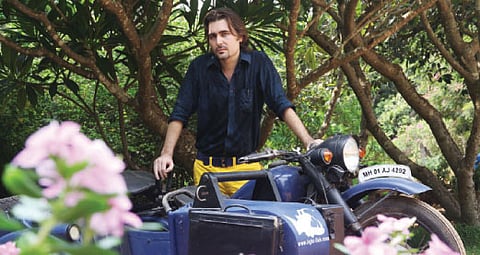
Another regular sight in Auroville is that of Blass on his R75 BMW replica. Lovingly restored by him, and referred to as the ‘Blue Burden’ by his wife Tejas, an Odissi dancer, Blass says it was used by the Chinese military for over 25 years before being sold as scrap. After crossing through China, Vietnam, Laos and Thailand, it is now used on trips across India. In time, the designer plans to convert the 750-cc engine to a bio fuel one. “‘Blue Burden embodies the spirit of LiGHT-FiSH and shows you how good quality design can give you a product that lasts more than a lifetime,” he says.