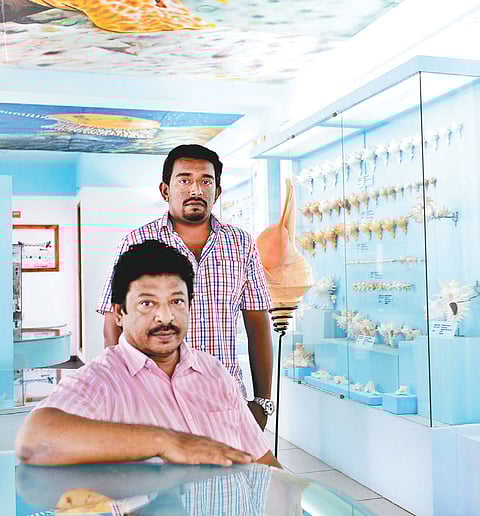

Even more wondrous than the sight of 40,000 different varieties of seashells neatly displayed inside glass cases at the India Shell Museum in Mahabalipuram is the fact that they have been collected from waters across the world by a single man with no academic expertise in marine biology or even a formal education. And that Raja Mohamed even sold off his ancestral property to fund this project reveals his abiding passion.
The museum, some 60-odd km from Chennai, opened in September 2013 and is the first of its kind in India. It has over 2,300 species of shells belonging to sea creatures like clams, sea urchins, oysters, snails, sand dollars, cowries and scallops, among others. The smallest of the shells is as miniscule as a poppy seed while the largest is the 44 cm long Australian Trumpet acquired from North Australia.
Raja Mohamed, who spent 33 years of his life collecting them, started his tryst with shells as a boy, beachcombing for them on the shores of the Indian Ocean near Rameshwaram, his native place. His first shells are from the Pamban islands near Rameswaram collected in 1979. Though his teenage years were marred by poverty and struggle to fend for his family after his father’s death, his passion for shells did not wane.
“I would always eke out a shell or two from fishermen who went to the deep sea for fishing,” says Raja, who spent those years of life as a fish trader. He spent the next two decades adding new shells that he collected during his business trips to different parts of India.
A boom in his business later led him to explore foreign waters. His museum boasts of shells from 60 countries of which Raja has travelled to 13, including USA, Australia, and China.
While the museum has some rare varieties of shells—including the Golden Courie, a piece of which costs about US $10,000, the Spider Conch which is unique for its six fingers and two mouths, the Stone Collector that attracts stones and other shells to its body as part of its defense mechanism and the Birth Maria shell which happens to be one of the four found in the world so far— there are many more with stories of their own.
Some of them are the Conus Geographus, shells which once sheltered poisonous snails; and Oyster shells carrying pearls formed out of tiny sea fishes. A striking feature of the museum is the meticulous display of an entire life cycle of a shell from infancy to adulthood. Regarding classification of shells, Raja is indebted to Antony Fernando, professor of Marine Biology at Anamalai University, who helped him with the nomenclature.
With the museum acting as a magnet for visitors, founder Raja has roped in his sons to oversee a sea food restaurant and a shopping complex Maya Bazaar, that sells everything from chunky bracelets, lampshades, to ornate trees and life-size mirrors—all made of shells. R Mohamed Riswan, who holds a B Tech degree, takes care of the museum, while his younger brother Rafi manages Maya Bazaar. “We plan to tie up with universities to conduct classes for students of marine biology,” says Riswan, who is eager to take his father’s dreams forward.
But for his 53-year-old father, neither age nor an open heart surgery has spelled retirement.
“He is still looking for shells,” says Riswan.