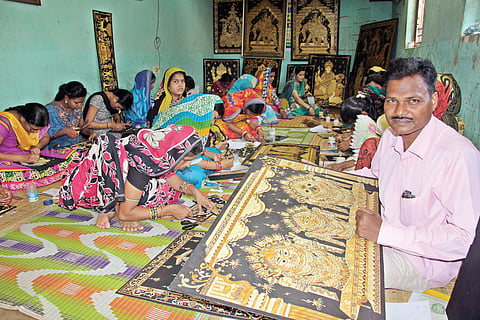

Jirala, a small village in Odisha’s Dhenkanal district, is synonymous with straw painting today. Thanks to the efforts of artist Pradeepta Nayak who has worked hard for the past 25 years to develop the art form.
At the backyard of his house in the village, Nayak carefully selects delicate rice straw strands and separates the dark brown-coloured ones from those having a golden hue. In a small room few metres away, a group of women are creating a massive painting of Lord Krishna playing flute for Radha in a garden replete with blooming flowers. The painting resembles Raghurajpur’s Patachitra (scroll painting), although the medium here is not natural dyes but rice straw. And instead of paintbrushes, the women are drawing with scissors, literally.
Nayak is the lone craftsman in the state practicing and promoting straw painting. Considering beauty of the art form, the Dhenkanal administration has roped in the artist to train others in the craft. At present, he is training 50 women at his Kalyani Straw Craft Centre in the village. In the last 15 years, he has trained at least 200 youths. Twenty-five years ago, it all started as a hobby to create art out of waste.
“The state government recognised rice straw painting as a craft very recently,” says Nayak, who has been participating in all major handicraft exhibitions across Odisha in the past two decades to showcase his craft.
Nayak, who drew inspiration from the patachitra style of painting, says this craft is time-consuming, while demonstrating the tedious process. Each strand of straw is carefully split into two halves with the help of a knife. He then flattens it with a pestle and pastes it on a sheet of an A4-size paper. After drying, the paper is cut into desired shapes and sizes for the straw paintings.
The subject of the painting is drawn on a butter paper, which is then replicated on the straw sheet. The design is then meticulously cut out in thousands of pieces to paste them on the canvas, which is made of thin plywood sheet covered with black velvet. “Since straws are golden in colour, the painting comes out beautifully on a black canvas,” he says, adding that heaps of straw are left to dry in the sun for five to six months before they attain a shiny golden hue.
The subjects of art works are drawn from local folklore, Indian mythology and Jagannath Culture. Sometimes, nature also finds space in the paintings. Recently, Nayak created a life-size painting of the Holy Trinity—Lord Jagannath, Devi Subhadra and Lord Balabhadra—in Nagarjuna Besha (attire), where he painted the deities as warriors seated atop a pedestal in the sanctum sanctorum of the iconic Jagannath Temple. The detailing in the painting would mesmerise any art connoisseur.
Nayak has also created a Kandarpa Ratha (cupid car) in which a group of gopis form themselves into a chariot that their beloved Sri Krishna rides with Radha. In another painting, gopis are arranged in a manner to create an impression of an elephant, with Sri Krishna and Radha seated on top. The subject of his paintings also include farmers working in the fields, tourism destinations and sunset at Chandrabhaga with the world famous Konark Sun Temple in the background.
The artist shows a painting with a scene of a village where farmers are getting ready for a new crop season on the occasion of Akshaya Tritiya. “The Kandarpa Ratha and Jagannath Besha themes are famous among buyers,” says the artist. Nayak dreams of a crafts village tag for Jirala like it has been in the case of Pipli (appliqué craft) and Raghurajpur.