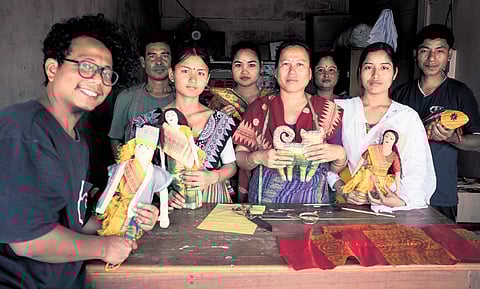

In the tiny hamlet of Rangapani, Assam, a quiet revolution is underway. Kirat Brahma, a former animation designer, is on a mission to bring to light the culture of his native community, the Bodos. His social enterprise, Zankla Studio, creates heritage toys—dolls adorned in traditional attire, animals and birds found in the region—each one representing either a tribal story or paying homage to a prominent figure from the community. So you have Sikhwna Jwhwlao, who fearlessly challenged the British; Upendra Nath Brahma, who is remembered as the father of the Bodo people; or fictional characters like Gowdang Rani, a tribute to regal legacy of the community; and Jarow, who loves to play and eat sweets. There are also animal toys such as a rhino that captures the struggle of the critically endangered species due to poaching and habitat loss.
Though the studio was registered in late 2022, it went fully operational this year in February. “A unique opportunity came my way through Samvaad, a tribal conclave, by the Tata Steel Foundation, which aims to document and preserve traditional knowledge of communities. I applied for the 2022 Fellowships.” It acted as the catalyst for his transformation. “I wanted to use animation as a tool to educate the community children about their folklore and languages,” says the 32-year-old, who created five animated folk rhymes based on the Bodo tradition as part of the fellowship. It further led him to experiment with crafting soft toys. “Animation and the creation of soft toys both involve the art of storytelling and building characters, and this connection resonated with me,” he says.
As Brahma traversed the country due to his work, he keenly observed the prevailing discrimination and lack of awareness regarding people from the Northeast. He decided to return to his hometown and craft a product that would highlight his culture. “What better way to acquaint children than through toys?” asks the NID graduate. “My training emphasises attention to detail, and character design skills enable me to visualise these toys with personality,” he says.
But what truly sets Zankla Studio apart is its commitment to sustainability. The plastic-free toys are made up of dokhona fabric woven by locals. “We are 80 percent eco-friendly,” claims Brahma, who further aims to replace synthetic fillings with cotton or plant-based alternatives. Each product is also thoughtfully accompanied by a pamphlet, which tells the story of the toys. Priced between `250 and `3,500, they are sold on the studio’s website, and social media and e-commerce platforms. So, which one are you bringing home now?