
There is catharsis in India’s real estate sector. The premium housing market has exploded while the middle class finds ‘affordable housing’ a joke, since most of them cannot afford the price tags. Meanwhile, Millennials and Gen Z have a flexible attitude towards housing—some of them stay away from getting a home of their own, and prefer renting even as others see ponying up for a place as an investment.
After a lurch during the pandemic in 2020, luxury housing is driving the market. Mumbai architect Vikas Dilawari, who typifies the educated middle-class Indian, is disappointed. He has spent three decades working on heritage structures and earned numerous accolades. His website lists 18 UNESCO Asia Pacific Heritage Conservation Awards.
He has restored old, classic residences across the country. Ironically, when it came to buying his own house, it was a nightmare. In August 2017, he had booked a 2BHK flat in a Goregaon project, and hoped to move in by 2019-2020. The project, like so many other in the country, stalled due to land issues, transforming what should have been a joyous occasion into a prolonged ordeal.
The rich have got richer from the stock market bull run. Average lower middle-class personal income in 2024 is just `35,000 in metros. The middle class comprises households with an annual income of more than `15-20 lakh. Hence, the average middle-class, middle-income Indian stands no chance of owning a house in a big city without disinvesting savings, taking a loan or selling off possessions.
Millennials and Gen Z in India are either postponing house-buying, or treating it as investment, especially after the pandemic. Karan Kumar, a 39-year-old Google professional prefers to rent a floor in Delhi’s pricey Panchsheel Park, paying Rs 1.5 lakh as monthly rent, which is low for the pin code. He sees buying a house as an emotional decision rather than taking a financial call: his wife is keen to get one.

“If a house is worth Rs 10 crore and I have the same amount in the bank, I can live well even after taxes,” he points out. His age group invests in Mutual Funds a lot. Kolkata-based 32-year-old economist Soumya Bhowmick says, “Residential property values in the top six cities in India increased by 10-15 per cent in 2023, the highest capital appreciation rate in a decade. It is still lower than annual returns from well-performing mutual funds.” Kumar says that many people of his generation live with their parents and know the house or cash, at some point, will come to them.
The reason why the majority of Millennials are either postponing or don’t wish to buy houses is fear of financial instability, preference for flexibility in personal and professional life and delaying marriage. During and after the pandemic, jobs were cut ruthlessly or salaries were halved. “I won’t buy a home because I don’t see a stable financial future. Companies like Google have sacked people ruthlessly; hence Millennials don’t see loyalty to a company worth it,” says Vivan, a design professional based in Bengaluru.
Young families today also prioritise spending on experiences and lifestyle upgrades over saving for long-term goals like buying a house. This means they often don't save enough money for a significant down payment on a home. Says Pradeep Misra, CMD of construction company New Modern Buildwell Pvt. Ltd. in Lucknow, “There’s a major shift in how young people think about owning a home. Unlike previous generations, who saw homeownership as a key life goal, today's young adults value flexibility and experiences more. They want the freedom to travel, explore new opportunities, and not be tied down to one place. The pandemic has reinforced this mindset. Remote work became more common, showing the benefits of being able to move freely. Many young professionals now prefer renting because it allows them to relocate easily based on job opportunities or personal preferences.”
High-rollers have a similar viewpoint but for different reasons. Raunaq Kamath, a successful 38-year-old intellectual property lawyer, who owns his own firm, is of the opinion that “buying a home is a waste of money. It’s better to invest the money and take good holidays when one has the time”. It is not just wallet logic; Millennials travel light: they like the freedom and self-worth that moving cities and jobs gives.
Hence, rent, not buy, is their motto. Gurugram-based Raghav Malik, 30, the founder of creative production house Kaamkhor, says, “The quality of life matters to me more than the assurance of owning property. Staying in a rented apartment can save me a lot of money for other experiences. People my age have an Airbnb hangover. The idea of house-hopping, like bar-hopping, fascinates me more than being a house owner.”
Millennials are also marrying late because they are risk-averse: they wait to have enough money in the bank and feel they are mature enough to take informed decisions about crucial personal issues like getting hitched and buying a home together. Public health professional Sapna Surendran moved to Delhi from Mumbai in 2020, ironically when the pandemic was at its height. In 2017, she had bought an apartment in Bandra. “I hadn’t been willing to put down roots career-wise. But, then I bought my place as a rainy-day house because it gives me a sense of stability. Besides, I was making enough money to cover the EMIs, and it is now a good investment. The rent is covering the EMIs now; so the house pays for itself.”
Middle Trouble: People like Dilawari have no such luck. “It took a lot of time and work to get the place right. Now, the interiors are being finished and we should move in soon,” he says. His decision to purchase the 815 sqft apartment was driven by his living situation at the time. “We put down our savings and borrowed the rest to book our apartment. We stayed in a rental for the last five years,” Dilawari shares.
It was the affordability factor that prompted the family to book in an under-construction project, “since apartments in south Mumbai are prohibitively expensive”. A 1BHK property in Mumbai costs between Rs 80 lakh and Rs 1.5 crore, depending on the location according to tech company MyGate. A 2BHK in the western suburbs is priced at an average of Rs 2.5 crore. This is when the average monthly cost of living in Mumbai of a middle-class working couple is between Rs 30,000 and Rs 60,000. Do the math. According to RBI guidelines, the price for affordable houses should not exceed Rs 65 lakh in metros, and Rs 40 lakh in non-metro areas. These are violated breezily by builders with political connections. As a NoBroker report highlights, the average price for even a 2BHK flat in Mumbai is Rs 1.5 crore. “There is no sense locking your money to buy a house,” feels Karan Kumar.
UHNIs, HNIs, NRIs and industrialists are in love with luxury residential real estate housing segment. Sales of state-of-the-art luxury housing units was up by 27 per cent in the first half of the year. Many Millennials who made money in startups are buying up luxury condos like in Magnolias in Gurugram. People who invest a windfall in real estate need not pay capital gains tax. Others are picking up houses in the Rs 2-crore range in smaller cities as investments. Or, they are buying holiday homes, which can be rented out on Airbnb when they’re not visiting. According to Bhowmick, “Millennials who invest in real estate can establish premium banking accounts in public and private sector banks. This eliminates the need for personal research or trading, offering significantly higher returns than property investments.”
Builders are aware that well-travelled clients identify luxury living clearly. High-end features means higher construction costs and property prices. Juxtaposed against Dilawari’s experience, the widening gap between aspirational living and affordability is clear. According to Karl Nagarwalla, Head of Residential and Commercial Real Estate at Nagarwalla Estates, a leading brokerage in Mumbai, “most buyers today look for buildings with extensive amenities,” he says, adding, “Basic amenities are a gym, swimming pool and banquet halls. However, current developments are pushing the envelope with luxury amenities.
For instance, Oberoi 360 West features a bowling alley, spa, indoor and outdoor pools and a pickleball court, which has become quite popular. The list of amenities offered in new buildings surpass those offered by top sports clubs.” Knight Frank’s ‘India Real Estate: Office and Residential Report’ reveals that 34,895 homes priced above Rs 1 crore were sold between January and March this year, a 51 per cent increase compared to the same quarter in 2023. Conversely, homes priced below Rs 50 lakh saw a decline from 25,714 units in Q1 2023 to 23,026 units in Q1 2024. Sales of homes priced between Rs 50 lakh and Rs 1 crore fell by 6 per cent to 28,424 units.
Luxe no Bar: It’s location, location, location. Lots of open space, greenery or a golf course, if possible, are taken for granted; many condos have become mini cities since malls, restaurants and other services have sprung up around them. Aesthetically premium homes in high-security gated communities have playgrounds, pet parks, lakes, gardens, walking and jogging paths, auto wash facilities and charging stations for electric cars.
Each block has multiple lifts made by premium brands such as OTIS and Schindler. The concierge service is the cherry on top. Smart homes sold by a real estate company in the heart of Hyderabad are equipped with voice commands for indoor appliances like lights, fans, AC, geyser and TV. They have motion sensors for washroom lights, a panic button and gas leak detectors as well.
Bathrooms with heated toilet seats that rise automatically when you enter are no longer a novelty. “In Mumbai, a Rs 2-crore ticket price is considered too low, at least in prime neighbourhoods. Rs 10 crore is a reasonable rate,” says Nagarwalla, who cites an upcoming project in Tardeo. “It offers a two-lane bowling alley, arcade, hammam bath, Vichy shower, escape zone, café, guest rooms, steam room, sports lounge and card table—and a 3BHK here is roughly priced at Rs 9 crore,” he says.
Affordability Crisis: According to the MagicbricksPropIndex Report (April-June 2024), several cities have seen significant hike in property prices. Noida witnessed a 7 per cent quarter-on-quarter (QoQ) increase, followed by Gurugram at 6.8 per cent, Mumbai at 6.5 per cent, Delhi was at 4.3 per cent. These hikes have far outpaced wage growth, putting immense pressure on middle-income budgets.
Such a person is Anish Chandran, a 42-year-old Merchant Navy officer, who is shelling out Rs 1.7 crore, slab-wise, for a 1,000 sqft apartment in Kharghar, Navi Mumbai. Chandran and his wife, Aarthi, decided to invest in a larger home to accommodate their growing family. They combined a home loan with personal savings, 50:50. “Initially, we had intended to move into a pre-existing apartment, but the better projects were all under construction, prompting us to opt for one of those,” he explains.
The Navy man’s situation highlights a broader trend among middle-income families who are looking for better living conditions. Recognising the potential growth in this sector, HDFC Capital Advisors, the world’s largest affordable housing platform plans to invest more than $2 billion in this segment by the end of 2025. Says Vipul Roongta, MD and CEO of HDFC Capital Advisors, “The government has just announced support for building three crore affordable houses, including one crore homes in urban areas. This is a $500-billion business opportunity that calls for investment of at least $100 billion infused through public, private markets and debt.”
All the talk apart, there is no clear definition of what is “affordable” and where. Atul Goel, Managing Director of E-city Ventures, points out, “In Ahmedabad, we see an oversupply of affordable housing, specifically homes priced around Rs 25 lakh. In Gurugram, homes of that price would sell out almost immediately on announcement,” he notes, adding that a one-size-fits-all approach to affordable housing may not be effective, given the varying market dynamics across cities.
Thirty-two-year-old Bengaluru-based pet-care startup founder Sharang Sharma says, “We have seen our parents struggle with loans. One needs a larger capital to invest in buying a house. An increase in financial awareness has made me realise that there are other areas of investment that are more beneficial. Corporate bonds, gold bonds, mutual funds and equities gives better returns than property.”
Floored aspirations: Buyers like Zainab and Hussain in Chennai place a premium on comfort and quality of life. According to PropTiger’s quarterly report ‘Real Insight Residential January-March 2024’, the share of affordable homes, priced up to Rs 45 lakh each, in total housing sales more than halved to 22 per cent in January-March 2024, down from 48 per cent in the corresponding period of 2923. Niranjan Hiranandani, founder and chairman of the Hiranandani Group and chairman of the National Real Estate Development Council (NAREDCO) explains, “High home loan interest rates have increased to 8-8.5 per cent from the previous 6 per cent a year or two ago.”
Meanwhile demand for high-end properties has surged. Delhi-based Learning & Design Specialist Anwesh Patnaik, 29, says, “For the large part of my twenties, I was against the idea of buying a house. Renting felt feasible because it gave you the freedom to move here and there easily. As I approach my thirties, I’m definitely considering stability. And if I own a house, I don’t have to necessarily live there. I can rent it out for additional income.”
Recently, Godrej Properties Ltd (GPL) achieved record-breaking sales in their new project, Godrej Reserve, in Kandivali, offering bookings for flats priced upwards of Rs 2 crore for a 750 sqft 2BHK apartment and upwards of Rs 6.85 for a 4BHK, 2,000 sqft place. The total sales was worth Rs 2,690 crore in a remarkably short period, marking GPL’s most successful launch in Mumbai in terms of both value and volume of sales.
Drawing the Curtains: The change in consumer sentiment towards such homes are driven by rising disposable incomes, changing aspirations, after the pandemic and growing NRI money power. Khilen Shah, of Hubtown, says, “One significant driver is the stock market boom, which has created a new class of property buyers. Consumer confidence has increased substantially after the implementation of the Real Estate Regulatory Authority (RERA), leading to a shift in behaviour, with more people willing to purchase properties in earlier stages of development, especially the ones developed by trusted names. The expanding options available in the market has contributed to an overall increase in demand.”
Tirthankar Poddar, a musician and former corporate executive, who recently moved into a 3BHK in Kandivali’s Lokhandwala Township, cites the need for more space and a better quality of life. “I wasn’t keen on buying a resale flat. The project in Kandivali is brand new and has the amenities I was looking for,” says Poddar, who shelled out Rs 2.25 crore for his new home. While he cherished his old neighbourhood in Charkop, he found the quality of life and access to key hotspots significantly better in the new location. The shift in demand towards higher-priced properties is a concerning trend, since it suggests that the housing market is becoming increasingly inaccessible to a large segment of the population, which will be forced to the margins of the city.
While there are smaller ticket-size projects in Mumbai, with apartments in the city centre priced at less than Rs 1 crore, Shah points out that the high land and approval costs in Mumbai make it challenging for builders to cater to this segment. “Today, interest costs for most projects are one of the largest components after land and approvals. It is difficult to reduce project costs,” he says.
Home may be where the heart is, but the heart is no longer the deciding factor in a landscape of new options and lifestyle attitudes.
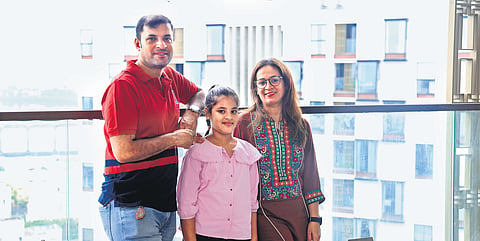
Zaineb and Hussain Pachmeriwala,
who run a family business and a home-based chef service respectively, spent a year and a half looking for a 3BHK apartment that would suit their family of three, which often has guests visiting—their non-negotiable requirements included sufficient space, a building where they felt their children were safe and secure, and proximity to family, all reasonable requirements for anyone. They had allocated a budget of Rs 2.5 crore for this. Eventually, they decided to spend twice the budget
Soumya Bhowmick,
A 32-year-old economist believes that most millenials who can afford real estate investments can also establish premium banking accounts. These digital investment options eliminate the need for personal research or trading, while offering higher returns. They also come with added benefits such as no maintenance or transaction costs associated with property buying and the avoidance of bureaucratic procedures in government departments
Anish Chandran,
A 42-year-old Merchant Navy officer, is in the process of shelling out Rs 1.7 crore, slab-wise, for a 1,000 sqft apartment in Kharghar, Navi Mumbai, in a complex developed by Satyam Developers. Chandran and his wife, Aarthi, decided to invest in a larger home to accommodate their growing family. To finance their new home, they combined a 50 per cent home loan with personal savings, including what had accrued from previous investments
Anwesh Patnaik,
A 29-year-old Learning & Design specialist from Delhi, plans to buy a house in the next five-10 years. Patnaik’s views on investing in property changed in his late twenties. Buying a house means more stability and having an additional source of income for Patnaik
Rahul Bhan,
A 41-year-old IT sales professional used to live in Vasai, Mumbai, but moved to his 2BHK in Balewadi, south Pune, because of the affordability factor as well as the fact that he’ll get better return on his investment. In Mumbai, he would only get a small apartment in Borivali or Kandivali, at the price, but in Pune, he got a much larger place with better amenities. He bought his Pune flat for Rs 1 crore in 2016, and now it’s valued at Rs 1.6 crore
Up, Up and Away
In Delhi-NCR, realty major DLF sold all 795 apartments for Rs 5,590 crore within three days of the launch of its new luxury housing project in Gurugram in May. The new project, DLF Privana West, is spread over 12.57-acre comprising 795 apartments.
Earlier this year, the company had sold 1,113 luxury apartments in Gurugram for Rs 7,200 crore within three days of the launch of its project DLF Privana South, which is spread over 25-acres. The apartments are priced at Rs 6.43 to Rs 7.15 crore for a 4BHK measuring 3,577 sqft and penthouse measuring 5,472 sq ft, respectively.
Lodha Ciel and Lodha Malabar in Mumbai cost Rs 35 crore and Rs 125 crore approximately
Isprava Group properties in Goa, Alibaug, the Nilgiris, and Kasauli typically start from Rs 7 crore and go up to Rs 45 crore
Viceroy Privé, a stand-alone signature residential tower in Thakur Village, Kandivali East, designed for 61 bespoke 4BHK apartments and
5BHK duplexes priced at Rs 8 crore onwards
Aaradhya Avaan by MICL Group, an upcoming project in Tardeo, offers a two-lane bowling alley, arcade, hammam bath, Vichy shower, escape zone, café, guest rooms, steam room, sports lounge, and card table. A 3BHK here is roughly priced at Rs 9 crore
Demand & Supply
Sales of luxury housing units priced at Rs 4 crore and above increased by 27% during the January-June period according to Coldwell Banker Richard Ellis, the world’s largest commercial real estate services and investment firm
Luxury
According to a comprehensive report by Knight Frank India, luxury apartments in Delhi-NCR are characterised by premium amenities, including landscaped gardens, top-tier security systems, concierge services, and opulent finishes. Luxury apartments in Delhi-NCR are priced at a premium, typically ranging from Rs 5 crore to Rs 20 crore
Ultra-luxury
Taking exclusivity, a notch higher, ultra-luxury apartments boast high-end designer interiors, private elevators, panoramic city views, and amenities tailored to the whims of the affluent. Prices for ultra-luxury apartments in Delhi-NCR soar beyond the Rs 20-crore mark. These residences boast bespoke features, personalised services, and panoramic city views
Premium
Premium apartments strike a balance between luxury and affordability. These residences offer modern amenities, well-designed living spaces, and convenient urban living at relatively more accessible price points, typically range from Rs 1 crore to Rs 5 crore in Delhi-NCR
Big and Bigger
● Exquisite blend of Indo-Portuguese design, French-Chateau architecture, and African tribal-inspired accessories
● Carefully curated world-travelled art and decor collectables, evoking a sense of history and nostalgia
● High-speed internet is critical to support remote work and smart apartment features
● Smart lock and keyless entries
● Motion sensors, timers, and automated lights turned on when they’re needed and off when they’re not
● Smart thermostats to adjust temperatures, and smart appliances
● Voice assistance through Google Home and Amazon Alexa
● Indirect lighting
● Stone countertops
● Heated washrooms
● Soaking tubs
● Walk-in closets
● Steam rooms
● Rooftop decks
● Outdoor kitchens
● Separate dry and wet kitchens
● Fire pits
● Screening rooms
● Golf simulators
● Electric car charging stations
Can the divide be bridged
Abhishek Bhadra, Head of Research at MagicBricks, emphasises the crucial role of infrastructure development regarding the affordable housing crisis. He cites the example of the Yamuna Expressway in Noida, which has significantly enhanced connectivity and reduced travel times between cities. “By improving transportation infrastructure, the pressure on high-demand neighbourhoods can be alleviated, as people can more easily commute from other areas,” says Bhadra.
As Abhishek Gupta from CRE Matrix points out, “The problem with Indian real estate is that it's limited to seven metro cities: Mumbai, Delhi, Pune, Bengaluru, Chennai, Kolkata and Ahmedabad,” he explains. We need more metro cities to alleviate pressure on existing ones.” Indeed, addressing the middle-income housing issue could include measures such as:
1. Redefining affordability
As Hiranandani and Bhadra suggest, the current definitions of affordable housing must be revisited to be realistic and inclusive of middle-class aspirations. Raise the price ceiling for affordable housing projects and provide incentives for developers to build more mid-range housing
2. Streamlining approvals
Streamline the currently complex and time-consuming approval processes for housing projects to simplify the regulatory burden on developers who can accelerate the construction of new housing
At the individual level, middle-income homebuyers need to become more proactive in their house-hunting process. As Zaineb and Hussain discovered, “There is a suitable home for everyone, and resale properties are always an option. For new constructions, many payment schemes are available, such as paying the initial booking amount and the rest after possession."
Home Loan Tips
Banks and non-banking financial companies (NBFCs) offer a wide range of home loan products for middle-class homebuyers. But rising interest rates have made a mockery of affordable housing. According to the Knight Frank report, EMIs have surged sharply across top cities over the past year, with EMI-to-income ratios leading to an average 14.4% surge in instalment burdens across cities, forcing middle-class families to tighten their belts to service home loans
Spot the Red Flags
Deals that seem too good to be true: They probably have issues such as water damage, termites or a cracked foundation
Homes located in emerging neighbourhoods
Sellers lack proper documentation or are in a rush
Photos seem heavily edited
An excess of for-sale signs, foreclosures or abandoned lots in the area: These can be indicators of stagnant growth and under-performance
Pest infestation and moldy interiors