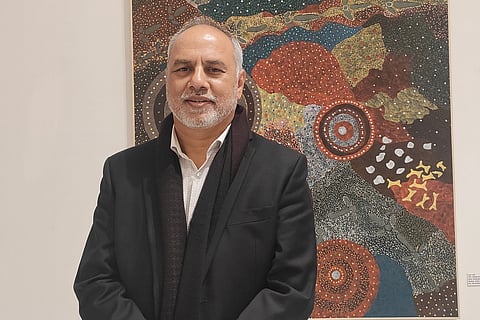

Why can’t tribal art be accorded the same respect and recognition as contemporary art? This was the thought that plagued Sundeep Bhandari and pushed him to set up the Gondwana Art Project in 2019. The collective, which had its first show in 2020, prides itself in shining the spotlight on tribal art and mentoring artists from central India practicing Gond, Bhil, Warli, Sohrai, Kohbar, Paitkar, Kurumba and Baiga art. On the sidelines of their ongoing show, Modern Tribal: Connecting Traditions, at Bikaner House, Delhi, in conjunction with India Art Fair as a parallel event, Bhandari says, “I am trying to blur the boundaries between contemporary and tribal art. I want these artists to create exclusive works.”
The exhibition largely showcases Gond and Bhil painting, while there are a couple of large canvases of Warli art. While both are manifested in folk stories, religion, festivals and rituals with nature playing an important role; Gond is characterised by the use of bright colours and elaborate patterning, and the distinctiveness of Bhil art lies in its use of dots with multiple symbolic meanings.
“I want to explore how traditional crafts can be transformed through modern compositions and styles. At the same time, I want to celebrate living traditions, illustrating how tribal art adapted and thrived in the contemporary world without losing cultural essence,” says the 60-year-old former oil and gas sector entrepreneur.

This year, the collective collaborated with the New England Regional Art Museum, Australia, to discuss the evolution of indigenous art and its coexistence with modern and contemporary art while also exploring the similarities between Indian tribal arts and aboriginal or ‘First Nations Art’ of Australia. The show has as many as 10 Australian aboriginal artworks, which look like an abstract version Gond or Bhil with their use of bright colours, dots and symbolic patterning.
“It is the first time that such a collaboration has been mounted. I am hopeful that it will culminate in Indian tribal artists showcasing in Australia,” says Bhandari. At the show boasting over 60 artworks, a unique segment is by Israeli foundation, Records Manya, which promotes sustainability by using unusable gramophone records to create tribal artworks.
The artworks are priced between `10k and `1.75L. “We want to target the new generation of collectors, hence we have kept the price points affordable,” says Bhandari. In these last five years, the Gondwana Art Project has managed to amp up awareness about tribal art. “Currently, we have 35 artists working with us. The collective pays each of them a fixed remuneration every month, whether works are sold or not. All paintings might not generate the same amount of interest, but the artist should not suffer. He should have the support to give full reign to his creativity,” he sums up.