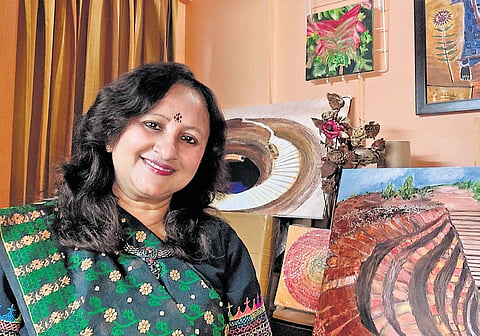

"We do not choose our obsessions, they choose us,” expounds Rashmi Ghosh. In 2022, the 57-year-old artist visited a 17th century stepwell in Karad, Maharashtra, and was captivated by the pattern of its steps, columns and platforms that descended in harmonious order into the earth. It spurred her to document these unique medieval structures.
Ghosh’s obsession led her to more than 40 stepwells in various states, engaging with guides, locals and archaeologists. Her passionate peregrinations culminated in her solo art exhibition held in Pune, Mapping of Stepwells: A Visual Narrative which showcased 20 photographs and 28 in mixed media.
Particularly noted for their beautifully carved walls, stepwells are little-known elements of Indian architecture that entered the Indian travel encyclopaedia about a decade ago. Built between the 2nd and 4th centuries AD, they were born of necessity in regions with capricious climate. Ghosh says, “I want people to be aware of these ancient structures and their vital role in water conservation in the face of climate change.”
Through detailed sketches, Ghosh has explored their formations, progressing from the lowest level to the surface and the fractal geometry with repeated patterns at uniform intervals. “These structures can be classified as linear, circular, rectangular or square,” she shares adding, “The depth of stepwells reflects the water table condition at the time of their construction.

Many of them are adorned with intricate carvings of idols and cultural motifs,” she adds, speaking about the aesthetics of form and function. The Pune-based artist has used natural materials to highlight the maximal nature of the structures; a work in jute fibre depicts the Helical Stepwell of Champaner, Gujarat. Strings visualise the stunning beauty of Lolark Kund in Varanasi.
In Jalasya Saar, Ghosh succinctly portrays the 3,500 rising and falling steps of Chand Baori in Warli art, native to the Thane district of Maharashtra. Aadritya encapsulates the essence of Lolark Kund, whose waters are famous for their fertility and medicinal properties, real or imagined. Perched high above Varanasi’s Tulsi Ghat, the kund emerges within a small plaza encircled by shrines. The towering, slender arch that separates the pool from the well is a testament to its extraordinary design.
Turtles find a place in most of her paintings. “They represent spirituality. During field visits, I spotted turtles swimming in the stepwells of Loni Bhapkar at Baramati, Maharashtra, and that image has stayed with me,” she remembers. She is in step with time, now and then.