
It’s late evening and the sultry Mumbai weather is giving way to a gentle breeze rolling in from the sea. At a musical gathering of Ibtida - Ek Mehfil featuring the renowned Sufi musician Nizami Bandhu in a posh uptown club, guests arrive dressed in traditional wear. They are offered jasmine gajras to tie on their wrists.
The air is heavy with the intoxicating fragrance of mogras, red roses and ittar. Bulky mattresses and long bolsters look inviting and once the guests have picked up their favourite drink from the bar, they relax on the gaddas.
The performance that follows is a captivating blend of qawwali and Sufi songs interspersed with humorous exchanges between the artistes and the audience, elevating the experience to a personal bond.
Almost 2,000 km away, on the serene Ganga in Kolkata, music travels far. Floating down the ancient river, the rich timbre of Kirana king Jayateerth Mevundi’s voice rises in the air in enchanting octaves.
The moon peeps through the clouds, and the audience on the boat is spellbound. Radhika Chopra’s ghazals soar through the stillness of the night - the idea of a musical river cruise is innovatively tantalising.
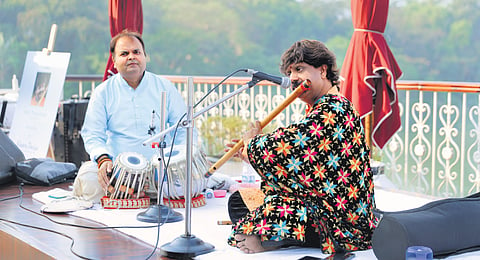
Usha Uthup cannot resist calling out to classical music doyen Aruna Sairam to accompany her on the stage. Next, Shujaat Khan creates magic on his sitar. Hours just go by, no one stirs as the stars shine down on the ship’s gentle passage. Finally, as flute maestro Ajay Prasanna’s morning ragas merge with the sound of bells from the temples on the shore, the melodious experience takes on a new, divine depth.

Media and entertainment professional Mala Sekhri, who brings extensive experience in organising large-scale music concerts from her time with a well-known music label, organised the riverine baithak titled ‘Kinare Dariya’. Approximately 50 guests on board enjoyed performances by the artistes.
“We also floated hundreds of diyas on the Ganges as a blessing for everyone aboard,” Sekhri recalls, adding, “We visited the 108 Shiv Temples in Kalna, West Bengal, where a spontaneous open concert took place with Aruna Sairam singing her Shiv Strotam accompanied by Ajay Prasanna. It was truly magical.” Sekhri is currently preparing for another such luxurious voyage starting in Varanasi this November.
It’s noteworthy that while musical gatherings and mushairas have been a part of Indian culture for years, there is a recent resurgence of interest in this format. What is more, the interest in Indian classical music is yielding intimate experiences for rasikas.
The cultural landscape is witnessing a revival of baithaks and mehfils, performances once considered exclusive to the wealthy. Now small groups of people, both middle class and upper middle class are booking private venues for concerts by well-known singers. Some happen in their homes.
Pramod Kapur, founder and publisher, Roli Books, says, “I see a lot of youngsters attending such classical concerts. There is a renewed interest and appreciation for Indian culture. Also, in intimate settings, the artistes are more accessible.”
Every year, his wife Kiran holds a private memorial concert for her late mother with different musicians. Both established and emerging artistes from across the country are invited to perform at the gatherings.
Some baithaks held by other enthusiasts or private groups are free, while a few of them charge a nominal fee to cover the cost of hosting the event and pay the artistes. The performers are happy to accept an honorarium, even if often much below what they charge commercially.
Social media has been instrumental in disseminating information regarding upcoming gatherings. Many hosts rely on word-of-mouth publicity. Such baithaks, especially home concerts, are creating micro communities of music lovers across India.
Reflecting on the reasons for the increasing popularity of baithaks and mehfils, renowned sitarist Pandit Shubhendra Rao draws on a treatise by Abhinava Gupta on the Natya Shastra. “He writes that an audience is like a spotless mirror - you receive what you give,” Rao explains, emphasising the artiste-audience connection fostered by such intimate gatherings.
“The artiste can literally feel the audience’s breath and respond to spontaneous expressions of appreciation. Every artiste is inspired by an inspired audience. Performing for a larger audience on grand stages offers a different kind of thrill, but the most profound connection is from one heart to another. This is the unique quality of mehfils and baithaks,” he says.
The current phenomenon of private classical music concerts owes its origins to royal India in the latter part of the 19th century when baithaks and mehfils were a common occurrence at the courts of emperors and Maharajas.
“Art thrived through patronage, and mehfils were once a privilege enjoyed by a select few,” says Sekhri. She feels that Indian music was never intended for auditoriums. “Our music has always been meant to be enjoyed in an intimate setting, much like a conversation between artistes and the audience,” she adds.
After the decline of Indian royalty, industrialists stepped in to establish institutions that would preserve and promote music. A prominent Delhi-based industrial family used to hold concerts by musical giants like Ustaad Vilayat Khan at home; one of the family members is an accomplished classical musician himself though he doesn’t perform in public.
Sekhri emphasises that elitism does not reflect the true essence of Indian music. She believes that the current proliferation of mehfils, baithaks and musical soirees reflects the intended nature of our musical traditions, bringing them to come full circle.
Writer and historian Sohail Hashmi recalls that baithaks were a regular occurrence at his childhood home in Aligarh, Uttar Pradesh. Once a month, his father would gather a few of his friends at their residence for an evening of discussions on various topics ranging from politics to music.
In addition to these gatherings, Hashmi also remembers poetry and storytelling sessions held at his home. When his father’s poet friends, such as Vamiq Jaunpuri or Punjabi poet Piara Singh Sehrai, visited, people would gather to hear them recite their poetry.
Over the years, Hashmi has attended similar poetry gatherings in cities such as Bhopal, Jabalpur and Indore. “The democratisation of our performing arts began with the availability of recorded music on All India Radio, which also organised concerts,” Hashmi explains.
Institutions like the Sangeet Natak Akademi in Delhi and the ITC Sangeet Research Akademi in Kolkata started organising public concerts.
Festivals such as the Harballabh Sangeet Sammelan in Jalandhar and the Swami Haridas Music and Dance Festival in Mathura further promoted the cultural traditions of music and dance.
“All of this was part of the democratisation process. What was once exclusive to the elite became accessible to the people. And the baithaks and mehfils you see today are a positive continuation of this trend,” Hashmi says.
Sadhana Rao, a research-oriented writer and curator in the arts and culture field, observes a significant resurgence of interest in baithaks and mehfils since 2021-2022, driven by a growing desire for knowledge and cultural experiences.
“From the organisers’ perspective, they aim to create an aesthetic and artistic expression,” she explains. “Smaller mehfils offer a more personalised space, fostering interaction and a stronger connection between artistes and the audience. That’s what people are seeking today,” Rao adds.
As a young man in his early 30s, Vinod Kapur, now in his 90s, who worked at a Swedish match company in Rae Bareli, happened to visit a fair in Rampur, about 35 - 40 km away. Wandering through the mela, he heard what he describes as “utterly feminine, emotional, and romantic” music sung by a woman. A keen music enthusiast, he was drawn to the singer’s captivating voice. He felt compelled to follow the sound until he reached the venue where the voice came from; the singer appeared to be in her early 30s. He did not know at the time that he was hearing the legendary thumri vocalist Girija Devi singing. Kapur invited her to perform at a club in Rae Bareli where he was a member. She graciously accepted.
During those couple of hours, as Girija Devi sat on the floor and poured her heart into her singing, just a few steps away from Kapur who was also seated on the floor, he felt a profound connection with music that transformed his life in unimaginable ways.
“She instilled something in me that was not just music but also the best way to appreciate it,” he recalls, adding, “The artiste could look me in the eye, and vice versa. The experience is unlike singing in an auditorium. She was singing to an audience, not ‘at’ an audience.”
Inspired by his experience, Kapur went on to host numerous ‘drawing room baithaks’ at his Delhi residence in the 1980s. In 1998, he established the now legendary VSK Baithak, which was held at the India Habitat Centre and later at venues such as the Shri Sathya Sai International Centre and the Ravi Shankar Centre.
Even after the Covid-19 pandemic, Kapur continues to host drawing room baithaks at his farm house in Gurugram. Across all these venues, the common elements are the intimate settings, the proximity between the artiste and the listeners, and the sole requirement for attendance: a genuine passion for music.
A similar inspiration led Tanvi Singh Bhatia to establish Ibtida - Ek Mehfil with fellow music enthusiast Anubhav Jain. Their aim is to take audiences back in time through these intimate gatherings. At their mehfils, not only the music but also the decor, attire and food play crucial roles in creating the sense of nostalgia and a longing for the past. There is the fragrance of ittar and the sweet smell of gajras on the wrists of attendees.
Chandeliers bathe the audience and performers in a warm, golden glow. Bhatia, whose mother is a trained classical singer, describes herself as an “old soul” and believes that the ideal audience for Ibtida - the Urdu word for ‘beginning’ - is composed of individuals seeking a balance between the traditional and the contemporary.
“In today’s world of reels and influencers, I wished to design classic decor and create something that resonates with current trends while retaining its unique charm,” she says. Renowned artistes such as Rekha Bhardwaj, Shilpa Rao, Papon, Harshdeep Kaur and Sonam Kalra, among others, have graced Ibtida’s baithaks and mehfils, which have so far been held in Delhi and Mumbai.
Speaking of Delhi, culture connoisseur Anand Maheshwari founded the self-explanatory group Culturally Active Delhiites (CADs) in 2012. He still gets goosebumps recalling Bharatanatyam exponent Arupa Lahiry’s performance in the living room of one of the member’s residences, with close to 40 enthusiasts jostling for space.
Speaking about the artiste performing in such close proximity, Maheshwari shares that it was an experience to cherish.
Along with Sanjeev Agrawal and Priya Gandhi, Maheshwari founded CADs for “like-minded and like-hearted” people who enjoy cultural activities but are not entirely satisfied by available performances. He describes CADs’ 600-plus member group as an audience collective.
“Our core idea is to become a better audience because we fundamentally believe that art forms will not survive unless there is a good audience for them,” he says.
The baithaks held by CADs have seen performances by several accomplished artistes including vocalist Dr Nabanita Chowdhury, vocalist Padmaja Chakraborty, Kuchipudi dancer Priya Venkatramani, sarangi player Murad Ali Khan and Kathak exponent Mahua Sankar among others. Held three or four times a year at one of the members’ homes, the baithaks have around 50-60 members in attendance who are alerted about upcoming sessions via Facebook or on their WhatsApp group.
With no sponsorship, members pool in the money and raise funds for the logistics and to pay the artiste. “The artistic community has been extremely supportive,” says Maheshwari.
For Lucknow-based musician and dastango Askari Naqvi, there is no better feeling than performing for a small, discerning audience who pays attention to his every word or gesture.
With his partner Madhavi Kuckreja, who started a city museum of culture known as Lucknow Bioscope, Askari, whose roots lie in Mustafabad in Rae Bareli, often organises mehfils at home.
“With 50 to 60 people sitting in a relaxed atmosphere in the living room or the lawn, there is constant conversation, which makes it even more interesting,” he says.
The listeners sit cross-legged on the gaddas while other are on chairs or standing in the background. Naqvi now plans to open an art studio in Malihabad near Lucknow where he wants to invite artistes to perform.
Celebrated classical vocalist Shubha Mudgal, who has been performing at house concerts ever since she can recall in cities such as Delhi, Mumbai and Kolkata, to name a few, agrees with Askari when it comes to the easy rapport established between the performer and the audience at such events.
“Chamber concerts come with a certain sense of relaxed leisure or ‘itminaan’ and are less formal than stage events. Rapport between the listeners and the performer is perhaps established more easily than when one performs on stage, where distance is maintained between the performance space and the audience,” she explains.
However, she adds that requests and ‘farmaishes’ are common in both the performance spaces. “It won’t be possible for me to generalise and say that audiences at baithaks are more attentive. In any situation, whether at baithaks or large-scale concerts, listeners are a diverse kind. Some listen carefully, others may be there to socialise and chit-chat, and also listen to a bit of music. And of course, there are the odd enthusiastic listeners who even break into song, and hum or sing loudly with you!” she adds.
One of the driving forces for classical musician Sukanya Banerjee and her husband Tejas to start hosting monthly classical concerts at their residence in Delhi in 2018, was because she wanted to take classical music out from what she thinks is an insular space.
“The challenge is that classical music is presumed as not meant for the masses. The result is that you keep meeting the same people in the audience and on stage,” she says.
Formerly known as Evening Raag, the monthly concerts at the third floor of their Vasant Kunj home in Delhi are now aptly titled Upstairs with Us. The furniture is moved, and dinner is cooked for more than 40-plus attendees who come from far and wide to enjoy an evening of classical music with the promise of a delicious meal after.
Chandrika Upadhyaya, a Delhi-based advocate recalls stumbling on an Upstairs with Us evening announcement on social media. Being a long-time lover of Indian classical music, she immediately booked two seats for herself and her date.
“From the moment I stepped into Sukanya’s home, I was enveloped by a warm, inviting atmosphere that felt more like a gathering of friends than a formal event. The space was thoughtfully designed, with every corner reflecting aesthetic sensibilities that complemented the vibe of the mehfil. The ambiance was cozy and unpretentious, putting everyone at ease and ready to immerse themselves in the music,” she says.
She recalls a performance by vocalist Iman Das, accompanied by Susamoy Mishra on the tabla and Ravi Pal on the harmonium navigating complex ragas.
“This mehfil was more special for me thanks to the personal connection it fostered between me and my date. It’s one of those cherished memories that still bring a smile to our faces, and attending intimate home-based gatherings has since become a tradition in our relationship. We even think of hosting one together sometime in near future,” she smiles.
For sitar player Sahana Banerjee, mehfils and baithaks were a common occurrence at her Kolkata home with both her parents being classical musicians. When she moved to Pune around 13 years ago, she wanted to create a similar space where like-minded people could interact with each other.
She started Swar Sudha whose subscribers are music lovers, students of music and savants.
The baithaks usually take place at one of the members’ homes. Carpets are laid out and tea is passed around before the performance begins.
“The rapport formed at such small baithaks is to be seen to be believed. There is a tremendous exchange of energy between the audience and the artistes. There is no restriction of time. One can just close their eyes and lose themselves in the music,” says the musician.
Down South, Carnatic maestro TM Krishna has presented 25 sessions known as TMK Unplugged.
“It is an evening of music, reading and conversations. Anyone can invite me to their home and host a session. The idea is to create a safe space where we can listen to music and engage in honest conversations about life, society, people and art,” he says.
Although he does not charge a fee for TMK Unplugged, the audience are encouraged to contribute to Sumanasa Foundation (of which he is the founding trustee). The contributions are used to support marginalised artistes.
Elaborating on the concept of house concerts in South India and the need for more, the Ramon Magsaysay awardee says that he sings at a few such concerts every year. He shares that monthly concerts are held even today at the Chennai home of the legendary musician Musiri Subramanya Iyer. Chamber concerts are a regular occurrence at homes in T Nagar, West Mambalam in Chennai and different cities in Kerala.
In 2018, when Sukanya Banerjee launched Evening Raag (as it was then known then), the decision to charge a fee for attendance created a minor controversy.
“There was significant criticism within the music community, arguing that classical music cannot be quantified,” Banerjee recalls.
Following the pandemic, she increased ticket prices to get fair compensation for musicians, many of whom had lost their livelihoods. In recent times, she holds music appreciation workshops to generate additional revenue and support house concerts.
“The funds can be used to compensate the artistes and cover the logistical expenses,” Banerjee states.
Most organisers agree that putting up such mehfils and baithaks in today’s times are expensive, both in terms of logistics and remuneration. Sekhri is very clear that there cannot be any other way.
“Musicians have to be rewarded for what they do,” she says, pointing out the state of artistes, especially during Covid-19 and related restrictions: “All celebrations stopped. Folk musicians who performed at births and occasions such as mundan, did not have food to eat. These musicians, who have trained in these traditions for years, are our national gems and must be compensated accordingly.”
Harsh Shah, who runs Creative Bloc Party at The Habitat in Mumbai with Adnan Shaikh and Faisal, says the move from free events to ticketed shows has been fairly smooth. The mushairas, storytelling and poetry sessions and kavi sammelans were free for the first three years when they were trying to build an audience.
“The idea was to slowly build an audience for these sessions and from there to become regular attendees. Eventually, we hoped that the culture picks up and they start paying to listen to it,” he points out.
He was pleasantly surprised to find that the struggle to fill up paid seats was more.
“Our efforts towards marketing have paid off because we have built an audience for this. People are willing to support us now because they have seen the standard of the artiste line-up we curate,” he says.
Sanjoy Roy, Managing Director, Teamwork Arts, believes nothing is wrong with ticketed baithaks.
“At the end of the day, artistes still have to send their kids to school, eat, pay rent, fill gas in their cars. ‘Don’t sell art’ is a lot of bullshit. People who have the passion to organise a small baithak, want to invite people but can’t afford it are justified in charging for it,” he says.
Moreover, smaller gatherings provide an excellent platform for younger artistes to show what they are made of, and for audiences to discover new talent. Kolkata-based tabla player Tanmoy Bose reminisces about the 1970s and 80s, when as a young boy, he witnessed senior artistes performing at baithaks alongside younger musicians.
“We, the younger artistes, learned immensely by playing with experienced musicians. It was like an internship, preparing us for the bigger stage. If a senior musician enjoyed my performance at a baithak, they might even invite me to participate in major concerts. This is how many of us got our big breaks,” he says.
In order to revive such gatherings, Bose started Tabla.Inc to organise regular baithaks and invite senior and younger artistes to perform together. At such events, even the audience, many of them emerging musicians themselves, are encouraged to interact with the seniors and ask questions.
With an increasing awareness about the need to preserve our arts, this grassroots revival-of-sorts of the ‘mehfil and baithak’ culture is being welcomed whole-heartedly by musicians, poets and storytellers.
“Baithaks are a beautiful way to share and experience music without amplification and the hullabaloo of a large auditorium. Musicians do not need to play to the gallery or succumb to the usual craving for applause,” says Krishna.
Entrepreneur Tejal Bajla, who has attended three Ibtida mehfils, shares that the community angle adds to the music experience. “Increasingly, we are getting lonelier as a nation and as people. Curations like these with a smaller audience of like-minded people is what sets baithaks apart from large concerts where conversations, with the performing artiste or another audience member, are not always possible,” she says.
The resurgence of mehfils and baithaks offers a refreshing counterpoint to the impersonal nature of life today and fosters a sense of community and appreciation. As a nostalgic reminder of the past, yes, but also as a reminder of the enduring power of the traditional arts person to person.