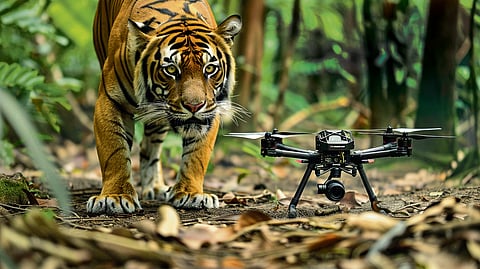

It was burning bright. For three months, a four-year-old tiger roamed across 12 villages in Lucknow’s Rehmankheda area, killing 25 animals and keeping residents on edge in the forest of the night. Daily life slowed as people stayed indoors, wary of the elusive predator that was a ghost with stripes. To track it down, forest officials took a blended approach—mixing traditional tracking methods with modern technology. They installed AI-powered thermal cameras at five key points and deployed three thermal drones to scan the forest canopy. On the ground, trained elephants Diana and Sulochana moved through dense undergrowth where vehicles couldn’t go. Meanwhile, a wildlife expert in Bengaluru monitored live camera feeds, studying the tiger’s patterns to anticipate its movements.
In March, came the breakthrough. AI cameras captured the tiger returning to a fresh kill. A ranger team was dispatched. A tranquiliser dart was fired, but the tiger fled, covering 500 metres before disappearing into thick foliage. Drones followed it from above, helping rangers close in for a second shot. Within 15 minutes, the animal was safely sedated. The 230 kg beast was then caged and transported to the Bakshi Ka Talab range office. The entire operation ended without a single human injury, thanks to the combined effort of AI surveillance, aerial tracking, and coordinated fieldwork.
In the past, conserving wildlife in India often meant navigating dense jungles with binoculars, spending months waiting for elusive animals to appear, or diving into the sea with nothing more than a net. Today, conservationists are adding something new to their toolkit: algorithms, thermal cameras, drones, and even genetic samplers. From the cold, high-altitude deserts of Ladakh to the lush mangroves of the Sundarbans, across coral reefs, tiger corridors, and railway tracks, a quiet revolution is unfolding. Technology is changing not only how we protect wildlife, but how we understand it.
In Ladakh, where the air is thin and snow leopards are more myth than mammal to most, a team of researchers set out to count the uncountable. “Tough terrain and a lack of transport facilities were major challenges,” recalls Pankaj Raina from the Department of Wildlife Protection, Leh. “We carried rations and equipment on ponies and set up temporary camps at subzero temperatures. Some places can only be accessed in winter, when the streams freeze. So, we’d place cameras one winter and return the next to collect them.” Over two years, they trekked more than 6,000 km and installed 956 camera traps across India’s largest snow leopard habitat.
But their real challenge began only after they returned with nearly half a million images. No human team could sort through that volume of footage manually. So they turned to AI. A system called CaTRAT, trained to recognise Himalayan wildlife, scanned each frame to identify species. But something more precise was required. A second programme was deployed, this one trained to analyse forehead patterns, which are more reliable. “Only the clearest image from each sequence was used,” explains Raina. “These were digitised and processed through AI software that scored pattern similarities, creating a photographic library of each individual snow leopard.” The study, published in PLOS One earlier this year, revealed a hopeful truth: snow leopards in Ladakh are thriving. And for the first time, India now has a national photo library of snow leopards—a visual archive that will enable researchers to monitor individual animals.
Far to the south, in the forested corridor between Walayar and Madukkarai in Tamil Nadu, a different crisis was unfolding. Since 2008, 11 elephants had died in train collisions along a single seven-km-stretch of track. In 2024, the Coimbatore Forest Division responded by installing an AI-powered thermal surveillance system. The setup involved cameras that detect heat signatures in real-time, capable of spotting large mammals even in pitch darkness or heavy rain. The moment an elephant is detected near the tracks, the system sends instant alerts to train operators and forest teams. In its very first year, the system generated over 5,000 alerts, enabled 2,500 safe elephant crossings—and recorded zero elephant deaths.
Technology is also transforming how humans coexist with big cats. In Maharashtra’s Tadoba-Andhari Tiger Reserve, AI-enabled cameras were installed on the edges of 13 villages starting in 2023. These motion-sensitive devices don’t just record tiger activity—they analyse it, sending real-time alerts to villagers when tigers are nearby. The system has worked so well that it caught the attention of Prime Minister Modi, who mentioned the effort during the 110th episode of Mann Ki Baat.

Keeping an Eye
In some cases, the key to peace between people and animals lies not in staying alert on the ground, but in rising to the skies. When elephants returned to Gadchiroli district in Maharashtra after decades of absence, they brought fear and uncertainty to farming communities. “We had only heard stories from our grandparents,” says Bhima Potavi, a farmer from Arewada. “Now the elephants were here, in our fields. We were not prepared.” In response, the wildlife rescue NGO RESQCT began using thermal drones. These unmanned aerial vehicles fly over the forest, scanning for body heat and mapping elephant herd movement—even at night or through thick vegetation. The drones collect data that help forest officials predict crop raids, guide elephants away from human settlements, and ease community tension.
Meanwhile, in Gujarat, drones are serving a very different animal. Mugger crocodiles, common along riverbanks, have long been difficult to count. But each crocodile’s back carries a unique pattern of scutes—raised scales that function almost like fingerprints. Researchers from Ahmedabad University trained a machine learning model to identify individual crocodiles by their scute patterns. Using drones to photograph basking muggers from above, they created an entirely new way to study these elusive reptiles. “Wild or free-ranging animals are never easy to study. But that shouldn’t stop us,” says Ratna Ghosal, an associate professor involved in the project. “We need to keep refining and applying technology to gather sharper, more meaningful data.”
While drones offer a bird’s-eye view, a more silent kind of intelligence is rising from the water, soil, and even animal droppings. In the coral-rich waters of Lakshadweep, reef ecosystems are being stressed by warming seas, El Niño events, and human activity. Until recently, reef surveys depended on sporadic diving expeditions. But in 2024, scientists from the CSIR-National Institute of Oceanography conducted India’s first environmental DNA, or eDNA, study in the archipelago. By filtering seawater and analysing the genetic fragments left behind by marine organisms—through skin, waste, or mucus—they identified a wide range of life. The study found DNA from four coral families, nine echinoderm species, 19 fish species, and many kinds of arthropods, mollusks, sponges, and algae. “For years, we only saw what the net brought up,” says Adil, a fisherman from Agatti Island. “Now, they show us lists of species in the seawater. It makes us see how much we’re missing and what we must protect.”
On the eastern edge of India, in the wetlands of West Bengal, another silent threat was discovered. Native fish populations had been dropping. “We always blamed the nets or the weather,” says Shibnath Das, a fisherman from the Sundarbans. “Now we know something else is swimming in and taking over.” That “something else” turned out to be Nile tilapia, a hardy invasive species from Africa. Researchers from ICAR used eDNA DETAILS techniques to detect tilapia by isolating its unique genetic fingerprint. This confirmed the invasive species’ spread across key wetland systems and helped design better control strategies.
Sometimes, the most powerful information lies in the most unglamorous places—like bird droppings. Between 2018 and 2022, researchers from NCBS-TIFR, Bombay Natural History Society, University of Cambridge, and other partners studied endangered vultures by collecting faecal samples across six states. “We focused on places where vultures had been seen recently,” says Moushami Ghosh, now academic dean at the Nature Conservation Foundation. They used DNA metabarcoding, a technique that identifies multiple species from a single environmental sample, to determine each bird’s species, sex, and diet. By layering this data over livestock density maps, they discovered that most vultures still rely heavily on livestock carcasses—even inside protected areas. This is troubling, since the veterinary drug diclofenac, still in circulation despite bans, remains deadly to vultures. The findings offer both a warning and a direction for future policy.
The Right Toolkit
In the parched savannas near Beawar, Rajasthan, the ground crackles like dry paper underfoot. Years ago, these plains were a mosaic of native grasses and hardy shrubs, resilient to drought and integral to the ecosystem. But today, they’re suffocating under a green invader—Prosopis juliflora. The thorny shrub spreads fast, chokes out native species, and alters the very chemistry of the soil. Locals call it a “green curse.” Chetan Misher, an ecologist with the Wildlife Conservation Trust, watched as traditional field surveys struggled to keep pace with the invasion. Counting trees by foot was too slow, too sparse. Then came LiDAR. Mounted on a buzzing drone, the laser sensor fired millions of pulses toward the earth, each beam bouncing back to build a 3D model of the forest—branch by branch, layer by layer. “This level of detail helped us map the vertical complexity and biomass accumulation of Prosopis with far greater accuracy than traditional field surveys,” Misher says. From his laptop, Misher can now see what his boots never could: the dense interiors of Prosopis-dominated patches, the ghosted outlines of native flora beneath, and the subtle gaps where restoration efforts might have a chance. Clearing operations that once swung blindly could now be laser-guided. But he’s quick to add a caveat: “LiDAR’s great at structure, but it can’t always distinguish between invasive and native species in mixed canopies. It’s powerful, but not magic.”
On the other end of India’s conservation spectrum, in the tiger-bearing forests of central India, a different tool is quietly reshaping protection work. At dawn, forest guards gather near campfires with rifles slung over shoulders, water bottles packed, and smartphones tapped open. The app? M-STrIPES—a GPS-enabled digital platform that’s quietly become the command centre for India’s tiger patrols. Every patrol route is logged. Each animal sighting is recorded, even offline. “As a monitoring tool, it’s a great value addition,” says Rajesh Gopal, who spent over three decades with Project Tiger and now heads the Global Tiger Forum. “It’s improved field protocols, tracking patrol intensity, and has highlighted conflict zones, enabling quicker action. It also aids forecasting and alerts,” he adds.
Supervisors back at headquarters track what areas are covered and where gaps remain. One module flags poaching-prone zones; another captures crop loss from herbivores, complete with geotagged photos and severity scores. M-STrIPES has become standard across all tiger reserves—and even in non-tiger regions like Sikkim, where the Global Tiger Forum (GTF) is supporting its rollout. “It needs site-specific customisation and capacity building,” Gopal admits, “but it’s user-friendly, and uptake has been smooth.”
Each Count Matters
While these digital tools track wildlife in the present, scientists are increasingly turning to algorithms to map their future. In the grasslands of India, Nepal, and Bhutan, the elusive hispid hare—a shy, rabbit-sized mammal once considered near-mythical—is finally being seen, thanks to species distribution modelling. Researchers like Imon Abedin at the Indian Statistical Institute combined rare field sightings with citizen-science inputs from Global Biodiversity Information Facility (GBIF) and iNaturalist, then layered in satellite data and climate models. The aim: predict not just where the hare lives, but where it might still survive as the climate shifts.
The result wasn’t reassuring. “Our study revealed that out of the total geographical extent of 1,88,316 sq km, only 11,374 sq km (6.03 per cent) is suitable habitat for the hispid hare,” said Abedin. And under future climate scenarios, even that sliver could shrink by over 60 per cent. The model wasn’t just a map—it was a warning. Other researchers are chasing subtler clues. In central India, the thick sal and teak forests echo with the quiet movement of gaur and sambar. They leave behind little—just droppings and faint hoofprints. But within those piles of dung, molecular ecologist Abhinav Tyagi and his team saw something revolutionary: DNA. “Both species are vital to carnivore habitats,” says Tyagi, who works with the National Centre for Biological Sciences. “But they’ve been understudied, especially at the genomic level.” Using Next-Generation Sequencing, his team extracted and decoded DNA fragments from faecal samples collected across reserves and corridors. The resulting genetic maps revealed a silent crisis.
Gaur populations, once thought to be wide-ranging, were increasingly isolated, hemmed in by farms, roads, and settlements. Their genetic flow—essential for healthy reproduction—was breaking down. Even sambar, known for their adaptability, showed signs of shrinking genetic diversity. “Without reconnection, these forest giants may vanish quietly, long before the forests echo their absence,” says Tyagi quietly.
Sometimes, data doesn’t come from a sample—or even from sight—but from sound. In Assam’s Puthimari village, a unique experiment unfolded in the rice paddies. Some fields were covered with nets to block bats. Others were left open. And through the night, tiny audio recorders listened. Each rustling wingbeat, each ultrasonic click, was logged. The results? Net-covered plots had more insect damage. Bats, it turned out, were unsung pest-controllers. “We used to think bats were just pests,” says Parbati Deka, a local farmer. “Now I feel proud that they visit our farm. Like we’re working together without meeting.”
Researcher Iqbal Bhalla, part of the study, discovered something else. “Most village houses are built with bamboo frames,” he explains. “Each roof has dozens of hollow poles, and almost every home had bats roosting inside.” Those simple bamboo rafters were acting as critical habitat. But as villages shift to concrete, Bhalla asks, “Where will the bats go?”
Meanwhile, from above, satellites sweep across the subcontinent. Using two decades of MODIS data and Europe’s Sentinel imagery, researchers trained machine learning models to predict wildfire hotspots. They fed in topography, vegetation changes, and human sprawl. The outputs were stark: red zones flared across the Northeast, Uttarakhand’s hills, and the core of the Deccan plateau. For Lakshmi Bai, a community fire watcher near Kawal Tiger Reserve, the tech maps are early warnings. “Now we know that in these parts, one spark is enough,” she says. “When fire season starts, we cut back the Lantana and keep buckets ready—we’ve learned not to wait.”
Faltering and Falling
Still, for all its promise, technology in the wild stumbles. Thermal cameras overheat. GPS collars go dark. Drones stall mid-air. And far too often, tools fail because of poor connectivity. “Weak satellite signals can lead to missed locations or failed uploads,” says Supratim Dutta, a conservationist working across the central Indian belt. “And low battery life limits how long we can track.”
Even behaviour changes. Low-flying drones altered the basking patterns of gharials. Sensitive species sometimes flee, hide, or shift their routines. And when tech breaks, few can fix it deep in the field. A global survey by WILDLABS, gathering voices from 37 countries, found three recurring pain points: unsustainable funding, poor coordination, and lack of technical capacity. Misher doesn’t mince words: “The high cost of the technology and the lack of technical capacity are major factors limiting its broader adoption.”
Training is another weak link. Tools like metabarcoding generate mountains of data—but without skilled analysts, they sit unused. “Robust inferences still require sound ecological knowledge and rigorous study design,” says Ghosh. “The data is only as good as the questions you ask.”
And then there’s trust. Communities sometimes see new tech as an outsider’s tool, imposed without dialogue. “Tech should support our instincts and knowledge, not replace them,” says Dutta. Gopal agrees, “In tiger reserves, traditional tracking continues alongside tech tools under Phase IV monitoring, so nothing is lost.”
The future, most experts believe, must be hybrid. In Tamil Nadu’s Walayar-Madukkarai corridor, herders like Muthusamy don’t need satellites to know when elephants are near. “We always knew where they crossed,” he says. “We’d move our cattle, warn each other, and give them space.” Today, his instinct is backed by real-time alerts and camera traps. He shrugs. “It helps. But we still watch the signs.”
In Jharkhand’s Mahuadanr Wolf Sanctuary, tribal communities protect steep sal-covered slopes without drones or apps. Their customs—limiting access in winter, letting the forest rest—mirror the goals of modern conservation. Wolves den there, quietly. And technology, when used, only confirms what the community already understands: that protection begins with belonging.
Race against time
Nearly 40 per cent of bird species in India have declined in just a decade, according to the State of India’s Birds 2023 report. Vultures, once wheels of the sky, have plummeted. Between 2002 and 2022, white-rumped vultures declined by 67 per cent, Indian vultures by 48 per cent, and slender-billed vultures by 89 per cent, according to WWF.
“It’s not just about conservation. When one species goes missing, the ripple effect is felt across the entire ecosystem,” says Anjana Singh, an ornithologist in Jaipur, who studies the Bustard in Rajasthan.
Even the forest floor is changing. Invasive species like Lantana camara and Prosopis juliflora, once introduced during colonial times, now choke the undergrowth. WII’s studies show that Lantana covers up to 40 per cent of tiger habitat today. Native grasses vanish, and with them, the prey.
Technology is tracking those changes too—mapping plant invasions, logging habitat loss, and predicting future shifts. From 2015 to 2020, India lost over 6,68,000 hectares of forest each year, second only to Brazil.
And the heat is rising—literally. In Uttarakhand, forest fires burn hotter, longer, and harder to control. In 2005, India had 8,400 forest fire alerts. By 2021, that number had jumped to more than 1,04,000. Satellite images once used for weather reports now pinpoint fire fronts. AI algorithms crunch wind data to predict the next outbreak. “The wind shifts fast now, and the grass catches fire like paper. We dread the fire season. Once it starts, it never really ends,” says Meena Devi, a forest watcher in Almora. Even in cities, tech is at work. Machine learning helps classify bird calls in urban forests. Bioacoustic recorders pick up frogs, leopards, or hornbills long before humans notice. High-resolution imagery tracks mangroves inching back—or disappearing entirely.
Yet the threats keep scaling up. Between 2019 and 2024, 2,727 people were killed in elephant encounters, and 349 in tiger attacks. Wildlife, too, dies in collisions, electrocutions, or poisonings—like the tigress and her four cubs found dead in Karnataka’s Male Mahadeshwara Sanctuary in June.
In response, conservation is no longer left to chance or instinct. India has pledged to conserve 30 per cent of its land and water by 2030, aligning with global biodiversity targets. The ambition is clear. But what shapes success now is speed, intelligence, and precision. Gone are the days when protection meant patrolling with a stick and a notebook. Today, it means networks of sensors, gigabytes of satellite data, and algorithms humming through heat maps. It means scientists building models, forest guards scanning QR codes, and drones flying night missions. It means telling the story of a tiger—or a bird, or a tree—not just by seeing it, but by measuring every step it takes.
In this new age, conservation is a choreography of movement and memory, of habitat and habit, guided by tech that listens, learns, and leads. It’s not magic, it’s data. And it’s giving wild hearts a way home.