
There are two things I remember distinctively in my great grandmother’s house—a red oxide floor, gleaming like water, cool and unmarred by tile-style boundaries, and a squawking parakeet in a cage next to the kitchen.
The parakeet, large-headed and loud-voiced, would often be provided with scraps or whole food—chickpeas, chilies, fruit, vegetables. He would in turn feed the family with his wisdom—words and phrases, some decidedly undecipherable. In the unbearable humidity of Bengal, I’d lie cheek-pressed to the coolness of that water-like floor, looking at the parakeet.
My great grandmother cooked for everyone. Perhaps the parakeet was the only creature that did not receive her cooking, but she loved him the most.
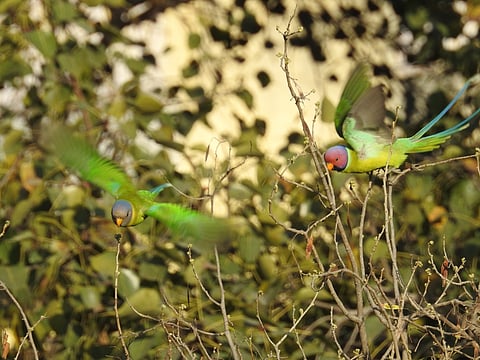
As we grew older, we learned parakeets are wild animals and are best left in the wild. The pet trade in parrots and parakeets—whether Indian species (which is illegal), or foreign species (legal, but only with permits)—masks a cruel trade in which birds are snatched from the wild, or kept in terrible conditions before sale. As an adult when I went birdwatching, parakeets effortlessly grabbed my attention. Rose-ringed parakeets are found in many parts of the country, and are loud and jaunty. I still haven’t seen one fly without crying out lustily to all the world, announcing its flight. Alexandrine parakeets were for some years on the red list as a Near Threatened species. The Plum-headed parakeet has a melodious tui-tui call, and the male possessing a grand head which is the colour of a ripe plum. Smaller than Rose-ringed or Alexandrines, I have spent many happy hours watching Plum-heads, which are smaller than Rose-ringed and Alexandrines, perch on the tips of peepal tree branches, feeding off purple peepal figs, ripe and just correct for eating.
And if you’ve ever sat under a tree and pieces of fruit have rained down on you, you can know without looking that it is the work of a parakeet. A Rose-ringed for instance will swallow a couple of bites from a guava, and then take great mouthfuls of the rest and spit them out with great conviction. This is great for germination of new trees, but may not be amenable to keeping your hair clean in case you are sitting under the tree.
Watching parakeets, it is easy to understand why people have coveted them as pets. The birds are electrified with energy and a zest for life. They squawk, they jump, they hang upside down, they groom each other, and then they squawk some more. Yet not everything beautiful should be possessed.
Wild animals are always better off in the wild. Apart from the cruelty and naked commerce of wild animal trade, wildlife’s needs can never be met in captivity. And our wild animals are still under threat from trade—whether as live animals or as animal parts. A female tiger poacher, who Interpol was on the lookout for, was apprehended in India this month. And recoveries of tiger skin and bones mean that people still covet wild animals, wanting to borrow their charisma.
As I jot down this column today, I see a Plum-headed parakeet hurtle through the evening sky, heading for its roost and leaving a trail of tui-tuis in its wake. I remember the little girl I was, looking at a parakeet, and am glad a cage no longer bars my vision.
Views expressed are personal
