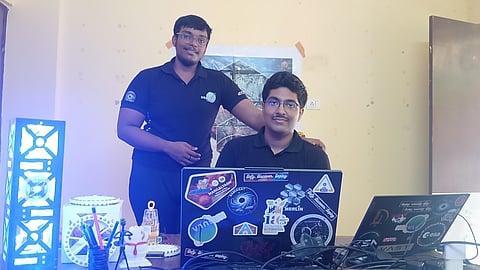

While most 14-year-olds were navigating adolescence through video games and schoolwork, Snehadeep Kumar was already charting a course for the stars. Today, at just 21, he and his business partner Mohit Kumar Nayak are developing shoebox-sized CubeSats in their lab in Bhubaneswar—marking India’s first student-led initiative to detect gamma rays from space. “Our research shows we can reduce the cost of billion-dollar satellites by about 98 per cent at an almost similar accuracy,” says Snehadeep, who is also the youngest Indian in history to be elected a fellow of the Royal Astronomical Society. Their findings, presented at the prestigious International Astronautical Congress, have piqued the interest of ISRO.
Snehadeep’s fascination with space began early—inspired by Discovery Channel documentaries and a science encyclopedia that was given to him as a gift. Yet, it wasn’t a telescope or lab experiment that shifted his path but a humble school science project involving drumstick (moringa) seeds in Class 9. “I was working on a project involving the use of drumstick seeds for water purification,” he recalls. “I showed it at an exhibition hosted by SRM University in Kolkata and then at another exhibition. One of the teachers there suggested that I publish such research works.”
But publishing research as a student was nearly impossible. “You usually need a PhD or formal credentials for that. So I started wondering—If I’m facing this barrier, how many others like me must be going through the same thing?” That realisation led to the creation of Aurora Academic Journal in 2021—a youth-led, interdisciplinary platform where students across the globe could publish original research without the gatekeeping of institutional pedigree. Within a month, Aurora had grown into a 40-member team across more than a dozen countries.
Despite Aurora’s success, Snehadeep couldn’t shake a nagging thought: the very field that inspired him, astronomy, was largely inaccessible. “You can’t just log in and use Hubble or the James Webb Telescope,” he says. “There’s a rigid hierarchy. You need to finish your PhD, do a postdoc, publish for years. By the time you’re 45, maybe you get access.” So in October 2021, he launched Nebula Space Organisation, a collective of students working to make space research more democratic. But the turning point came in 2022, when he met Mohit, a Computer Science student at KIIT University in Bhubaneswar.
We met in the hostel bathroom,” Mohit laughs. “I was stepping out just as he was walking in. We struck up a conversation, then started visiting each other’s rooms. The ideas flowed naturally. He told me about a project he was exploring, and I realised I had a similar interest in space. I said, ‘Yes, I’m in. Let’s build something together.’ That was the beginning.” Today, both are in their final year—Snehadeep studying Electrical Engineering, and Mohit leading as Managing Director—working to bring their CubeSat dreams to life.
Their CubeSat project promises high-efficiency data collection at a fraction of traditional costs. “The research is done—we’ve completed that phase,” says Mohit. “We’ve developed a discovery related to gamma-ray burst reduction in CubeSats. The prototype is ready. Now we need to move on to the practical implementation.” But building space tech isn’t cheap. “Space-grade components can cost up to `10 lakh each,” Mohit explains. “So we try to build what we can in-house. An onboard computer that might cost `10 lakh—we can build one for `10,000.”
Support has come in part from family: Snehadeep’s father, Tushar Kanti Kumar, a Durgapur Steel Plant employee, and his mother, Ritu Kumar, a homemaker, have funded his early conference trips. But to scale, they now seek pre-seed investors. Guiding them are global mentors: Dr Gerard ’t Hooft (Dutch theoretical physicist), Dr Robert Lefkowitz (Nobel Laureate in Chemistry, 2009), and Dr Tom Welton (former president of the Royal Society of Chemistry). “They could sense we had a mission,” he explains.
Dr Salazar, retired NASA lead engineer, is now an official advisor, along with informal mentors like Dr Welton and Dr Hooft. They’re currently working to formalise a full advisory board.
Mohit’s journey carries its own weight. After losing his father to a brain stroke in Class 11, his mother, Padmalaya Nayak, became his strongest support. “I’m the kind of person who thrives on doing things that haven’t been done before,” he says. “I wanted to study abroad, explore new disciplines. But when that didn’t work out, I needed to find something equally meaningful here.”
One of their long-term goals is to tackle space debris. “Each time a satellite is launched, junk remains in orbit,” Mohit says. “A single shard of metal can collide with an active satellite or crewed shuttle and trigger disaster. We try to clean up our terrestrial waste—why not space? It’s the only home we’ve got.”
Ultimately, their vision goes far beyond startup metrics. “Maybe a university student wants to study space, but lacks funding. We want to create that opportunity. We want to empower the dreamers—the child who looks up at the sky and imagines being there. We’re not just building a company. We’re building an ecosystem,” they say with quiet determination.