
Narayani Basu’s biography of KM Panikkar, A Man for All Seasons, sheds light on a key player in the story of Indian Independence who, despite being at the center of events during a crucial period of history, remains an obscure figure. It was not for want of trying, as Panikkar was a towering intellectual and a colourful personality in his day. He was a strident editor, Gandhi’s emissary, academic, diplomat, constitutional lawyer, politician, and man of letters.
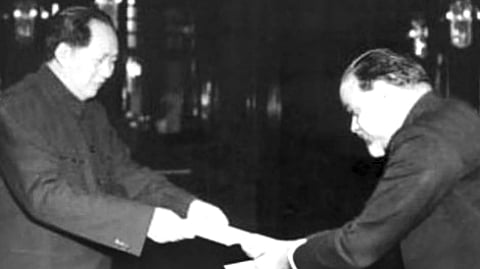
The founder of Hindustan Times, he made waves during his tenure as Nehru’s ambassador to both Nationalist China and the People’s Republic of China, and later as a member of the States Reorganisation Commission. Having lived through the British Raj, the framing of the Constituent Assembly, two world wars, and the Cold War, Panikkar’s life was anything but dull, marked by encounters with Gandhi, Jawaharlal Nehru, Sardar Patel, Chairman Mao, and even Benito Mussolini (whom he admired!).
Basu reconstructs Panikkar’s life and times with respect, reverence, and intricate detail. The book makes for an engaging read, bringing alive action-packed chapters from Indian as well as world history. His was a life of privilege, and one can’t help noticing that despite his initial lack of scholarly aptitude, repeatedly failing his matriculation exams, and even attempting suicide, Panikkar’s generational wealth and family connections opened rare opportunities that launched him into a high-flying, globe-trotting life. Yet his own intellect, ambition, and work ethic carried him far beyond that privilege.
While Basu’s admiration for her subject is clear, she doesn’t gloss over his flaws. She highlights Panikkar’s capacity to aggravate even his admirers with arrogance and provocation, while still managing to earn the grudging respect of his harshest critics. As a reader, one feels both impressed and exasperated, particularly at his work with the Princely States and the cartoonish, often villainous royals he served in high-ranking roles.
While Nehru and Gandhi languished in prison and Bhagat Singh faced the gallows, Panikkar was comfortably serving petty princes whose loyalty to the freedom struggle was largely absent. He himself wrote, ‘They were under the impression that this technique of toadying would induce the British to perpetuate their autocratic rule.’
His stint as India’s ambassador to China was even more fraught, a litany of diplomatic blunders that saw India’s interests undermined and its relationship with China damaged beyond repair. Nehru, though privately frustrated by Panikkar’s errors, continued to defend him in public. The result was disastrous: India’s betrayal of Tibetan interests, China’s rejection of the McMahon Line, and the loss of territory in the North-East and Ladakh. Patel’s reaction was telling: ‘Our Ambassador has been at great pains to find an explanation or justification for Chinese policy and actions… there was a lack of firmness and unnecessary apology in one or two representations that he made to the Chinese Government on our behalf.’
As part of the SRC, Panikkar argued for regional identity and linguistic demarcation while also writing and speaking about not just a Hindu Rashtra but a Hindi Rashtra. Basu insists that his position was an intellectual and philosophical one, and he was not in favour of militant Hindutva ideals. However, Panikkar still comes across as someone better at theorising than acting, not quite the “man for all seasons” as the title claims.
In the end, what emerges is an authoritative portrait of not just a remarkable, if flawed, man but the country he served as well. Through Panikkar’s life, we see India’s communal and sectarian fault lines laid bare. We can feel the bitterness seeping into his words: ‘The lesson that I drew from it was that with the generality of people in times of peace, narrow parochial interests count for much more than broad national interests.’
A sad truth. Panikkar made it clear that regional identity and aspirations ought not to subsume the larger Indian identity and get in the way of national unity. For this sentiment alone, the man deserves admiration and respect.
