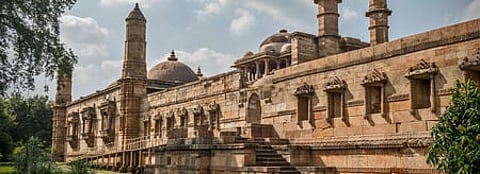

When my young, beautiful, and talented dancer friend, Arupa Lahiry, the Regional Director of IGNCA, invited me to the e Champaner-Pavagadh Heritage Festival 2025, I was over the moon. Why? Primarily because I had always wanted to visit Champaner. I first encountered Champaner through two photographic exhibitions many years ago at the India Habitat Centre—one by Karan Grover and another by bureaucrat Varun Maira. What stayed with me was the profound sense of syncretic culture—the layered coexistence of Hindu and Muslim traditions—that Champaner seemed to embody.
Over the years, Champaner kept resurfacing in my cultural memory. While writing my book on Devi and Her Avatars, I devoted a chapter to the Devi of Pavagadh, identifying the site as one of the Shakti Peethas, also mentioned in my book The 51 Shakti Peetha. Upon arriving in Champaner, I was not disappointed. The moment I entered the spaces where the academic sessions and the Heritage Festival were to unfold—beginning from the ramparts of the Champaner Fort precinct—the setting established a dialogue between history, architecture, and contemporary engagement. The architectural ensemble anchored the festival’s programming with remarkable sensitivity. The Baradari, where Gauri Diwakar later offered a glimpse of her Kathak performance, and the Kevada Masjid precinct, where the morning academic sessions were held, revealed how thoughtfully the festival had been embedded within the architecture.
Historically, Champaner flourished as the capital of the Gujarat Sultanate during the late 15th and early 16th centuries under Sultan Mahmud Begada. The architecture of this period reflects an elegant synthesis of Islamic spatial planning with earlier Hindu and Jain craft traditions. Following the morning sessions, we moved into conversations that were centring and beautifully conceptualised by Lahiry. The half-day seminar held at the Kevada Masjid precinct brought together an interdisciplinary range of discussions on heritage futures, public engagement, hospitality, community stewardship, archaeology, memory, and the reconstruction of historical narratives. The seminar positioned scholarly dialogue in direct conversation with the architectural and historical fabric of Champaner-Pavagadh.
Seeing Diwakar dance was an immersive experience. Her Kathak responded sensitively to architectural thresholds, arches, and spatial rhythms. Equally compelling was the Dastangoi performance Dastaan-e-Champaner by Sukrit Sen and Palash Chaturvedi, staged near the water bodies of the site. As the day progressed, workshops and student-led engagements unfolded across the ASI Office Sarai and Teen Kothri. Traditional practitioners conducted hands-on workshops on Pithora painting, bead-making, and Mata ni Pachedi, while tribal communities from Chhota Udaipur demonstrated indigenous skills including archery.
We must know the past to understand the present and plan for the future—and this is precisely what the Champaner-Pavagadh Heritage Festival achieved. Through movement, music, scholarship, craft, and collective participation, the festival presented Champaner-Pavagadh not as a static archaeological park, but as a living cultural landscape. It was particularly enlightening to witness the work and perspectives shared by scholars and practitioners, alongside insights into heritage-based initiatives in places like Murshidabad, and to see how these conversations were grounded through workshops conducted within the historic spaces of Champaner-Pavagadh itself.
