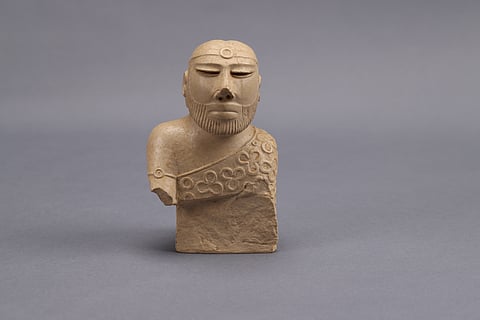

Have you heard of a study gallery within a museum where 20 universities are invited to devise their own curriculum based on a collection? Well, I, for one—an avid goer of museums big and small—had not. It was therefore an unusual surprise when I first heard of this concept by the Director General of the Chhatrapati Shivaji Maharaj Vastu Sanghralaya (CSMVS), Mumbai, Sabyasachi Mukherjee. Over the last decade, I have followed his vision closely, ever since he organised the insightful exhibition India and the World, which traced India’s global networks through significant archaeological objects. This same vision is evident in his latest initiative—the opening of Networks of the Past: A Study Gallery of India and the Ancient World, which opened on December 12, 2025, and will be on view for three months at the CSMVS, and is supported by the Getty Foundation.
The opening of the Ancients Gallery, with the perceptive exhibition is an eye-opener for any museum visitor. It not only introduces viewers to the timeless beauty of Indian objects but also communicates the significance of archaeological finds as symbols of society and culture. The new Study Gallery, as the Ancients Gallery is called, presents a re-envisioning of India’s place in a global context. “Its narrative traces key moments in the human journey, from the earliest farming communities to the first expressions of governance, law, belief, and artistic imagination. The journey culminates at Alexandria and Nalanda, two radiant centres of learning, which remind us that the human quest for knowledge and understanding is both timeless and unending,” says Mukherjee in his brief, clear, and succinct introduction.
Fine specimens of art within sophisticated vitrines beckon visitors closer, inviting them to view, absorb, and inhale their beauty. A sandstone Mother and Child from Mathura (2nd century CE) from the National Museum, New Delhi, is placed near a miniature wine jug in red clay (early 4th century CE) from the Staatliche Museum, Berlin, adjacent to a painted limestone stele (2nd century CE) from the British Museum. Through the juxtaposition of such fine pieces, cross-cultural storytelling unfolds.
The exhibition transports you back 5,000 years, into the world of the Harappan Civilisation, which flourished along the rivers Indus and Ghaggar-Hakra and the Arabian Sea. The gallery guide released at the opening serves as a key to unlocking these treasures. As the guide notes: “Though the script-like signs of the Harappans—inscribed on steatite seals and pottery—remain undeciphered, material remains from the Mature Harappan Period (2600-1900 BCE) reveal their skill in agriculture, crafts, metallurgy, and trade.” The ancient Sumerians, who lived along the rivers, knew them as the inhabitants of Meluhha.
The richness of the collection can feel daunting—almost overwhelming. Featuring nearly 300 artworks drawn from six international and 14 Indian museums, the exhibition is a veritable moving feast. What personally impressed me most was the inclusivity of the project. From dyed-in-the-wool academics and aspiring scholars to informed regular museum-goers and aspirational “know-your-heritage” enthusiasts, the exhibition offers slices of history that are deeply revelatory.
Two clear ideas emerge from the curatorial vision: to inform visitors of the wonder that was India, and to celebrate the enduring legacy of the Harappan Civilisation. As the guide aptly urges: Explore the Past to Understand the Present and Save the Future.
