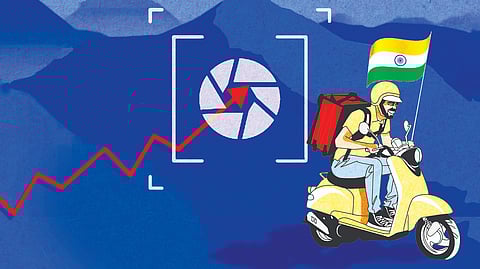

The Davos meeting has once again become a stage for a grand performance that costs the Indian taxpayer dearly. This January, the world witnessed the familiar sight of Indian politicians and corporate leaders flying to the Swiss Alps to participate in a ritual that has very little to do with the actual progress of the nation. We are told that the Maharashtra government signed memorandums of understanding (MoUs) worth `14.5 lakh crore on a single day. These numbers are so massive that they are impossible to verify or even visualise. They serve only one purpose: to create an illusion of growth while the ground reality remains grim.
The most embarrassing part of this spectacle is not the cost of the trip, but the nature of the deals being signed. It is a mockery of the system when an Indian state government flies across continents to sign an agreement with an Indian company for a project located in India. For instance, a senior minister in the Maharashtra government, whose family owns the Lodha Group, led a delegation to Davos only to sign a Rs 1 lakh crore deal for a project in the Mumbai region. Similarly, JioStar signed an agreement with the Madhya Pradesh government for tourism. Why was it necessary to fly to Switzerland to do this? Could these agreements not have been signed in Mumbai or Bhopal? Using taxpayer money to fund a foreign trip for a domestic handshake is a blatant waste of resources. It suggests that our leaders are more interested in the photo opportunity than in the actual investment.
This obsession with managing numbers rather than managing the economy has led to a serious credibility crisis. While the government celebrates record-breaking growth figures, international organisations are raising red flags. For the second year in a row, the International Monetary Fund (IMF) has graded India’s national accounts with a “C.” This is the second-lowest rating possible. It means the world’s leading financial body does not trust our data. The IMF pointed out significant discrepancies and outdated methods in how we calculate our GDP. When the numbers used to claim success are themselves under suspicion, the entire narrative of being a “global bright spot” begins to crumble. We are effectively managing a balance sheet of fiction, where growth exists on paper but is nowhere to be found in people’s lives.
The reality of India today is not found in the boardrooms of Davos but on the streets, where the youth are being pushed into a new form of exploitation. The “quick commerce” model, which promised 10-minute deliveries, is a perfect example of this. It was never a technological breakthrough; it was a system that relied on the desperation of young men who had no other choice but to risk their lives in traffic for a pittance. These delivery workers have no social security, no health insurance, and no future. While the government eventually stepped in to stop the 10-minute branding, the underlying problem remains. We are training an entire generation to be delivery boys rather than building their skills for a real economy.
Some CEOs in this sector have shown a disturbing indifference to this suffering. They claim that because people are signing up for these jobs, the system must be fair. This ignores the fact that in an economy with record-high unemployment, people will take any job to survive. It is not a choice; it is a lack of options. This is the “skill set” we are giving our citizens: the ability to navigate through toxic air and broken roads to deliver groceries to a comfortable upper class that remains indifferent to their struggle. The gap between those who benefit from this mode of development and those who are left behind has never been wider.
While the elite discuss “sustainability” in the Swiss mountains, the citizens of India are breathing the most poisonous air in the world. From the permanent smog in the north to the industrial pollution in the south, the basic right to breathe clean air has been taken away. Our water is no better. Reports from the Central Groundwater Board show that uranium levels in the groundwater of several states are far above safe limits. In some areas, industrial waste has turned water into a toxic cocktail. We can send rockets to the moon and brag about trillion-dollar deals, but we cannot provide a glass of safe drinking water to our people.
The health sector is another monument to this failure. Despite the grand schemes announced every year, the public health system is in shambles. For most Indians, one serious illness is enough to destroy their life savings and push them back into poverty. The social security net is non-existent for the majority. We are told to wait for the wealth to “trickle down,” but the only thing that trickles down to the common man is pollution and the rising cost of living.
The indifference of the government toward these fundamental issues is staggering. Governance has been reduced to a public relations exercise. Every failure is covered up with a new set of numbers or a new slogan. But numbers cannot hide the fact that our cities are unlivable, our water is toxic, and our youth are hopeless. A government must be held accountable for the quality of life it provides, not the number of MoUs it signs in a foreign country.
It is high time we stop celebrating these Alpine vacations and start asking hard questions. Progress is not a figure on an Excel sheet; it is the health of a child, the safety of a worker, and the honesty of the data that defines our nation. The government must be forced to look at the reality of the Indian street rather than the luxury of Davos. We need an economy that works for the majority, not a management of numbers that only serves the few. Anything less is a betrayal of the people’s trust.