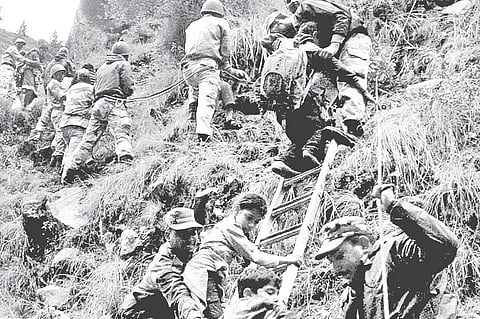

The latest Himalayan tsunami that suddenly struck Uttarakhand and parts of Himachal Pradesh has once again revived debate over whether it was a natural disaster or a man-made tragedy. Whatever be the answer, one thing that comes out clearly from what followed the catastrophe is that neither the Centre nor the state government were in a position to respond to it adequately.
Notwithstanding the fact that an elaborate disaster management structure has been put in place and it is mentored by the National Disaster Management Authority (NDMA) under the Prime Minister, the level of response of Central and state agencies left much to be desired. The fact is that, except for the NDMA, even after eight years of the enactment of the Disaster Management Act, SDMAs are yet to be established all over the country and made operational. In some states, the department for disaster management is the changed name of the department of relief and rehabilitation, home guards and emergency fire services with ad hoc personnel. The ITBP, Indian Army and Air Force, resultantly have to step in and assume total control of a situation wherein the first responders proved inadequate.
In India, the level of preparedness for disaster management at the Centre and in the states is extremely uneven and requires considerable strengthening. The concept of handling disasters with appropriate programmes on disaster management based on the fundamental elements of prevention, mitigation, preparedness, response, relief and recovery is of recent origin.
However, although the responsibility for coordinating disaster response and relief operation is that of the home ministry, it is the armed forces under the defence ministry that are called out to assist and manage the situation. Generally, the armed forces respond to disasters as a part of their mandate to aid civil authorities during calamities. Their involvement, however, was meant to work on the principle of being the ‘last to enter and the first to leave’. Conversely, in most post-disaster operations, the armed forces have been the first to enter and the last to leave.
Since the civil administration remains ill equipped for undertaking quick response to major disasters, the armed forces have been the primary option to handle major disasters. As one of the most dedicated, professional and modern armed forces in the world, the Indian forces respond to any disastrous situation with all their might.
They are also located in most remote areas where natural calamities are frequent. For instance, when the tsunami hit the Indian coast on December 26, 2004, the Indian armed forces, co-coordinated by the Integrated Defence Staff (IDS), efficiently handled relief, rescue and evacuation work. Whether it was the Kashmir earthquake of 2005, the tropical cyclone in Bangladesh in 2007, the flash floods in Ladakh’s capital Leh in 2010 or the Sikkim earthquake of September 2011, the armed forces have been at the forefront of disaster management.
The involvement of the armed forces in disaster response and relief operation is an important issue in civil-military relations. In the Indian context, their role is primarily in response to the immediate requirement of human resources and technical equipment for rescue and relief operations by the civil authorities of the affected area. However, in view of the fact that the disaster management system of the civilian administration is yet to become operational, the civil authorities will continue to depend on the armed forces for disaster response. Hence, a defined role for the armed forces in disaster management is required.
First, the government must set up a centre for excellence in disaster management for the Indian armed forces. Second, since the field formations are unlikely to be equipped with the state-of-the-art equipment to deal with disasters, the field formations in the disaster-prone areas need to be given brick formations (logistics) specifically for disaster response at the earliest. This would ensure that the military equipment meant for war is not used for secondary tasks.
Efforts should be made for using the expertise of the armed forces for bolstering the capacity of the civil authorities, including the disaster response forces. It would enable the latter to achieve self-reliance and thus reduce their dependence on the armed forces.Enhancing capability for risk reduction in urban as well as rural areas and having suitable legislative and regulatory mechanisms to promote safe buildings should be encouraged as part of the civil-military relations programme.
An equally important imperative for disaster management is the need of self-restraint by the political class. In a democracy, as elected representatives that form the government, politicians no doubt must be at the forefront of handling any situation that affects the masses. They, however, should not indulge in partisan blame game and refrain from undertaking ‘observation sorties’ in state helicopters that can be put to better use in rescue and relief missions. emmdiem@hotmail.com
Menon is a former additional secy, Cabinet Secretariat