
NTA reforms: Balancing school education, coaching classes

I can’t help but recall an old teacher’s analogy on the selfless, thankless and tireless job of a school teacher. As kids enter school in their kindergarten, they sit on the floor with the teacher on the chair at a higher level. As they progress, they sit on a small bench which later becomes a chair only to become a bigger chair with the teacher still in the same chair-level despite students progressing through differing seating heights.
As the students sit elevated in today’s amphitheatre type gallery classroom, the teacher is still in the same chair at the bottom-centre elevating students’ career. Such a noble profession of teaching in schools is at challenging crossroads today.
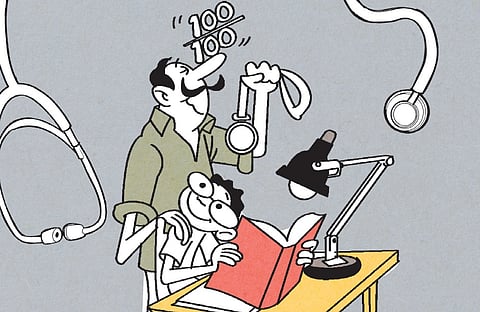
The competitive schooling ecosystem not only takes the mental health trajectory of students to dizzying levels, but also glorifies a coaching class teacher to trivialise the schooling class teacher. There cannot be a time more appropriate than now to strike a balance between the two alternatives to meritocracy—Class XII aggregate or entrance exam scores—neither cuts the mustard.
The global experiment of having entrance exams for college admissions has its own evolutionary story—manmade, systemic and also judicial intervention. In India, it’s a cocktail policy for entrance exams for admissions to medical, engineering, law, management and other degree programmes.
Recent efforts like CUET are primitive to be characterised, but popular ones like JEE-Main, NEET, CAT, CLAT, etc. have resulted in a coaching class industry that puts certain unicorn success stories to shame. The questionable narrative that only coaching classes can produce star performers undermines genuine effort and native intelligence of students.
This unfair characterisations of student abilities during their formative years is a big demotivator. Students are taxiing in their career runaway preparing for entrance exams from Class VI onwards with parents and career counsellors becoming their auto-pilots. In a supply-demand situation that is widely polarised, the mental strength of India’s demographic dividend is subjected to avoidable stress creating fatigue and influencing students’ daily lives.
The phantasmagorical coaching class industry aka ‘shadow school’ or ‘proxy school’ or ‘school away from school’ has stunted school education that is responsible for polishing the contours of student thinking and creativity, a NEP 2020 objective. The high-power committee headed by Dr K Radhakrishnan as part of their NTA reform exercise should revitalise school education, failing which schools shall remain brick-and-mortar vintage edifices, while the stentorian chorus for coaching classes create animated showpieces of artificial success.
One of the largest and oldest college entrance exams, Scholastic Aptitude Test (SAT) has its own evolutionary story right from its start in 1926. Many changes have been made to the SAT in the past 30-40 years, some of them to prevent cheating, some infusing technology and some to put back school education in the right track. Schools develop creative thinking, reading and writing skills, etc. besides subject knowledge making the school-going experience from K to 12 running parallelly strong along with SAT prep centres.
Admissions to top colleges is based on school scores, SAT scores, community service, essays, etc. A similar system is prevalent in all non-medical UG degree admissions worldwide with certain exceptions. For a big schooling system like India and a bigger rush for college admissions, competitive exams system for UG admissions certainly needs to balance the interest of various stakeholders—schools, higher education institutions, parents, teachers, students, etc. Here are certain fundamental questions as the NTA reform exercise begins.
Why should entrance exams be multiple subjects based (Maths, Physics, Chemistry) in a manner that catalyses coaching classes? For UG admissions, isn’t general reading, writing and mental ability skills with minimum school learning outcome adequate? Why should schools be forced to shift gears into the entrance exam mode impoverishing students’ life skills and create irreversible learning outcome loss? Why should limitless offers be given to students who end up repeaters with rich experience in cracking entrance exams, shattering hopes of debutants?
Why should entrance exam scores alone be a predictor of merit when there is a huge socio-economic academic ‘gini’? Why can’t states decide on the ratio of entrance and Class XII scores for admissions to professional colleges? Why is technology not positively disrupting the present conduct of vulnerable entrance exams? Why should teachers struggle for respect inside classrooms trying to meet unreasonable student-parent demands? More questions fill the NTA quiver as the reform process begins, with a hope that the satisfying answers of the committee ignite aspirational careers for the millions.
S Vaidhyasubramaniam
Vice-Chancellor, SASTRA Deemed University
vaidhya@sastra.edu