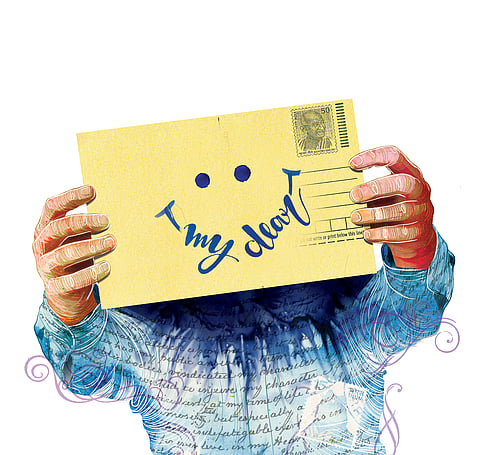

Letters will work like charms or talismans for the invalids of the Convalescent Depot,’ wrote Captain Young, after he cajoled the Directors of the East India Company into setting up a post office in Landour. The year? 1827.
It’s about our history. Or what little there is left of it. On October 1, 1837, as Queen Victoria ascended the British throne, the Post Office Act XVII came into force and Landour’s first post office began operating from the Chowk. From 1850 to 1862, Jim Corbett’s father, Christopher William Corbett, was its postmaster. Afterwards, in 1909, the General Post Office shifted to Rolleston House on the Mall in Kulri, while Landour became a Sub Post Office.
Though none of the buildings, housing these post offices are dilapidated or falling apart, the rentals are low, nothing to write home about. Add to this the fact that life here grew around the post offices in Landour, Library, Charleville, Barlowganj and Jharipani. Initially, the mail totalled less than a hundred articles a week, which by June 1935 peaked at 1,31,562 articles, all wonderfully managed by one postmaster and his two able assistants.
From the old days, a story survives. An ageing colonel gets a new orderly, whom he instructs to drop the mail ‘into the hole in the red box’ at the GPO. This the orderly does with regularity. Six weeks go by and urgent official letters remain unanswered. The colonel grows anxious. He drags the servant by the ear (I believe one could do so in those days!) and that is how the twain arrives at the post office.
Next to the office was the postmaster’s drawing room, neat, clean, and with a fireplace three-quarters draped in the summer months with a plush red curtain. Of course, the letters had been posted, there. They lay—behind the curtains—all 17 of them behind ‘the hole’!
How we take our postman for granted, who without fuss, delivers mail to 90 per cent of the countryside, much like he did a hundred years ago, when mail running was, at best, a risky occupation. Hikaras ventured out armed with a spear or sword and after dark, would occasionally be assisted by torchbearers, or dug-dugiwallahs to scare away wild animals. Sometimes the countryside was infested with man-eating leopards and tigers: ‘Day after day, for a long time, some of the dak people were carried off,’ says an old Gazetteer.
‘Sir! I have started a public library in Pungro, but the empty shelves have to be filled with books!’ urges Abhinav Shivam, a well-intentioned student of mine posted in Nagaland. ‘But no courier company will deliver packages. Only the Indian Postal Services works.’ No wonder then that we have the largest postal network in the world with 1,55,105, post offices.
Ganesh Saili
Author, photographer, illustrator
sailiganesh@gmail.com
