
The prasadam controversy in Tirupati, regardless of political motivation, eroded devotees’ trust in holy sites. Temples have long been political tools, fuelling calls to free Hindu temples from government control. While other religions manage their shrines independently, Indian-origin faiths’ places of worship become political battlegrounds.
Historical reasons explain government involvement in Hindu temples, which once served as royal treasuries. British conquerors claimed these temples, looting wealth and artefacts before appointing committees for management.
Princely states administered temples traditionally, often controlled by upper castes, who denied entry to others. The Vaikom Satyagraha in Kerala led to reforms allowing all Hindus access to state- and priest-controlled temples, addressing regressive casteism. By then, temples had devolved from cultural centres to dens of superstition serving the privileged few.
When India won freedom, we inherited many British rules and acts. Most of the temples were passed on from the royal families or the British government to the secular state of India. One would have expected the pace of reforms that many social reformers triggered in the early 20th century would have continued, and temples would have regained their status as community centres accessible to everyone who believed in that form of worship. Instead, the reverse happened. Temples, especially the richer ones, became a place for politicians to employ their cronies to extract financial benefits.
In most of these temples, the progressive reforms that started in the last century were halted, and privileges returned. Even now, most of the priestly duties are done by people born into the so-called priestly classes. In some temples like Sabarimala or Guruvayur, it is reserved for priests of particular families. Such posts should be based on merit, and not familial or caste privilege and anyone who has learned the specific rituals and mantras and who can do the priestly duties should be able to do so.
As the government is insisting on controlling the temples and treating them as government departments, why is the reservation quota for caste and gender not applied to all jobs, including the priestly one? Can a secular government run temples? And if they run the temple, can they defy their laws of allowing reservations in every post?
The government is not the agent of social change, nor is it allowing the devotees to run their temples as they wish. At the same time, due to the land reforms, most of the lands granted to these temples have been lost to the temple. So, the government is bringing reforms when it benefits them and continuing to encourage casteism and regressive practices when it doesn’t suit them.
In the previous year, the Supreme Court denied the public interest litigation pleading for freeing the Hindu temple from the clutches of politicians by remarking that it is a legislative matter. There has been no legislation regarding relinquishing the unfair and discriminatory government control of temples so far and there isn’t going to be any.
Ideally, the temples should be controlled and administrated by an elected council voted by those who profess faith in that particular deity. How they run it is their internal matter of faith. Suppose someone doesn’t like the way such elected committees are administrating them. In that case, they can either defeat them democratically in the temple committee elections or start a new temple.
That was the age-old method, and that is why every caste and community had their own temples, rituals, customs, beliefs and priests before the British consolidated many temples and handed them over to a few for ease of collecting taxes and controlling the society. Our politicians, irrespective of the colour of their flags or ideology, have proved so far that they are the true inheritors of the British, and all their talks about secularism, democracy and social justice are just a smokescreen.
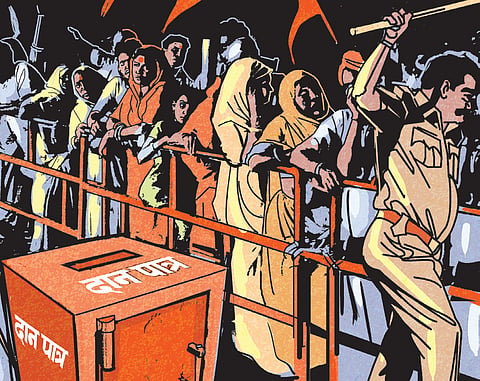
They are only after power and pelf, and personal gains. So, on one side, we have a handful of wealthy, grossly mismanaged temples, where devotees clamouring for darshan are treated as illegal migrants trying to gatecrash the borders and are pushed, shoved and beaten like cattle. They are just milch cows to be milked dry through whatever possible means.
It doesn’t matter how filthy the temple premises are kept or how badly the age-old institutions are maintained as long as the money keeps flowing to their coffers. On the other hand, we have a vast number of dilapidated, neglected temples, many of them of great artistic and historical value, but now crumbling under the weight of indifference.
It is such a shame that no legislation is being moved in the Parliament to correct this. Maybe, this is not an issue that will divide the society and fetch votes. Maybe, this will take away the privileges of many politicians. Unless the people force them to change using the power of vote, the devotees should learn to live with adulterated prasadams and bear the brunt of lathi charges in the sanctum sanctorum for the crime of going to pray.
Anand Neelakantan
Author of Asura, Ajaya series, Vanara and Bahubali trilogy
mail@asura.co.in
