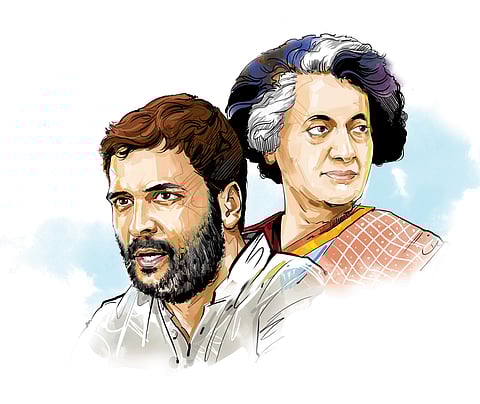

Always Janus-faced, the Congress was steeped in enlightened elitism and authentic people contact. She began the movement away from those twin moorings and he is foundering at the fag end of that process.
To begin with, the Indian National Congress was not a political party -- the uncharitable would say it has attained that status all over again! But over its long life, it has been built (and unmade) around a set of dualisms. The first Congress -- an elite club of merchants rubbing shoulders with the British, bargaining across the fault-lines of trade discrimination -- is almost indistinguishable from the Davos set of recent times. Then there's the other Congress, the one born after Gandhi gave it a demotic turn. That's when the 'unwashed masses' join in, contributing an anna each, and he in turn assumes their unembellished dress code and lifestyle in a gesture of 'identification', literally sending the suited-booted, the likes of Mr Jinnah, scurrying. (Jinnah too would be forced, in his comeback, to shed his clubbiness and throw himself open to the heat and dust of mass politics.) The two Congresses always coexisted, as one entity marked by this inner tension. In its most recent avatar, the curious diptych of the 'reform-minded' Manmohan Singh and the 'NGO-minded' Sonia Gandhi played out the same dichotomy. One was the modern Dadabhai Naoroji, the other represented a nod to the hoi polloi.
But through all those early formative years -- when Gandhi gets Nandalal Bose to bring a folk art ethos to Congress conferences (a spirit that lived on till the 1980s Festivals of India), or when Jinnah/Ambedkar/Subhas Bose pose their ideological challenges -- the Congress remained a platform. This continued with Nehru and Patel at the helm. It was an umbrella-like idea under which anyone wanting to take part in 'nation-building' (and a bit of influence peddling!) could gather. That's why the history of that period can be discerned more from the letters they write to each other -- Bose to Nehru, Nehru to Patel, Patel to Rajaji, and Gandhi to all of them, including Jinnah and Ambedkar. Even with their often incompatible positions, they are a national coalition of political thought, a diverse talent pool in conversation, right up to Shyama Prasad Mukherjee. A certain western-derived, enlightened elitism of knowledge overrides pure class and caste interests, as extremely erudite jurists and legal minds write a Constitution for millions of unlettered Indians. Merit and fluency in the Queen's language is of such high value that caste, creed and religion do not come in the way (despite Partition). Ambedkar's skills are given far greater credence -- he is trusted enough to balance his Dalit identity within a constitutional universalism. The Congress subsumes him in its pantheon, nearly forgetting that he never truly belonged to them.
The Congress sheds that universalist tinge and truly becomes a political party only with Indira Gandhi. The old antagonisms have congealed and hived off into separate politics -- JP-Lohiaite, Swarajya, Jan Sangh. Indira picks up not stalwarts, not political thinkers or manoeuvrers of destinies, but community satraps. Barring from her CPGB-vintage friends, the flow of ideas stops. Sanjay offers a parody of mass politics (as Rajiv does later of the old elitism). Gandhi's politics from below is replaced by the top-down, statist tokenism of Garibi Hatao. The end of the social-political consensus around the Congress is marked by the Emergency.
It's ironical that her grandson, Rahul Gandhi, is now supposedly fighting against an 'economic emergency', while trying to retrieve the Indira legacy from the trash bin of political history. He is handicapped, in more savage irony, by the very divorce from lived Indian experience that she inaugurated for the Congress. His mother, Sonia, once rescued the party from sudden death by emulating Indira -- both in surface form and in the welfarist tenor of politics. (Whether she initiated a genuine expansion of that politics with her NAC turn is for historians to decide.) Now he waits for her to depart from centre-stage to carry on this twice-diluted legacy. For, what Sonia emulated was already a travesty of true Gandhian politics.

Indira, through her bristling nationalism, her bank nationalisation, abolition of privy purse and harnessing of the media, bore more the stamp of Soviet-style grand strokes. If the present times offer a sense of déjà vu, it's no wonder Rahul is struggling to pull off what he's attempting. Which is the street agit-prop of the JP days, with an Indira veneer. Or the student rebels of the 1970s, in Sanjay attire. For the Janata vocabulary sits better on his actual rivals -- not Prime Minister Narendra Modi, but the street-smart ethics of Arvind Kejriwal, the common-touch demagoguery of Mamata Banerjee. Demonetisation may be a game-changer that could go either way. The serpentine queues in front of banks nationalised by Indira may present the Congress with an opportunity, but it's the party's own emasculation on two crucial fronts that prevents it from grabbing it. The two elements that made up its formative dualism -- a genuine knowledge elitism, and an authentic people contact.
Indira Gandhi's 99th birth anniversary: Rare pictures of late the Prime Minister
Why All India Radio could not announce the death of Indira Gandhi till six in the evening
Rahul Gandhi at a queue yet again for money? No, he fancies crowds!
How will new Rs 2,000 notes help purge system of black money, Rahul asks PM