
NEW DELHI: Three weeks into demonetisation, the government and the Opposition remained deeply divided over the impact of the move ostensibly aimed at curbing black money, but which has had collaterally shaken up the economy and the middle, lower, and the lowest income groups of the population.
Both sides took potshots at each other. Prime Minister Narendra Modi sought public opinion through a smartphone app he launched on Tuesday to prove his opponents wrong; the Opposition sought an immediate response from him in Parliament. Much of the shadow boxing happened outside the walls of the House.
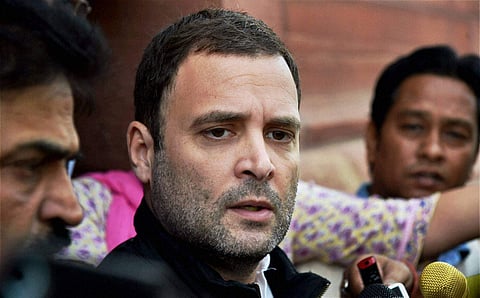
Congress vice-president Rahul Gandhi gave a throwaway line in the forecourt of Parliament, “The prime minister can speak on TV and at pop concerts, why not in Parliament? We will hold a demonstration in front of the Gandhi statue (outside Parliament) tomorrow morning (to make him speak)”.
In this politics of one-upmanship, the AAP was not found wanting. Delhi Deputy Chief Minister Manish Sisodia led a protest march from Jantar Mantar to Parliament. Stopped on the way, he said “demonetisation has reduced people to genuine tears” while “the PM was shedding crocodile tears’’.
As the political class remained ranged over the new currency, Parliament, as expected, resembled a war zone — repeated adjournments, slogan shouting, placards waving at the well of the Upper and Lower Houses was the order of the day — the treasury benches too screamed to be heard over the din.
Despite Parliamentary Affairs Minister Ananth Kumar’s protestations to the contrary, in the Lok Sabha particularly, sources later indicated the prime minister may intervene, like his predecessor Manmohan Singh used to do, but not to reply or can be subjected to “point of order”. The prime minister’s intervention, if at all, “will be on his own terms’’ and “not one set by the Opposition”. Both sides, naturally, seemed busy puncturing the opponent’s agenda.
Eleven Opposition parties immediately went into a huddle where it was decided that there would be protests across the country on Wednesday and a march to the Rashtrapati Bhavan on a later date, depending on when the president gives them time. Bihar Chief Minister and JD(U) leader Nitish Kumar, however, continued to break the Opposition ranks. He steadfastly supported Modi on this move. But the BJP’s old ally Shiv Sena again hit out at the government, also bashing it for “issuing certificates of nationalism’’ at “every drop of the hat’’.
Previous fence-sitters, like Sharad Pawar’s Nationalist Congress Party too joined the strategy gathering of the Opposition. And, both Mamata Banrjee’s Trinamool Congress and the Left parties participated, giving the meeting a “united Opposition’’ flavour.