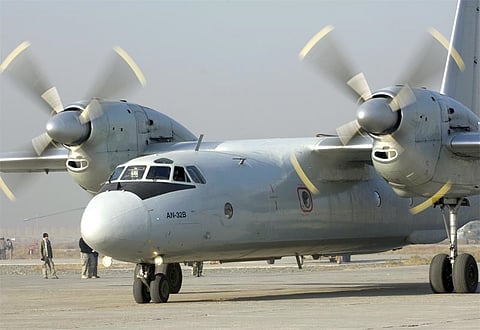

CHENNAI: The pilot of AN-32 aircraft with 29 member crew would have tried to return to Chennai after the aircraft had a sudden descent from 23,000 feet, sources told Express.
Usually, the aircraft is safe and the pilot could even return to Chennai if one engine failed. There is a remote chance that both the engines in the aircraft would have failed and it could have resulted in sudden descent, a former pilot said.
Since the aircraft flew only for 45 minutes, it would not have crossed more than 150 nautical miles. Experts rule out weather could be an issue. The aircraft could not have entered the clouds with hailstorm as it has a weather radar. It could possibly be control-related problem.
The search and rescue operation of the aircraft depends on the signals emitted from the Emergency Locator Transmitters (ELT).
In the event of an aircraft accident, these ELTs are designed to transmit a distress signal on 121.5, 243.0-megahertz frequencies.
The ELTs are designed to be used in times of crashes as well as going down in the sea. The frequencies are picked up by satellites and then transferred to local user terminal (LUT) in Bangalore and Lucknow.
If the ELT frequencies were not activated, then it would result in delay of locating the aircraft. Usually, the frequencies have Hex Code through which the aircraft is identified by local user terminal.
This is then given to the organisation conducting search and rescue operation which knows the exact location of the aircraft.
Usually, the Indian Air Force has three kinds of aircraft - Fighter, Transport and Helicopter. The transport pilots could have an experience of one year to 25 year. Here Flight Lieutenant Badsara had an Instrument Rating of Green which means he is qualified and could fly the aircraft through rough weather, said a former defence personnel.