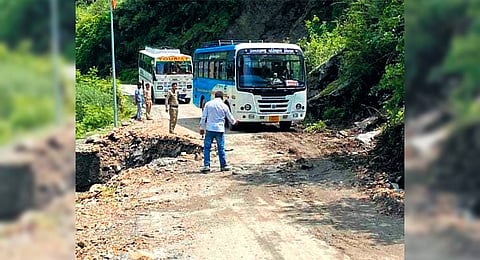

DEHRADUN: In a bid to tackle landslides that pose challenges during the tourism and pilgrimage season in Uttarakhand, the Border Roads Organisation (BRO) has turned to rock-bolt technology, which has proven beneficial in treating landslide zones in the mountainous regions.
This innovative technique is being employed at active landslide zones in Raturisera and Bandarkot along the Gangotri Highway. Previously, the same tech was utilised to address hazards in Nalupani and Chungi Badethi landslide zones.
BRO officials say the implementation of rock-bolt technology enhances the stability of vulnerable rock formations, ensuring safer travel for pilgrims and tourists.
Uttarakhand attracts over 50 lakh pilgrims each year who visit the Char Dham sites, including Badrinath, Kedarnath, Gangotri, and Yamunotri. Experts suggest that rock-bolt technology is up to 90% effective in preventing landslides.
BRO Commander Vivek Srivastava said, “The widening work carried out under the Char Dham road project has addressed several long-active landslide zones using this technology. The results have been promising.”
He highlighted specific areas where improvements have been made, including the Nalupani site near Chinyalisour on the Gangotri Highway and the Chungi Badethi close to the district headquarters. “However, considering the risks at Chungi Badethi, a separate road safety gallery was later constructed,” he added.
According to officials, the BRO is using the rock bolt technique in two landslide zones, Raturisera and Bandarkot, on the Gangotri Highway. The projects, costing Rs 19.8 crore and Rs 9.3 crore, will coincide with highway widening and are expected to be completed by March 2025.
In response to the landslide debris that occurred last year in the Silkyara Tunnel, authorities are employing the rock-bolt tech for effective removal.
After stabilising the debris using this method, excavation tunnels have been constructed with machinery. So far, two out of the planned three tunnels have been successfully completed, officials said.
Speaking on innovative rock stabilization techniques, BRO Commander Shrivastava said, “We effectively stitch fractured rocks through a specialised drilling process. By employing perpendicular drilling at specific fracture points, we then secure these fractures with bolts, significantly enhancing the stability of the rock formations.”
