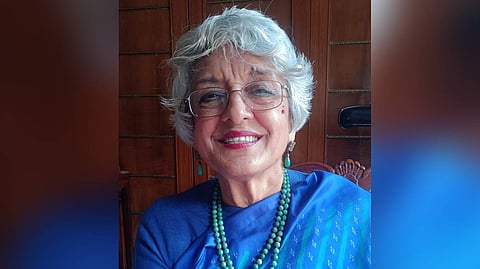

The interim government, led by Muhammad Yunus, has come to power through a carefully orchestrated coup, says Veena Sikri, former India’s high commissioner to Bangladesh. She tells Rajesh Kumar Thakur that Bangladesh currently has no constitutionally-valid government, and adds:
“The caretaker of Bangladesh’s interim government, Muhammad Yunus, has steered the country towards self-destruction. All of Yunus’s decisions are effectively made by his advisor, Mahfuz Alam.”
Excerpts:
You had been India’s high commissioner to Dhaka. How do you perceive the interim government in Bangladesh?
Democracy has been dismantled through a carefully orchestrated coup against the Sheikh Hasina government. The interim government, propelled by anti-Hasina sentiment, is driving the nation into utter chaos and violence, particularly targeting Hindus and other minorities.
Muhammad Yunus operates through his advisor and special assistant, Mahfuz Alam. The interim government is taking Bangladesh on a path that echoes Pakistan’s anti-India rhetoric. Without elections, the country’s future appears bleak. There is no constitutional provision for an interim government in Bangladesh. So, I refuse to call it a legitimate government. Instead I label it a constitutionally-invalid regime.
Was the coup against the Sheikh Hasina government a spontaneous reaction to student unrest, or there was something more to it?
It was a meticulously planned operation. Anti-India and anti-Hasina sentiment had been nurtured for years, portraying her as an agent of Delhi. These sentiments have been leveraged to execute the coup. Yunus, who maintains close ties with Hillary and Bill Clinton, acknowledged at a public event in New York that the coup was well planned and Alam was brain behind it. Yunus called Alam on to the stage and gave him credit for the operation. Alam has close ties with banned outfits.
Are you suggesting that Mahfuz Alam orchestrated the student-led uprising against the Sheikh Hasina’s government?
Indeed, Muhammad Yunus himself publicly stated this in September in New York. This validates the fact the the regime change was premeditated. The anti-India rhetoric continues, branding Sheikh Hasina as pro-Delhi, thus fueling public anger against her party and India.
Why is the interim government perpetuating anti-India sentiment even after Sheikh Hasina’s removal?
The ideology behind the regime change seeks to establish a government inherently opposed to India, effectively reversing the progress made since 1971. When Sheikh Hasina left the country on August 5, the regime immediately targeted minorities and aimed to dismantle pro-India policies. Violent attacks followed, prompting PM Narendra Modi to call for protection of minorities. The regime seeks to establish an Islamist government, undermining the values of 1971, Bengali nationalism, secularism, and social justice. Their goal appears to be a governance model rooted in Sharia law.
Do you see Pakistan’s influence in the recent developments in Bangladesh?
Pakistan has played a significant role in the regime-change operation, strengthening its ties with the Bangladeshi army. Historically, these links were weak earlier during Sheikh Hasina government, but have grown stronger recently in the wake of coup. Pakistan’s objective is to reverse the historical outcomes of 1971 by influencing Bangladesh’s political trajectory.
Do you think Bangladesh is on a path to self-destruction?
Yes, the interim government under Muhammad Yunus is steering Bangladesh towards self-destruction. Yunus effectively operates through Mahfuz Alam. The regime’s policies are pushing minorities, who make up 9% of the population, out of the country. Despite relentless attacks, minority communities, particularly Hindus, are standing firm, choosing to stay and fight for their rights. Over 1,000 attacks by Islamist groups have been reported, but the regime has termed these as non-communal violence. Such denials highlight the regime’s negligence in protecting minorities, which is unprecedented in Bangladesh’s history. The younger generation of minorities remains resolute, demanding legal protections and refusing to leave their homeland. However, the communal divide is eroding Bangladesh’s social fabric.
Do you foresee any possibility of Bangladesh merging with Pakistan?
While Pakistan may harbor such ambitions, the people of Bangladesh are unlikely to support this. They demand elections and prefer to maintain their independence, although current relations between Bangladesh and Pakistan seem to be growing closer.
How do you evaluate India’s approach toward the ongoing crisis in Bangladesh?
India has handled the situation with diplomatic prudence.
Offering shelter to Sheikh Hasina aligns with India’s tradition of neutrality and humanitarianism.
Additionally, India has taken a balanced approach in addressing the violence against minorities, emphasizing measured diplomacy over overt intervention.
