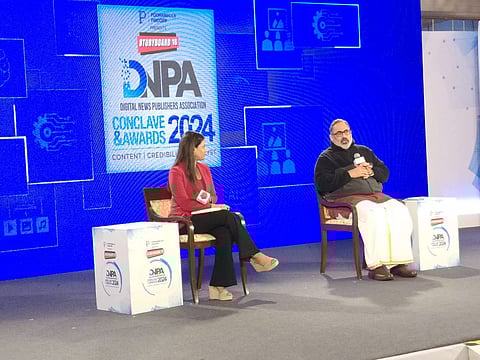

The coming Digital India Act aims to address the asymmetry in revenue sharing between digital news publishers and Big Tech platforms, declared Rajeev Chandrasekhar, Minister of State for Electronics and Information Technology (MeitY). He was speaking at the 2nd DNPA Conclave & Digital Impact Awards hosted by Storyboard 18 and the Digital News Publishers Association (DNPA) in New Delhi on Tuesday.
In his keynote address at the conclave, Chandrasekhar said, “We are concerned there is a deep asymmetry between those who create content and those who help content creators monetise that content.” He said the Digital India Act, once rolled out after the 2024 general elections, would “deal with this very pronounced and very visible asymmetry between the small guy or the medium guy in the Indian digital ecosystem and the big [tech] platforms, the gatekeepers for monetising that content. The asymmetry needs to be legislated, or at the very least, regulated through rules of a new legislation”.
Big Tech giants, such as Alphabet-owned Google, take a far larger share of the revenue than news publishers for using their published content. It’s an issue that India has been seeking to address, alongside Australia, Europe, the US and Canada.
MoS Chandrasekhar pointed out the need for having a legislation in place that would democratise India’s vast internet space. “We want the internet to be open. We don’t want the internet or the monetisation from it to be controlled by just two or three companies,” he said. He lamented that social media platforms have an ecosystem of influencers and content creators, and “they’re playing pick-and-choose and playing God”.
The minister clarified that the Indian government doesn’t want to act as an arbiter, but only to ensure that appropriate rules are in place.
Amitabh Kant, G20 Sherpa and former NITI Aayog CEO, hailed India’s policy to keep its digital landscape competitive. “The Western world has grown in recent years on the back of Big Tech. It’s the same case with China, and it’s a case of monopoly. But India is the only country that’s taken a different route,” he said.
The conclave saw policymakers, stakeholders, and industry insiders from India and abroad getting into a huddle, discussing and debating the challenging road ahead for the digital media ecosystem, especially in the context of AI-led transformation.
They discussed solutions to democratise the publisher-platform relationship, such as breaking up Big Tech monopolies into more competitive units, and exchanged ideas on the future of digital media amid AI disruptions.
The 2024 DNPA Conclave & Awards featured speeches, conversations, fireside chats, panel discussions, Q&A sessions, and a gala awards night where Indian digital innovators were recognised in various categories for impacting the lives of netizens and stakeholders.
The night also saw the launch of a report by Ernst & Young (EY), titled ‘State of Digital Media in India’. It gives industry insiders a deep look at which way the digital news media industry is headed. An intriguing takeaway from the EY report for stakeholders is the revelation that a vast majority of news consumers rate ‘credibility’ as the primary reason behind selecting their favourite digital news media outlet.
The Digital News Publishers Association of India (DNPA) is an apex industry body of the digital arms of India's top news publishers from print and electronic media.
