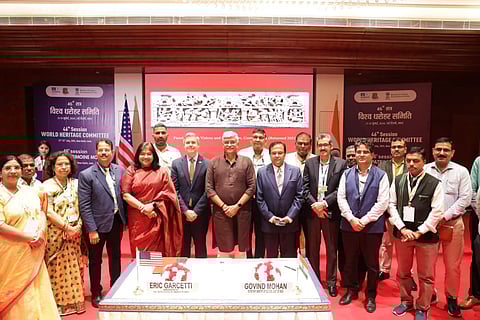

NEW DELHI: India and the United States of America (USA) on Friday signed the first ever ‘Cultural Property Agreement’ to prevent and curb the illicit trade of antiquities and simplify the process by which stolen and smuggled culture objects are returned to their country of origin. The accord marks the culmination of nearly two-year-long bilateral discussions, negotiations held on the sidelines of the G20 Culture Working Group meetings and efforts made by experts from both countries.
The Secretary of Culture Ministry Govind Mohan and US Ambassador to India Eric Garcetti signed the document in the presence of Union Minister of Culture and Tourism Gajendra Singh Shekhawat on the sidelines of the 46th World Heritage Committee being held in Delhi.
The agreement restricts the importation into the US of selected archaeological material dating to certain time periods and also ethnological articles, which may include categories of religious, royal architectural material, or manuscripts from 2nd century BCE to 1947. The arrangement will also be helpful in the quick seizure of Indian antiquities at US Customs and their repatriation, otherwise multiple agencies are involved, said the ministry officials.
Speaking on the occasion, Garcetti said that the US has been unwavering in its commitment to protect and preserve cultural heritage worldwide and to restrict trafficking in cultural property.
“This cultural property agreement is about two things. First and foremost, it’s about justice – returning to India and to Indians, what is rightfully theirs. Secondly, it’s about connecting India with the world. Every American and every global citizen deserves to know, see, and experience the culture that we celebrate here today. To know Indian culture is to know human culture,” he said.

The Illicit trafficking of cultural property is a longstanding issue that has affected many cultures and countries throughout history and a large number of antiquities have been smuggled out of the country over the years, and which are now housed in various museums, institutions and private collections across the world.
However, in the last 10 years, the Centre had expedited the process to repatriate antiquities, which were illegally taken out of the country, from the different countries including the US, France, Germany, Singapore, Australia and Canada.
Since 2014, 345 heritage objects have been brought back and the highest pieces—about 190--were from the US. Only 13 objects could be fetched between 1947 and 2014. Most of these articles were smuggled by the notorious art dealer Subhash Kapoor, who is serving a jail term in Tamil Nadu.
Shekhawat mentioned that the subject of repatriation is not merely a moral imperative but also a practical investment in cultural diplomacy and sustainable development.
“By returning artefacts to their countries of origin, we nurture cultural stewardship, promote tourism, and stimulate economic growth within local communities. This process empowers nations to leverage their cultural assets for educational enrichment, social cohesion, and economic empowerment, thereby fostering inclusive and sustainable development pathways,” he said.
According to the culture ministry, 262 antiquities, which were handed over to India during the visit of the Prime Minister Narendra Modi in June 2023, will soon be brought back. The US authority, last year, offered 1,440 artefacts, which are in possession of its museums or authorities, for repatriation.