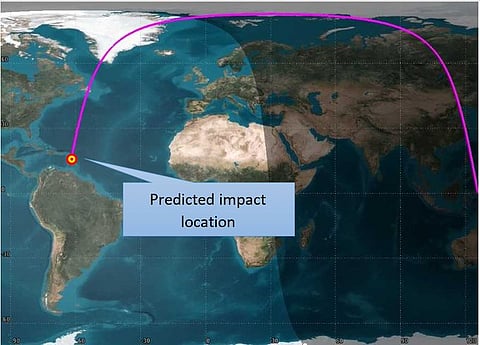

BENGALURU: The Indian Space Research Organisation (ISRO) on Tuesday reported the successful re-entry of the Polar Satellite Launch Vehicle-C37 ( PSLV-C37’s) upper stage into the earth’s atmosphere on October 6, in compliance with the global space debris-free efforts and to achieve the objective of having debris-free space missions by 2030.
The PSLV-C37 was launched on February 15, 2017. ISRO research team in a release said the re-entry eight years after its launch is fully compliant with international debris mitigation guidelines, particularly the Inter-Agency Space Debris Coordination Committee guidelines, which recommended the post-emission orbital life of a defunct object in the low-earth orbit to be 25 years.
Special initiatives are being taken to ensure that the residual orbital lifetime of the PSLV upper stages is reduced to five years or even less by de-orbiting them to lower orbital altitudes using re-start engines in the PSLV-C38, PSLV-C40, PSLV-C43, PSLV- C56 and PSLV-C58 missions in the future.
ISRO said that as a part of its commitment to preserve long-term sustainability in outer space, the country’s premier space agency is committed to taking proactive measures to meet the objectives of a debris-free space mission by 2030.
The PSLV-C37 was launched in 2017 with Cartosat-2D as the main payload and 103 other satellites as co-passengers. The team then created history by launching 104 satellites in a single launch, which included eight Lemur-2 satellites, 88 Flock 3p satellites, INS-1A and 1B, Al-Farabi, BGUSAT, Nayif-1, PEASS and DIDO-2.
After ejection of the payloads, the upper stage (PS4) was left in an orbit of around 470x494 km. The ISRO scientists were regularly tracking it and had found that its orbital altitude had started to slowly decay (the loss of orbit), due to atmospheric and gravitational drag effects.
The researchers from September 2024, started to monitor the orbital decay using the ISRO System for Safe and Sustainable Space Operations Management (IS4OM) as a part of their activities and predicted that it would re-enter the earth’s orbit in the first week of October 2024 and that the orbital decay was to the extent of 134x148 km.
According to US Space Command predictions, published in Space Track, the re-entry was estimated to take place on October 6 at 3.49 pm, while the IS4OM prediction showed the re-entry to occur at 3.48 pm and 25 seconds on October 6, while the predicted impact point was in the North Atlantic Ocean.