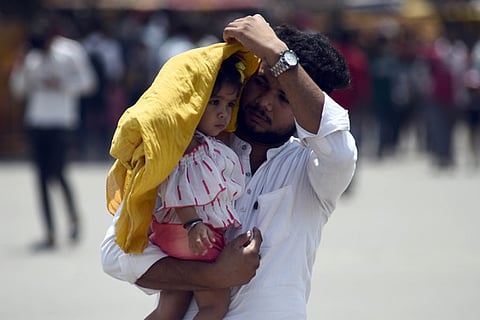

A new study reveals that extreme weather events frequency such as heatwaves and precipitation have increased by three to four times in Southern India due to shifts in tropical weather patterns in the past four decades.
The study found an increased frequency of heatwaves and precipitation up to three or four times more frequent at the tip of South India including the Kerala region, which is vulnerable to landslides. Further, it analysed that weather patterns which were quite rare before the 1990s become more common while prominent weather patterns like dry days have nearly disappeared.
The study would help policymakers in advance planning for heatwaves and extreme rainfall to mitigate the effects. The study named ‘Indo-Pacific regional extremes aggravated by changes in tropical weather patterns’ published in Nature Geoscience provides groundbreaking insights into long-term changes in tropical weather in the Indo-Pacific region. It underlines shifts in tropical weather patterns that are leading to an increased frequency of extreme weather events such as heat waves and heavy rainfall.
The study used a new approach as previous methods failed to observe long-term weather trends on a daily time scale. The new approach can identify an occurrence of trends for each daily weather pattern and its direct association with extreme events.
This study is one of the first to investigate long-term changes in tropical weather patterns and their relationship with extreme events on a daily time scale.
The emerging patterns cannot be explained by interannual modes of natural variability, such as the El Niño Southern Oscillation (ENSO), the Indian Ocean Dipole (IOD), the Pacific Decadal Oscillation (PDO), and the Atlantic Multidecadal Oscillation (AMO), but they are instead likely driven by long-term trends from the 1940s to the present.
The study found that certain Indo-Pacific regions such as South India, Indonesia, Singapore, Philippines and western Pacific exhibit markedly increased frequency of heatwaves and severe rainfall by three to four times than normal.
“Extreme rainfall may also lead to crop failure, contamination of drinkable water, and landslides and more frequent heat waves may lead to high peaks in electricity demand with possible power outages, many heat-related illnesses,” said the main author of the paper Mengaldo Gianmarco of College of Design and Engineering, National University of Singapore.
“Further efforts are required to better prepare policymakers and local communities for a changing climate,” he further said.
